
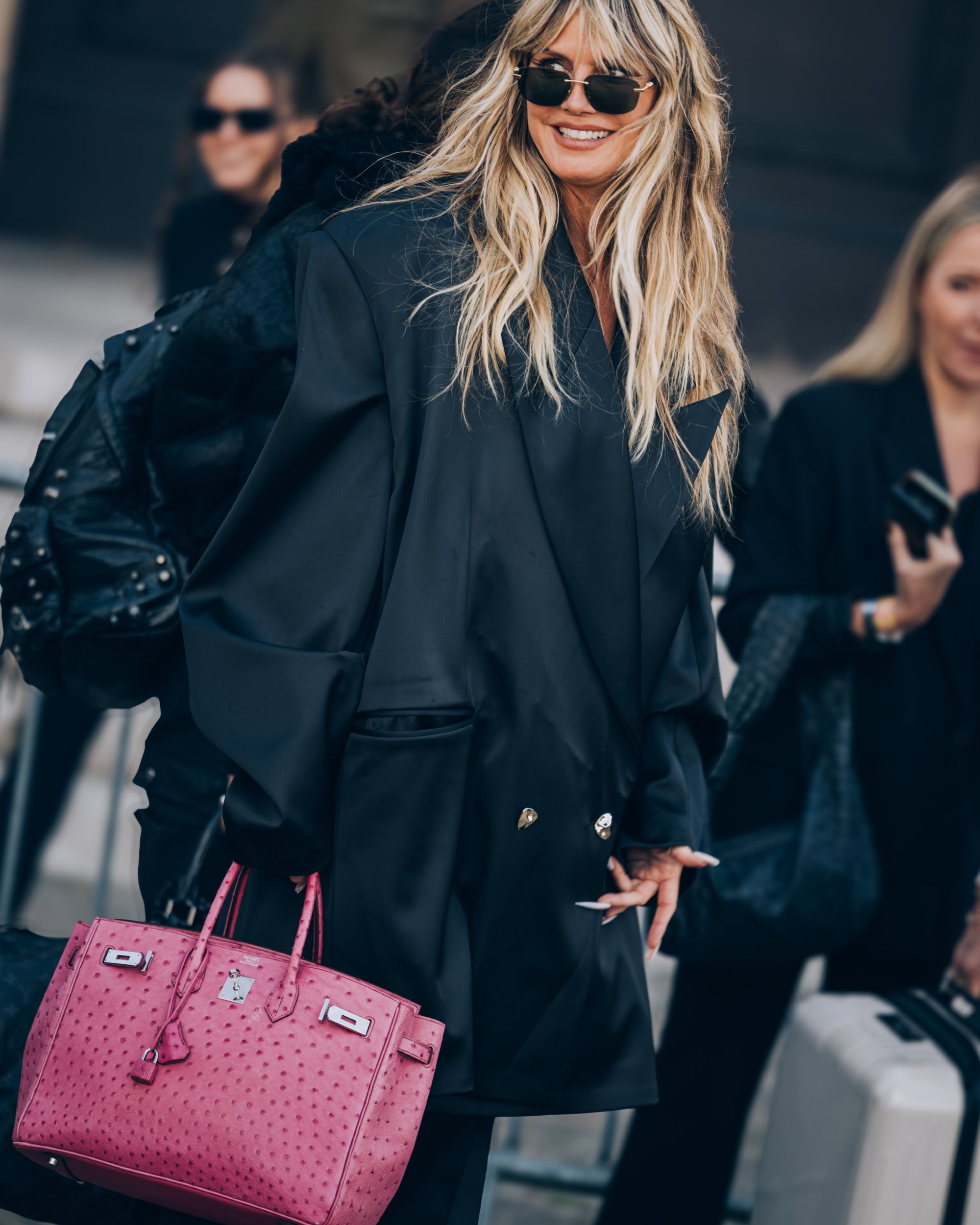
Have influencers made the Birkin embarrassing? After several golden years, Hermès is facing a major reputational crisis
A bag says a lot about the person carrying it. What are their tastes? How do they think they're impressing others? Which brands do they perceive as the most exclusive? And ultimately: what kind of fantasy are they living in? Until a few years ago — and really even today — the bag that inspired the most fantasies was the Hermès Birkin which, alongside the Rolex and the Ferrari, represented the ne plus ultra of exclusivity and luxury. But between the spending boom among the old and new ultra-rich (especially the new), the rise of the caste of obscenely well-paid influencers and content creators, and the proliferation of resellers and bag-rental services, even the mythological Hermès Birkin has become (painful as it is to say) a cliché.
It is, in fact, a bag so expensive, so difficult to purchase, and genuinely rare that, when you spot one out and about or on the street, the questions that spring to mind are: "Is it real?" followed by "Did she buy it with her own money?" which inevitably becomes "What did she have to do to get it?" and finally the more general "Did she really decide to wear a bag like that in a place like this?" All questions that weigh rather heavily on the perception of a product so truly legendary that it isn't worn — it "wears" the person carrying it.
Add to this the problem that, faced with the proliferation of new iconic bags of recent years (The Row's Margaux, Balenciaga's Rodeo, Chanel's Maxi Flap, and then those from Fendi, Prada and Bottega Veneta), the task of signalling an unreachable taste and social status no longer belongs exclusively to the venerable Birkin. In fact, the venerable Birkin itself seems to have become a victim of its own myth: the ultimate aspiration of those who harbour banal dreams. And this seems to have been noticed even by those who, until recently, were the guardians of that myth: wealthy women who had bought them in less suspicious times. But how did the Birkin become mainstream?
Blame it all on social media
@elizabethdotnet The Birkin became the ultimate status symbol. Which is exactly what’s started to work against it.
original sound - Liz
Originally, the Birkin's power lay, on one hand, in its scarcity and, on the other, in its impermeability to the uninitiated. In any case, the ordinary world — the one that doesn't holiday on a mega-yacht in Saint-Tropez — became aware of the Birkin in 2001, when it appeared in the fourth season of Sex and the City. Flash forward more than twenty years: between the ecosystem of online magazines recycling the same stories endlessly and that of celebrities wearing it for the paparazzi, there is no escaping the Birkin. Even The Cut has devoted an article to the matter, citing a Reddit thread titled They did it, they killed the Birkin.
The thread's starting point is a story by Greta Louise Tomé in which she and two other influencer friends all have a Birkin. The user who posted it says, with a certain wisdom, that "it's not a fucking Longchamp Le Pliage […]. Everyone is not supposed to have one. Seeing this is just… ick. It reminds me of how in college everyone had a Neverfull and Burberry quilted jacket". Indeed, on TikTok and Instagram feeds, the bag appears with a frequency that would once have been unthinkable. Every third- and fourth-tier it-girl wears it with her Alo leggings, makes unboxing videos after trips to Japan, or flexes a collection of five, six, ten pieces.
And even though Hermès hasn't changed the rules on how it can be purchased, it isn't the bag's scarcity that has changed but its accessibility. Today in Milan, as in Paris, New York, or any sufficiently large European capital, you can buy a Birkin for under €20,000 at a vintage boutique with no waiting lists or anything else. You can buy one on Vestiaire Collective, eBay or Vinted. You can rent one, for those with money to burn. Or you can buy a fake: the options are overwhelming, from ordering a facsimile from China to buying one in some shady back-room shop, from simply buying an unpretentious dupe to finding the same silhouette at another brand's store. It's a jungle out there.
The numbers behind the narrative
While the cultural conversation focuses on the symbolic "death" of the Birkin, financial data tells a more nuanced — and in some ways more interesting — story. Hermès remains the benchmark (and benchmark of excellence) for luxury, but investors are learning to live with less exceptional growth than usual. Over the past year, the brand's stock market shares have lost around 32% from their 52-week high near €2,300, falling to around €1,570. Despite the decline, the group continues to outperform LVMH and Kering. In mid-August, RBC downgraded the stock not because the brand has collapsed but because it is growing less than expected and is losing ground relative to other stocks in terms of revenue.
Clearly, Hermès — like the entire luxury sector — is weighed down by the delay of the much-vaunted recovery of luxury in China. Before the pandemic, many expected the country to absorb a third of global luxury spending, but as WWD explains, it has now settled at a more modest 15%. Compared to 2019, the industry has lost roughly 9–10% of its Chinese market size, even though the country's consumption is returning to growth in value if not in volume. And Hermès, whose business has more than tripled compared to pre-Covid levels, needs greater volumes to maintain the same growth rates.
First-quarter results revealed the limits of this new phase. Sales rose 5.6% at constant exchange rates, below analyst expectations (around 7.4%). The region that includes the Middle East recorded a 5.9% decline, while France fell 2.8% due to a drop in tourism. The Asian region (and therefore largely China), excluding Japan, grew by just 2.2%, less than half of what had been forecast. And so the brand continues to grow, but against far more demanding comparison bases than in the past. The brand is like a record-breaking athlete who can no longer beat their own personal best, yet must do so to keep the title.