
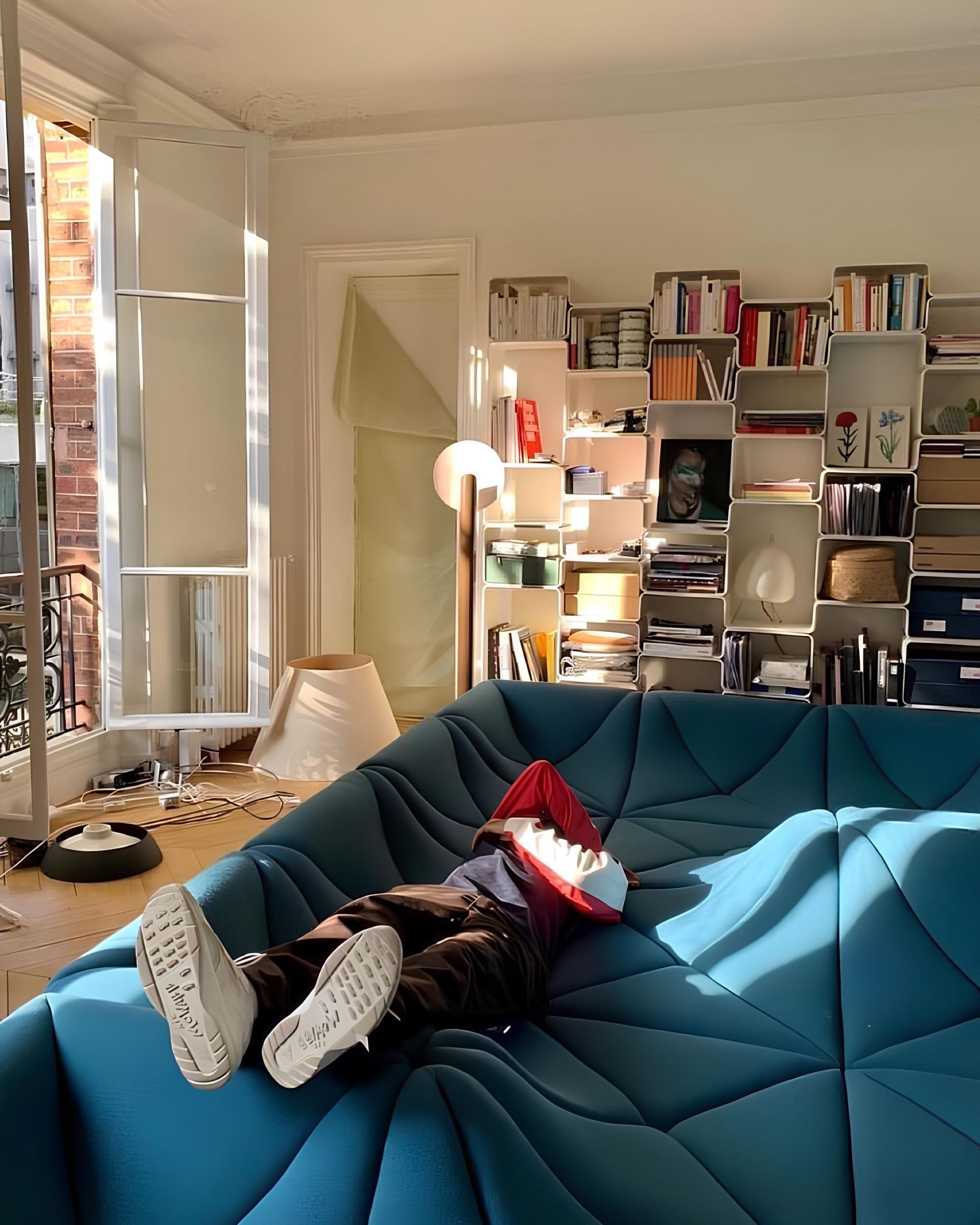
Interior design has become performative too On why the homes of people with good taste all look the same
"I don't care about the materials, as long as the house looks good in photos." That's what an influencer told an interior designer while they were planning her apartment. A perfect sentence to describe what is happening to our homes: no longer just a space to live in, but a tool to show others our taste.
Fashion grasped this shift very quickly. In 2025, JW Anderson reimagined its brand as a true lifestyle project, pairing clothing with homeware, furniture, art, collectible objects and even food products. That same year, The Row presented its first home collection at Milan Design Week, while Bottega Veneta had already collaborated with Cassina and the Fondation Le Corbusier to reinterpret the LC14 Tabouret Cabanon. These moves are the result of a boundary between fashion, furniture and lifestyle that keeps getting thinner.
If until a few years ago the home remained a private space, today it constantly enters the frame. Mirror selfies, TikTok, Instagram Stories, home tours, Pinterest, videos shot from the sofa and everyday content have made the backdrop of our lives public. The home has become a kind of permanent outfit, just far more expensive and complicated to change.
In 2026, good taste is learned online
Social media, above all, play a direct role in shaping it. A study published in The Design Journal, conducted on one hundred people outside the design world, found that exposure to social media content increases interest in interior design, largely thanks to the quantity and variety of images available. Even more interesting is a study published in New Media & Society that defines activities such as liking, following, sharing, bookmarking and commenting as genuine "taste-making" practices. In essence, taste can be learned online too, based on what others select and share.
Pinterest is probably the clearest example of this mechanism. The platform places home décor, fashion, beauty, travel and food within the same endless stream of references and desires; in its report on 2025 trends, Pinterest stated that 65% of the trends identified for that year were driven by Gen Z. On the platform, users have access to a vast, practically inexhaustible visual archive, and it is precisely this abundance that is producing one of the most interesting aspects of contemporary interiors: the codes of good taste are becoming increasingly recognisable.
Interior design is borrowing fashion's logic
Even the idea of an authentic, lived-in home easily gets absorbed into this system. In 2024, the so-called "bookshelf wealth" trend became one of the most talked-about interior trends on TikTok: bookshelves crammed with books never actually read, photographs, paintings, memories and objects accumulated over the years, in opposition to perfectly coordinated shelves and coffee-table books bought purely for decoration. The concept was born from the idea that a home should look personal, imperfect and built up over time. Then the internet arrived and, in no time at all, even authenticity acquired a recognisable, performative aesthetic — to use a neologism.
This is where interiors and fashion start speaking exactly the same language again: an object is rediscovered by a community or subculture, becomes a signal for those who know how to recognise it, spreads across the feed and shortly afterwards enters the collective imagination. At that point, alternatives arrive — dupes, reinterpretations — until that code no longer sets apart those who use it and is replaced by another. Interiors have begun to absorb fashion's logic, while continuing to work with objects that are supposed to last far longer than a pair of sneakers.
When everyone has good taste, no one has good taste
This is precisely where the growing interest of fashion brands in the home becomes even more significant. When Jonathan Anderson describes JW Anderson as a world that can encompass furniture, objects, art and fashion, the product almost fades into the background behind the aesthetic universe that contains it. What is being sold is no longer just a jacket, but the possibility of living inside a particular sensibility. The same customer can recognise themselves in a silhouette, a bag, a blanket, a mug and the chair placed beside their bed. Fashion and design thus cease to be separate categories and become parts of the same identity project.
The real paradox comes at the end. We have more tools than any previous generation to build a completely personal home: international vintage marketplaces, digitised archives, artisans reachable online and decades of design history available directly from a smartphone. We can mix eras, origins and price points with enormous freedom. And yet, we settle for copying others and buying ready-made aesthetics to secure ourselves the label of good taste.
The home has become one of the most powerful places through which we tell the story of who we are, but the more we try to make it refined, the more we risk reproducing the same references everyone else is using. In our attempt to show who we are, we have all learned to speak the same language.
What to read next

5 trends that Trainspotting anticipated Back in 1996
There is much more to the film than the famous Helmut Lang tank top
The rise and rise of burner accounts
Anonymity is the new luxury, but you can't quit social media
The Row is now selling vintage Yohji Yamamoto and High Fashion Twitter is outraged
A long-running debate has flared up again on X