
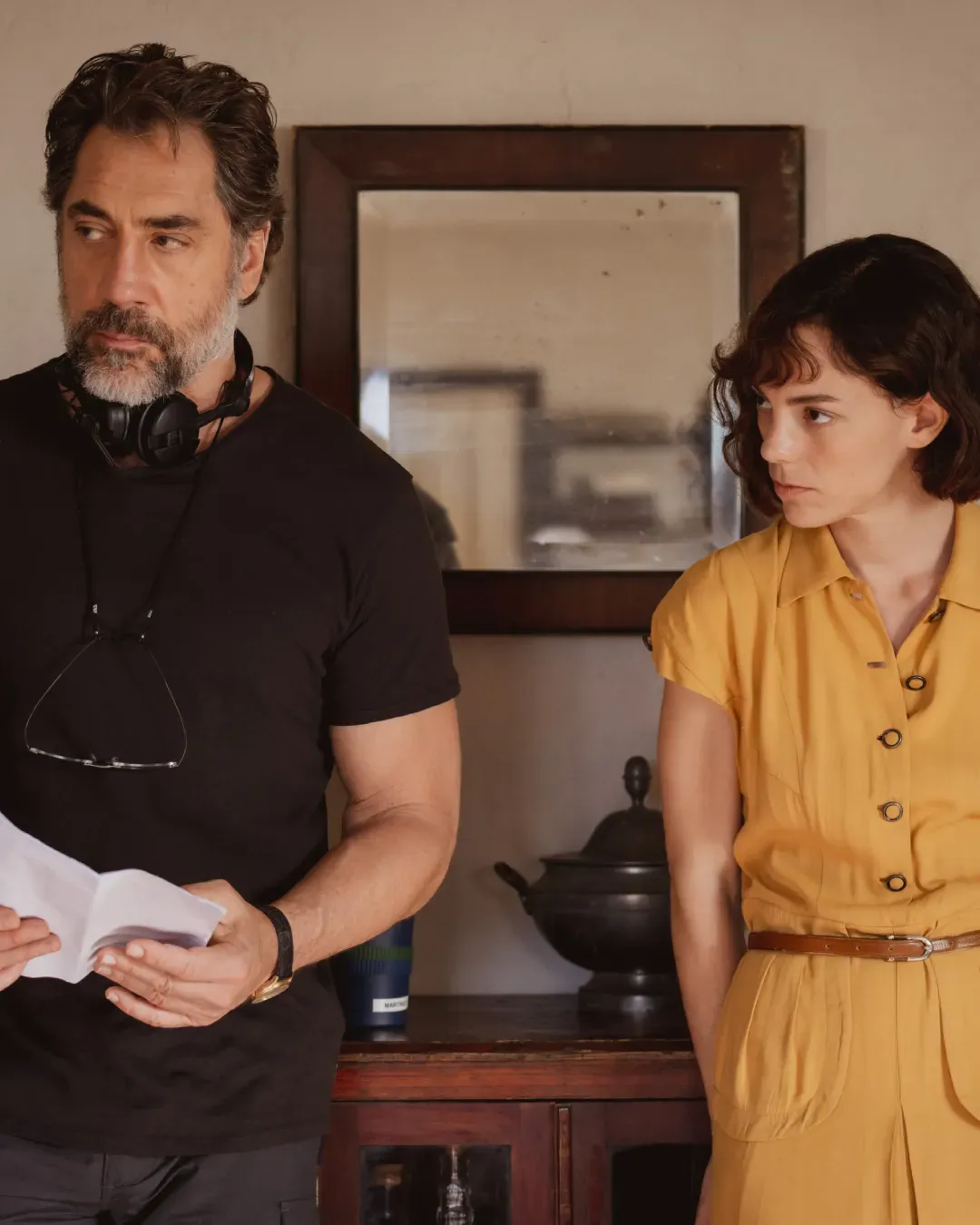
There is a scene in El ser querido that explains how the world is changing The film is directed by Rodrigo Sorogoyen and stars Javier Bardem and Victoria Luengo
There is a scene in El ser querido by Rodrigo Sorogoyen, releasing in Italy under the title L'essere amato, that captures what today's world looks like. The microcosm of a film set becomes a window through which to observe the contemporary moment we are living, offering an analytical and considered portrait of how society is divided today. A fundamental rift that, in this sequence as throughout the film, is embodied by the characters played by Javier Bardem and Victoria Luengo — a father and daughter with a fractured relationship whose contact intensifies when the man, a celebrated director and Oscar winner, decides to cast the young woman as the face of his new film.
The conflict at the heart of El ser querido draws on the personal lives of the auteur, his actress daughter, and their respective roles not only in the workplace but in the society we inhabit every day. On one side stands the arrogance of a director who believes he can behave however he pleases, as the one holding the reins of the project they are working on — because, after all, that's how it has always been done. For the daughter-actress, this attitude is almost synonymous with tyranny, the kind the man seems intent on exercising: on his own set, he never lowers his voice and refuses to entertain any contradiction. Her character pushes back, bringing to the surface the very disagreements that divide them in life too — disagreements that are amplified by the stress and demands of their shared profession.
Bardem is placed at the centre of the sequence — a lunch scene in which the director demands a certain realism that the cast's way of eating fails to deliver. They don't follow his instructions; he grows more irritated with each take, until he ends up shouting and insulting his actors. But unlike how things might once have gone, what Luengo's character embarks on is a genuine act of defiance against authority — a stepping outside, into a collective that is changing and has changed, one in which staying silent will do nothing to uproot the weeds that for too long have grown undisturbed in both private and public life.
This is why the scene operates on a dual level within the film: there is a reflection on the present day — never didactic, but rendered eloquently through dialogue, glances, and the framing Sorogoyen brings to it — and alongside it, the portrait of a fractured family whose gradual rapprochement is possible, even tentative, yet ultimately unable to heal the rifts that will always remain. Those rifts will continue to shape the lives of a father who was absent and a daughter who felt abandoned; art may draw them closer, but it cannot fully close the deep differences and separate histories that have made director Esteban and actress Emilia two distinct and not entirely compatible people.
It is an attitude for which Javier Bardem's character must answer, tolerated not only by his daughter but by the film's crew, who — despite acknowledging the auteur's recognised genius — take sides, making clear their opposition to an old and overbearing way of operating. Here is a man who seems to feel the world owes him everything, at a moment when the skin of society has changed and it has become understood that it is perfectly acceptable to dismantle the figures of authority that have entrenched themselves over the years, whether they are artists or fathers — sometimes both. It is a reckoning with masculinity, one in which the world's transformation is thrust directly into its face, and Rodrigo Sorogoyen needs only a single sequence to show it.
What to read next

What is VisionQuest, the new Marvel series on Disney+?
Paul Bettany once again plays Vision, although this is not the same character from the films of the cinematic universe
5 trends that Trainspotting anticipated Back in 1996
There is much more to the film than the famous Helmut Lang tank top
Andrew Scott gives the best performance of his career in "Elsinore"
Simon Stone's film tells the true story of actor Ian Charleson and his production of "Hamlet"