
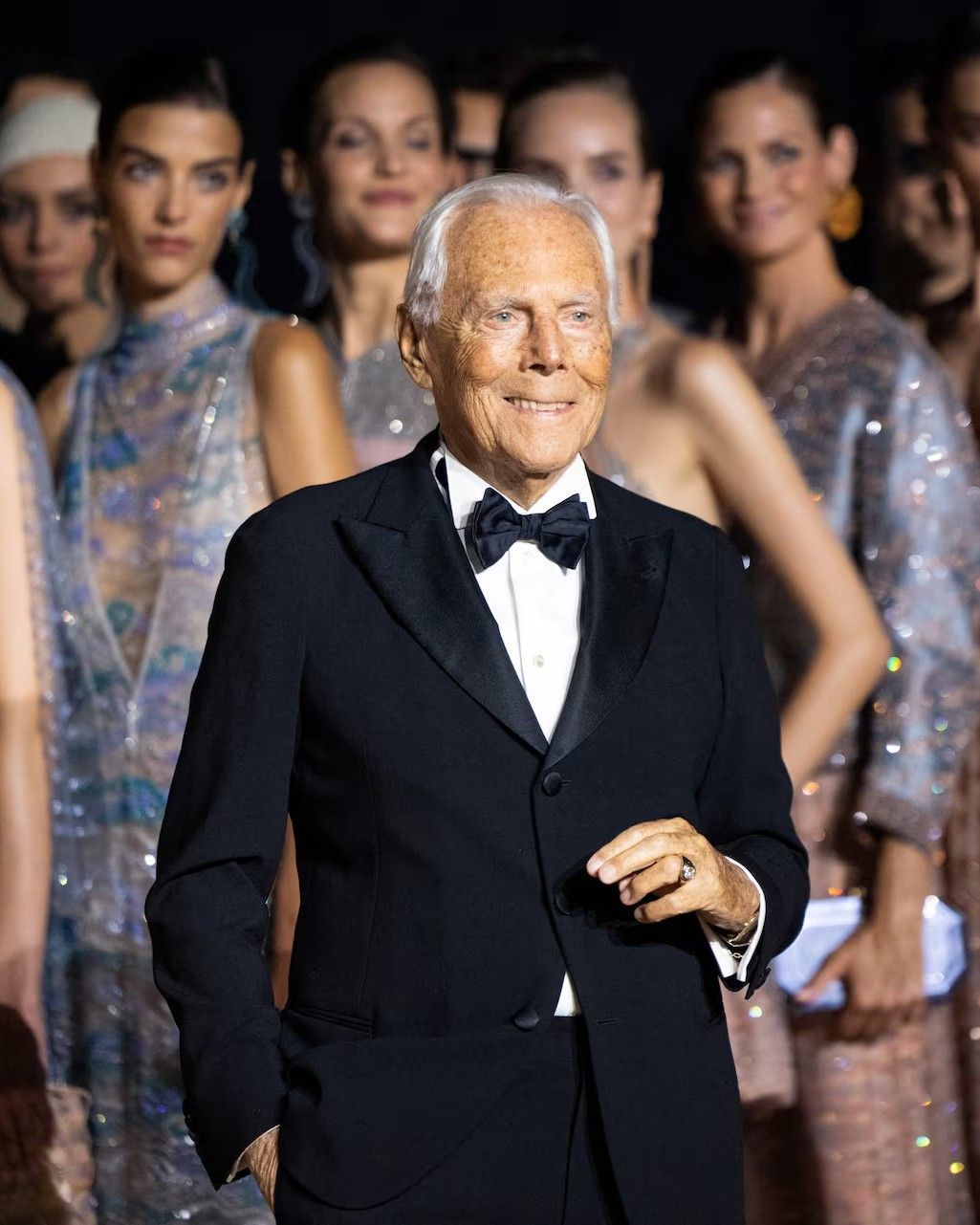
So How Many Billions Is the Armani Group Actually Worth? In short: it's complicated
Tomorrow, the board of directors of Gruppo Armani will meet to approve the 2026 half-year results. A routine meeting taking place approximately one year after the death of the founder, who passed away on 4 September last year. In his will, among various instructions, Armani had included the directive to sell a 15% stake in the Giorgio Armani Foundation to an external investor within a year and a half of his death. There were some more likely investors identified by Armani himself (namely L'Oréal, EssilorLuxottica, and LVMH), but there is also a fairly fundamental question: selling 15% also means understanding what Gruppo Armani is truly worth.
There's a seller — but who's buying?
The valuation question is complex precisely because it is dynamic. Whoever acquires the 15% stake in Armani could, over the following three to five years, be required to take on a stake of at least 30.1% and no more than 54.9%. This would represent a majority stake, given that the Foundation's share cannot fall below a certain threshold. It is a major gamble, because not only will whoever acquires the initial stake already have to spend a considerable sum (we'll get to how much shortly), but they will have to keep betting. But what happens if the business performs less well than expected?
Last week, MF Fashion asked a pool of analysts to provide an estimate of the group's value. According to Luca Solca of Bernstein, the right price is around 7.5 billion or, as he himself more cautiously put it, the midpoint of a range between 5 and 10 billion. Another anonymous source at MF Fashion suggested a lower valuation, between 6 and 7 billion. In general, both estimates are considerably lower than the figure initially hypothesised, which ranged between 6 and 12 billion.
At the lower end, then — if the entire group were worth 5 billion — the 15% stake would cost 750 million. If we go with Solca's figure of 7.5 billion, the stake would be worth 1.125 billion, while at 10 billion it would rise to 1.5 billion. But it's not all that straightforward: in the course of an actual valuation, considerations beyond the brand's financial results could come into play, taking into account its intangible equity, its various licences and partnerships, as well as the growth and business development potential. According to MF Fashion, the group also benefits from a very solid asset base of around 2 billion; debt that is being absorbed at a healthy pace; and liquidity of 528.8 million. But is business going well?
A period of calm
Last August, the Corriere della Sera devoted a lengthy article to an analysis of Gruppo Armani's financial health. Since it is not publicly listed, the group does not publish quarterly results, but it does file its annual accounts and its figures are publicly available. In short, as noted, the group remains solid for now, but the winds that once propelled it appear to have died down in a considerably weaker market. The group sold less: revenues for 2025 fell 4.5% compared to 2024, and even stripping out the negative impact of currencies (the dollar, yen, etc.), the decline remains around 2.8%.
Nonetheless, by managing to cut costs, gross revenues rose 3.2%, reaching 152.7 million, which translated into an operating profit of 52.6 million. In the end, however, the group's net profit (what remains after all expenses, interest, and taxes) fell to 35 million, down from 95 million the previous year. A significant portion of this decline is attributable to fluctuations in foreign currencies. If sales from partners such as L'Oréal and EssilorLuxottica are also included, total revenues exceed 4 billion. Counting products sold at final retail prices, the figure rises to over 6 billion. To these numbers must be added hotels and restaurants.
According to the Corriere, the group's net sales recorded a decline of 7.5% at current exchange rates and 3.9% at constant exchange rates. The decline is entirely attributable to wholesale, while direct sales grew 3.5% at constant exchange rates. In addition, course corrections implemented by the new board of directors generated a further saving of 25 million in operating costs. In general, this trend is expected to be confirmed at tomorrow's meeting.
Gruppo Armani, also thanks to its galaxy of licences and partnerships, is therefore holding its own on a fairly solid platform. But just because the ice holds doesn't mean the rest of the sea is cooperating with navigation — quite the contrary. The entire luxury sector, for both broader and more specific reasons, is going through a period of calm, with consumer spending winds barely blowing. And Gruppo Armani is feeling it, given that revenues have been contracting for a year now with no sign of recovery. The heirs have already indicated to the Corriere that there will be no discussion of a sale of that famous 15% stake before the end of the year.
All the data indicates that margins are holding because costs are being cut. It is a measure of financial discipline that, according to some industry observers, should be extended to encompass a general pruning of low-cost sub-labels that dilute the brand's equity, as well as a push to transform Emporio Armani into a genuine growth engine in the way Prada has done with Miu Miu. But if, as is being said, Dario Vitale were to become the brand's new designer, we could soon see Gruppo Armani outpacing many of its rivals at speed. All we can do is wait and watch.
What to read next

Dario Vitale is the new creative director of Emporio Armani
The first outsider to the family to hold the role