
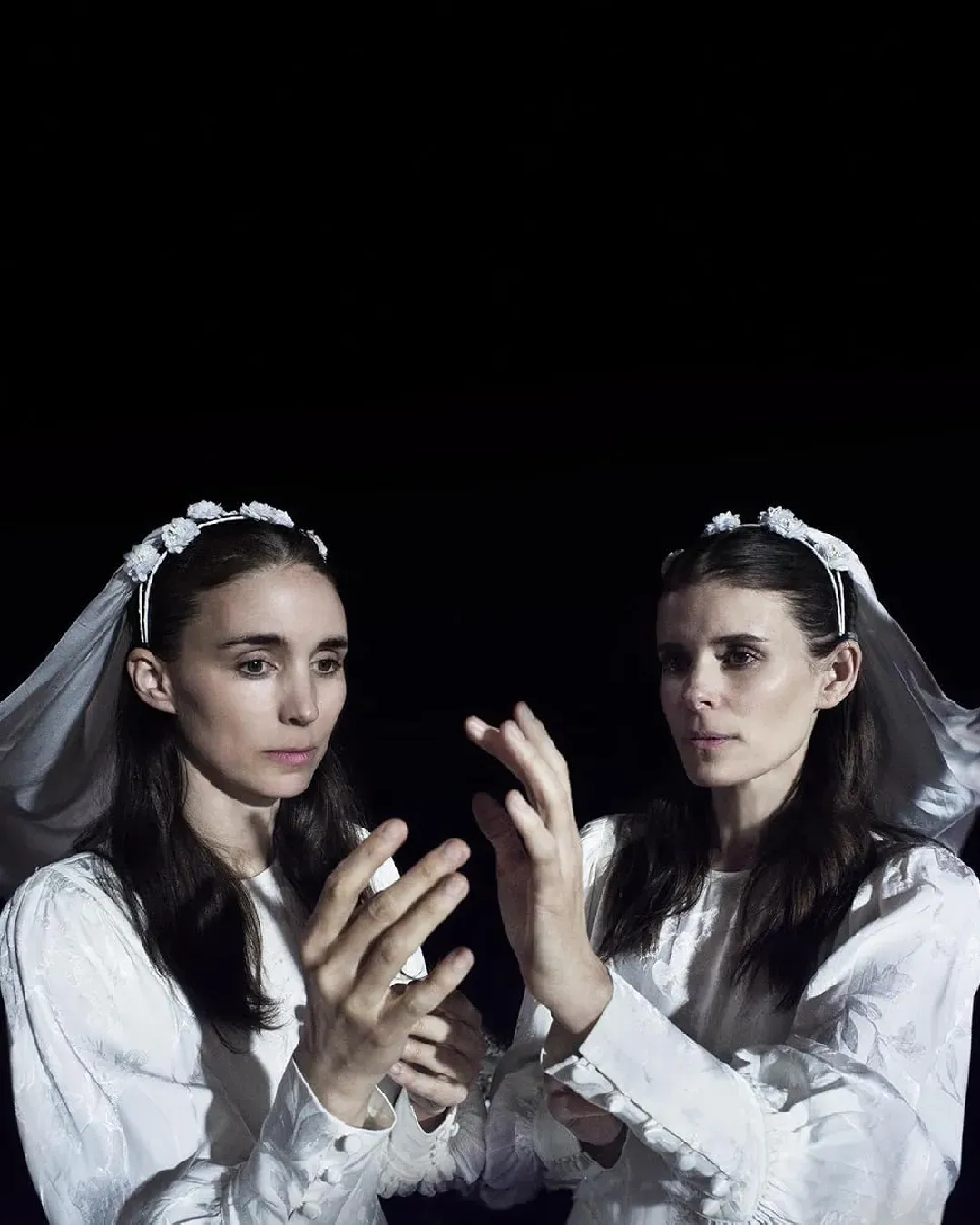
The absurd story of the sisters in "Bucking Fastard" And how Werner Herzog told it, with Kate and Rooney Mara
Bucking Fastard is the new film by Werner Herzog, which instead of premiering as planned at the Cannes festival arrived for its world premiere at the Venice Lido. The story is well known: the German director and screenwriter had been invited by artistic director Thierry Frémaux, who had not, however, included the feature film in competition. A decision that led Herzog to decline his presence on the Croisette, which the Film Festival promptly exploited by reserving a spot for Bucking Fastard in the official selection.
Rooney Mara arrives to the "Bucking Fastard" premiere at #VeniceFilmFestival pic.twitter.com/XdUZ6r0ded
— Variety (@Variety) September 3, 2026
The move adopted by Frémaux, and the public's awareness of the minor diplomatic incident, certainly contributed to the curiosity surrounding the title and, even more so, to a kind of protective feeling toward it. Not that Werner Herzog needs it. However, having withdrawn because Cannes did not consider him worthy of competition, and therefore choosing to go to Venice, created a sense of vindication around the film, championed by cinephiles as well as the director's many devoted fans. It is also worth recalling that last year's Golden Lion was likewise a title Cannes had passed on and that went on to win: Father Mother Sister Brother by another veteran, Jim Jarmusch.
Having now seen Bucking Fastard in full, one might venture to say that from a certain point of view Frémaux's reservations were understandable. On the other hand, it is impossible not to be captivated by the hypnotic, surreal power with which Herzog transports audiences into the worlds he chooses to portray each time, whether real or fictional, whether belonging to documentary or narrative filmmaking.
Drawing on a real news story and then transforming it into something else entirely over the course of the film, Bucking Fastard tells the story of sisters Jean and Joan Holbrooke — not twins, yet so symbiotic that they speak in unison. The protagonists are inspired by Freda and Greta Chaplin, who were actual twins and the center of a tabloid affair in the 1980s. The women, who lived as a single entity, became infatuated with the same man and were taken by him to court. The twins had displayed obsessive behavior toward him and, as a result, ended up in prison. But after a month, refusing to be separated, they found themselves placed in the care of an assigned guardian who helped them reestablish their daily lives.
Herzog met the twins while they were still alive, incorporating into the film events he himself witnessed (the scene in which they get ready, using each other as mirrors) or that may have been documented in the two documentaries dedicated to Freda and Greta Chaplin: Pair of One from 1987 and The Twins from 1994. But the director's curiosity about the two women does not end there. It is not morbidity or a desire to dig into the murky, nor is it an attempt to investigate what it was that bound two women together so symbiotically that they ended up speaking simultaneously and saying the exact same things. Herzog's film is an act of looking beyond what the gossip surrounding them failed to see, and of understanding that perhaps these two halves of a single whole belonged to dimensions ill-suited to those of ordinary people. That perhaps, in their inseparability, they were in fact very much alone.
Co-stars and sisters Rooney Mara and Kate Mara arrive to Vanity Fair’s toast to Werner Herzog’s new film ‘Bucking Fastard.’pic.twitter.com/L0bZYcr28D
— cinemaland (@thecinemaland) September 2, 2026
It is the incongruity between their inner world and their surroundings that governs the dynamics of Bucking Fastard — an incongruity amplified by Herzog's hand, which renders these characters a monad that seems not to belong to the environment in which they are immersed. Like creatures from another land, the sisters exist within the contemporary world we know, where selfies are requested and train tickets are bought on touchscreens, yet they seem to come from the past, from a distant place, perhaps not even aligned with our reality and certainly not with our time. This is probably why it is so difficult for the protagonists to exist in our world, which they reproach above all else for its absence of love. They who are so desperately in need of it, excluded from everything and feeling utterly alone despite always being together.
Playing them, in a singular performance from which it is impossible to look away, are sisters Rooney and Kate Mara, appearing together on the big screen for the first time. Natural in the mechanics of repetition, in being each other's echo, Jean and Joan are figures one can reflect upon, and whose spirit one comes to understand so deeply as to grow fond of them and overlook their problematic behavior. One comes to love them as one loves the entire ramshackle, offbeat enterprise that is Werner Herzog's film — which transforms into a genuine mythological quest in search of a place of one's own out there in the world. A place the film found during the 83rd edition of the Venice Film Festival, dedicated at its opening to the memory of David Lynch.
What to read next

In "The Debut" Julianne Moore gives a masterclass in acting
The film, premiering at the Rome Film Fest, hits theaters on January 1, 2027
"Masterplan" is everything a heist movie shouldn't be
The film starring Stanley Tucci, Simona Tabasco and Victor Belmondo is available on Prime Video
"Fjord" is an impressive piece of writing
Cristian Mungiu's film, winner of the Palme d'Or at Cannes, arrives in cinemas on November 19