
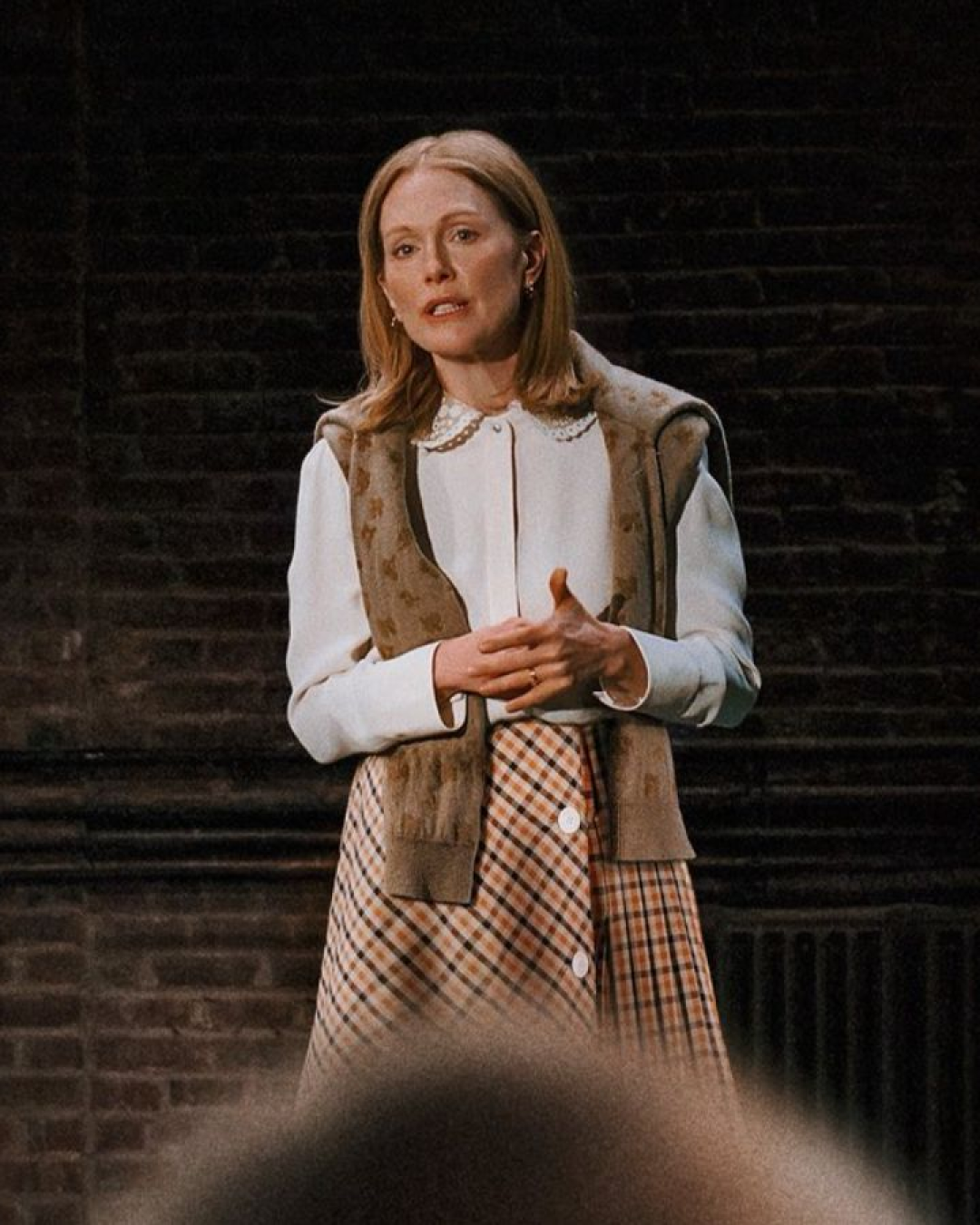
In "The Debut" Julianne Moore gives a masterclass in acting The film, premiering at the Rome Film Fest, hits theaters on January 1, 2027
Julianne Moore and Jesse Eisenberg worked together in 2022 on When You Finish Saving the World, the actor's feature directorial and screenwriting debut. Two years later, the filmmaker returns with A Real Pain, guiding co-star Kieran Culkin to an Oscar for Best Supporting Actor. For his third feature, Eisenberg has once again directed Moore, writing the part specifically for her. It was that first film they made together that stayed with him — a moment in which the actress uses her voice in a particularly distinctive way, the same voice that guided his pen as a screenwriter.
The Debut: plot and characters in Jesse Eisenberg's new film
Thus was born The Debut, a blend of that moment offered by Julianne Moore and Jesse Eisenberg's own past as a theater kid — shy and reserved as a boy, who, as he has his characters say, found through art that he went from being an outcast to being in-cast. A celebration of work on the stage that can be simultaneously intimate, profound, introspective, transformative, therapeutic, and regenerating. But also silly, superficial, and deliberately playful, just as theater can be.
The story follows Mona (Moore), a housewife ignored by her husband and children, who one day decides to audition for the role of Mrs. Danielle in the musical Nosy Neighbors. A show whose songs and lyrics are written by Eisenberg himself, who brings his characteristic humor to the intentionally naïve production being staged by director Jerry, a remarkable Paul Giamatti, who will push Mona to bring out everything she feels inside. And this will be both her fortune and her undoing. Going so deep into the role in search of its truth that she loses sight of Mona. But perhaps that is precisely the point: who is Mona?
How Jesse Eisenberg transforms emotions into cinema
Jesse Eisenberg’s hilarious but heartbreaking The Debut is a beautiful piece of filmmaking that perfectly toes the line between high comedy and heart-rending poignancy, elevated stratospherically by Julianne Moore’s generational, sensational performance #lff https://t.co/5O56jK2kyw
— Rhys (@rhysrmann) October 18, 2026
All of The Debut is built on the emotional experience of its protagonist. When Mona feels invisible and is arrogantly cut in front of in a supermarket queue, when she is frightened and the city around her mirrors the dangerous, restless neighborhoods of 1940s noir. When she steps onto the stage, then, Mona must focus on who Danielle truly is, setting herself aside — as she has always done. The risk, however, is that of confusing the two identities, until they become blurred and overlapping. A subjectivity that belongs to the protagonist as she studies her role, and that is at the same time the perspective from which Jesse Eisenberg wrote and structured the film.
Right at the beginning, when Mona comes into contact with her future stage colleagues, the first thing they tell her is that it's fine to be nervous — in fact, she must use those negative feelings to channel and harness them when performing. Everything that causes pain and ties the stomach in knots is fuel for an art that transforms adversity into potential. And it is on this ironic provocation — gently needled yet simultaneously cherished by Eisenberg — that the screenplay of The Debut finds its form. One that is shaped by never seeking the real, unless one is looking at what the characters feel. Where everything can afford to be excessive and disorienting, to disregard authenticity in tone and staging, unless it concerns what the protagonist is experiencing.
Julianne Moore and Paul Giamatti are the heart of The Debut
Julianne Moore, then, makes it all feel so real. If Mona doesn't quite know who she is — or if, on the contrary, knowing does nothing but cause her pain — the audience is immediately able to grasp the discomfort the woman feels in her own body and in the world, in her relationships with others, and in her search for a place to express herself through acting. An art of which Moore gives proof by opening the protagonist up across a wide range, allowing herself to show audiences her boundless capabilities. Not that it was necessary — she who won the Academy Award in 2015 for Still Alice and holds honors received at the world's major film festivals, from Cannes to Berlin to Venice. The tenderness of the protagonist mingles with the discomfort of saying the wrong thing, doing the wrong thing, which becomes Mona's need to be perfect on stage, to find coherence between text, reality, and meaning. A performance rich with nuance that culminates in a tribute to icons such as Liza Minnelli and Patti LuPone whom she can never equal, but whom Mona will find it beautiful simply to admire from afar.
And, although Moore is the beating heart of The Debut, Paul Giamatti deserves unreserved praise — a timeless giant who, echoing a role like Professor Paul Hunham in The Holdovers, once again stands beside a character to help them step outside themselves. To dig deep and draw out unexpected sides. Even to get angry, unsettling or frightening those around him, while the audience watches in awe at yet another display of intensity he is capable of delivering. Two actors in service of a story where theater and mimesis are the vessel for infecting audiences with one's own emotions. Which is, after all, the desire of anyone who makes art — whether by directing a production or claiming center stage in order to finally feel seen.
What to read next

"Masterplan" is everything a heist movie shouldn't be
The film starring Stanley Tucci, Simona Tabasco and Victor Belmondo is available on Prime Video
"Fjord" is an impressive piece of writing
Cristian Mungiu's film, winner of the Palme d'Or at Cannes, arrives in cinemas on November 19
Clayface is the first truly horror superhero film
The lead is Tom Rhys Harries, and the story concept comes from Mike Flanagan of "The Haunting"