
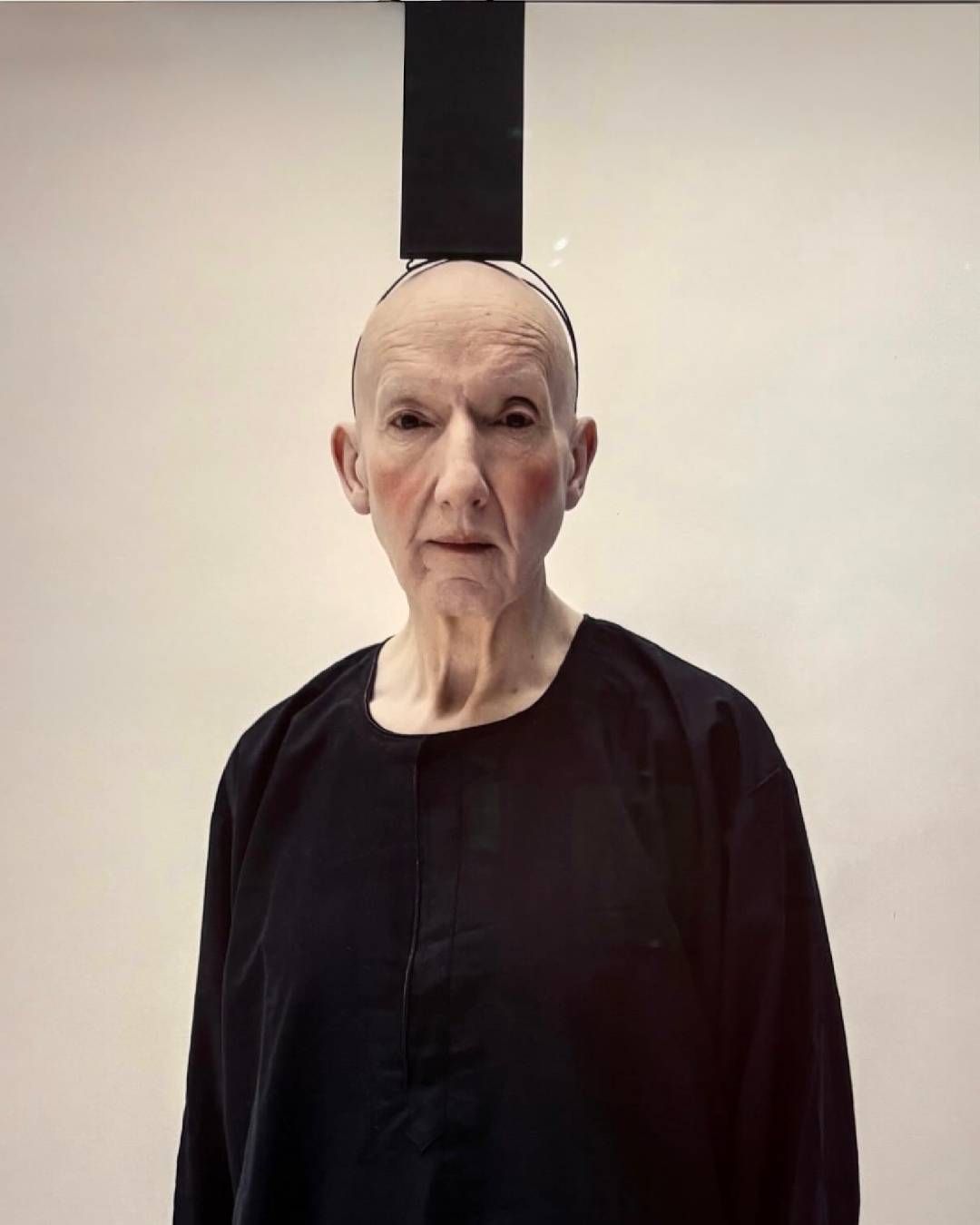
Stephen Jones shares his vision of fashion at SSENSE’s Salon des Refusés From London to Paris, a look back at the journey of an extraordinary milliner who came to shake up fashion’s status quo
During Paris Fashion Week this October, SSENSE reinvented the legendary 1863 Salon des Refusés - the historic exhibition authorized by Napoleon III so that the public could judge for themselves the artworks rejected by the official Salon. That gathering of artists caused a scandal, sparking outrage over a canvas that would go on to become a classic masterpiece of early Impressionism: Édouard Manet’s Le Déjeuner sur l’herbe. SSENSE revives this tradition by bringing together the new guard of fashion. On this occasion, legendary British milliner Stephen Jones reflects on his vision of a craft freed from constraint, where the hat remains the ultimate “exclamation mark” of a silhouette.
In 1863, the original Salon des Refusés disrupted Paris' artistic institutions by giving the most avant-garde artists a space to express themselves. More than a century later, SSENSE breathes new life into that spirit during a one-day Parisian event. As a premier global platform for emerging talent alongside established luxury houses, the Canadian retailer transposes its digital universe into the physical world. It was a rare moment where the community could finally see, touch, and above all try on pieces from the emerging designers who are pushing the industry's boundaries today.
If any creator embodies this break with academic tradition, it is Stephen Jones. Emerging from London’s 1980s club scene and trained at Central Saint Martins, the British milliner turned headwear into wearable art. From the runways of Jean Paul Gaultier and Vivienne Westwood to Dior shows during the John Galliano era, he has infused even the most sophisticated silhouettes with a rebellious spirit for nearly five decades. His strength lies in this permanent tension between a distinctly British sense of subversion and a uniquely Parisian savoir-faire. Rather than simply exalting Haute Couture, Stephen Jones prefers to disrupt it: “ I’m very much about the unusual, the Punk, the New Romantic etc, but what I would like to do is challenge it with French Haute Couture. I like to do it the other way round than the way people expect it. So, to do the thing that appears very unusual, radical, and challenging but made in the most beautiful way. ”
It is a theatrical aesthetic drawn from the heart of the 1970s and 1980s, in the wake of figures like David Bowie. Between neo-rococo nods, pirate-inspired silhouettes, and dramatic presence, the milliner subverts the codes of subculture to elevate them to the heights of fine craftsmanship. It is precisely in this liberation from rules that he finds his playground: for Stephen Jones, the hat remains the last true domain of radical freedom in fashion. Less codified than the rest of the wardrobe, it allows for spontaneity and a heightened sense of theatricality. In a fashion landscape sometimes stifled by commercial constraints, millinery retains a unique spontaneity. Where garments must fulfill strict functional requirements, a hat stands as a space for uncensored expression, hovering between sculpture and craftsmanship. When asked how he defines himself, Jones replies with the lightheartedness of a free spirit that he is “all three depending on where the wind is blowing [designer, craftsman, artist].”
Beyond the artistic gesture, the milliner remains fascinated by the psychological - almost magical - power a headpiece holds over its wearer. Heightening posture and transforming presence, a hat acts as a catalyst: “How transformative it is and how it can make people smile, both the wearer and the observer. It’s extraordinary and it always happens.”
As fashion accelerates and reinvents itself at a breakneck pace, Stephen Jones navigates the eras with an intact irreverence. For someone who has witnessed the industry transform over a career spanning nearly fifty years, the secret to longevity lies in a deep humility toward youth: “Stay curious. When you think you know what’s right you are probably wrong. Every generation thinks they have discovered something, which is not correct but they have a new take on it and the antenna have to be open enough, in order to accept that point of view.
More than a fleeting event, this modern reimagining of the Salon des Refusés reads like a manifesto. By uniting the new guard with a guiding figure like Stephen Jones, SSENSE proves that fashion is never more powerful than when it dares to challenge convention. Between exceptional savoir-faire and absolute freedom, the story continues to be written - and always with an exclamation mark.
What to read next

5 key trends from Paris Fashion Week SS27 Women's
What we'll be wearing next summer, according to the fashion of the Ville Lumière