

























Have loafers really become the new sneakers? In our opinion, they haven't completely replaced them yet
There was a time when wearing sneakers was the only possible option. But that era ended with Covid. It was specifically with the FW21 season that the fashion weeks of Paris and Milan literally filled up with formal shoes that supplanted the previously omnipresent sneakers. From then on, in addition to fashion, the flourishing of pages like @uniformdisplay marked the beginning of a new style made of baggy trousers, cropped cotton shirts, visible boxers and loafers.
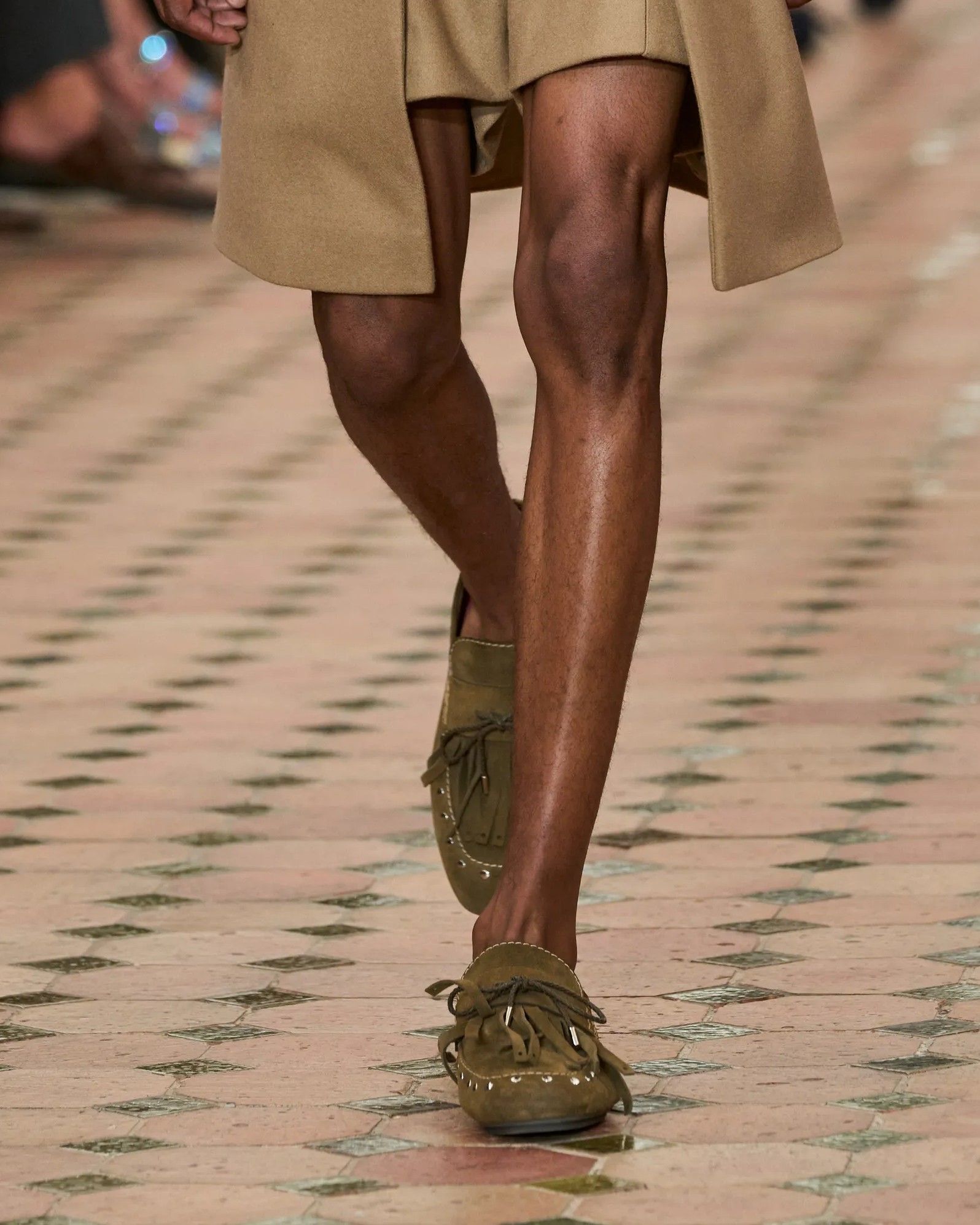
And loafers are particularly important because, unlike derbies and boots, they have become the default casual shoe for the most fashion-conscious audience, effectively replacing the loud sneakers of the streetwear era and learning to coexist only with the more minimal and classic ones. Over time, we then saw the classic loafer evolve towards new similar or hybrid forms such as men's ballerinas or snoafers that made it both more sophisticated and less formal. But how did this evolution happen?
Growing beyond streetwear
The loafer became a slip-on shoe surrogate when the old audience of the streetwear era grew up. When the pandemic setback arrived, the market was in fact suffocating in sneakers: at first they were functional, modern and collaborations kept them fresh; after a while, however, the mechanism got stuck on itself. Drops had become daily, creativity was increasingly lacking. With the 2020 release of the Air Dior, the absolute peak of luxury streetwear was reached: Kim Jones closed the circle opened with Louis Vuitton x Supreme, but represented the conceptual exhaustion of the trend.
At that point the collaborations were too many, forgettable and disappointing; the market was hyper-saturated with increasingly bland and blatantly commercial releases, the audience had been reduced to resellers/hypebeasts who were still in high school (or dressed as if they still were) and the public was tired of the superficiality of it all. Even Virgil Abloh himself disapproved of the new drifts of the scene and, after his death, and with the Astroworld tragedy on one hand and the epic downfall of Kanye West on the other, mainstream culture turned towards new and less risky shores.
After the end of lockdown, hype culture became something for teenagers. Sneakers returned to the niches of gorpcore or running. The ex-hypebeasts were passionate about fashion but wanted a product with material value and that wasn’t just hype: Aimè Leon Dore maintained the comfort of streetwear but made it more mature by pairing the hoodie with a wool coat, the blazer with a baseball cap and the sports shorts with boat shoes. A change that was read as a return of the preppy style, old money or quiet luxury.
The role of the loafer
@haval.s Loafers or sneakers ?
original sound - luke
The cornerstone of all these changes was the loafer. Anyone who started wearing them after sneakers at some point thought they were perfect substitutes for sneakers, only with a more composed and mature appeal. They could be worn in a youthful way, but above all they represented a search for classicism and a conceptual center in a confusing men’s fashion scene.
Today we have the opposite problem, namely too many excessively basic brands riding the normcore wave as an expression of a more authentic self. But the loafer incredibly resists, also thanks to the fact that it is available across different price categories, that the vintage market is full of them and that shoe culture can accommodate much higher levels of nerdiness about shoes than the sneaker world.
But here’s the twist. If in the immediate post-hype culture moment the loafer was contrasted with the sneaker as a superior and more mature alternative, with the advent of more neutral and classic slim sneakers we moved to a narrative of equivalence. On TikTok, for example, content saying that loafers elevate every outfit has been supplanted by those saying that choosing between sneakers and loafers is the hardest decision to make every day. From a relationship of competition, we have arrived at one of equivalence.
A peaceful coexistence
something i've noticed is that people who are new to something — whether it's tailored clothing or catholicism — are often very rigid and dogmatic in their thinking. much more zealous than people who have been into it for a while. not sure what causes this. pic.twitter.com/g89bEYbzYS
— derek guy (@dieworkwear) March 18, 2026
Today footwear trends have a breadth and variety that were unthinkable until 2019. We could use the footwear of Miu Miu as a general indicator of the entire sector, as it is currently the guiding brand for almost all the trends we see today. While the collaboration with New Balance has revitalized low-profile sneakers and brought back motorcycle boots, a huge part of the brand’s offering consists of loafers.
Analyzing Miu Miu’s e-commerce, out of 156 different shoe models, loafers and similar shoes represent 24.4% of the total offering with 38 models, the highest percentage, followed by 21.2% sandals with 33 models and 18.6% ballerinas with 29 models. Sneakers, with 19 models, are 12.2% of the offering. It is clear that these figures are approximate, relative to the current season and do not take into account any regional differences in the offering but, nonetheless, they can help explain how, even though loafers remain the most popular category today because they are more versatile and genderless, their dominance is not complete.
The situation is almost identical for other brands, obviously with “blends” of models relative to each one’s ecosystem, but it is still indicative that loafers are currently among the flagship products of brands like Saint Laurent, The Row, Prada, Chanel and obviously Gucci, just to name the most famous. A peaceful coexistence of trends that in fact indicates the emphasis fashion is placing on classicism but also the presence of an audience that, increasingly inspired by the multiplicity of styles offered by algorithms, becomes increasingly eclectic in its demands and, therefore, more difficult to anticipate and surprise.