
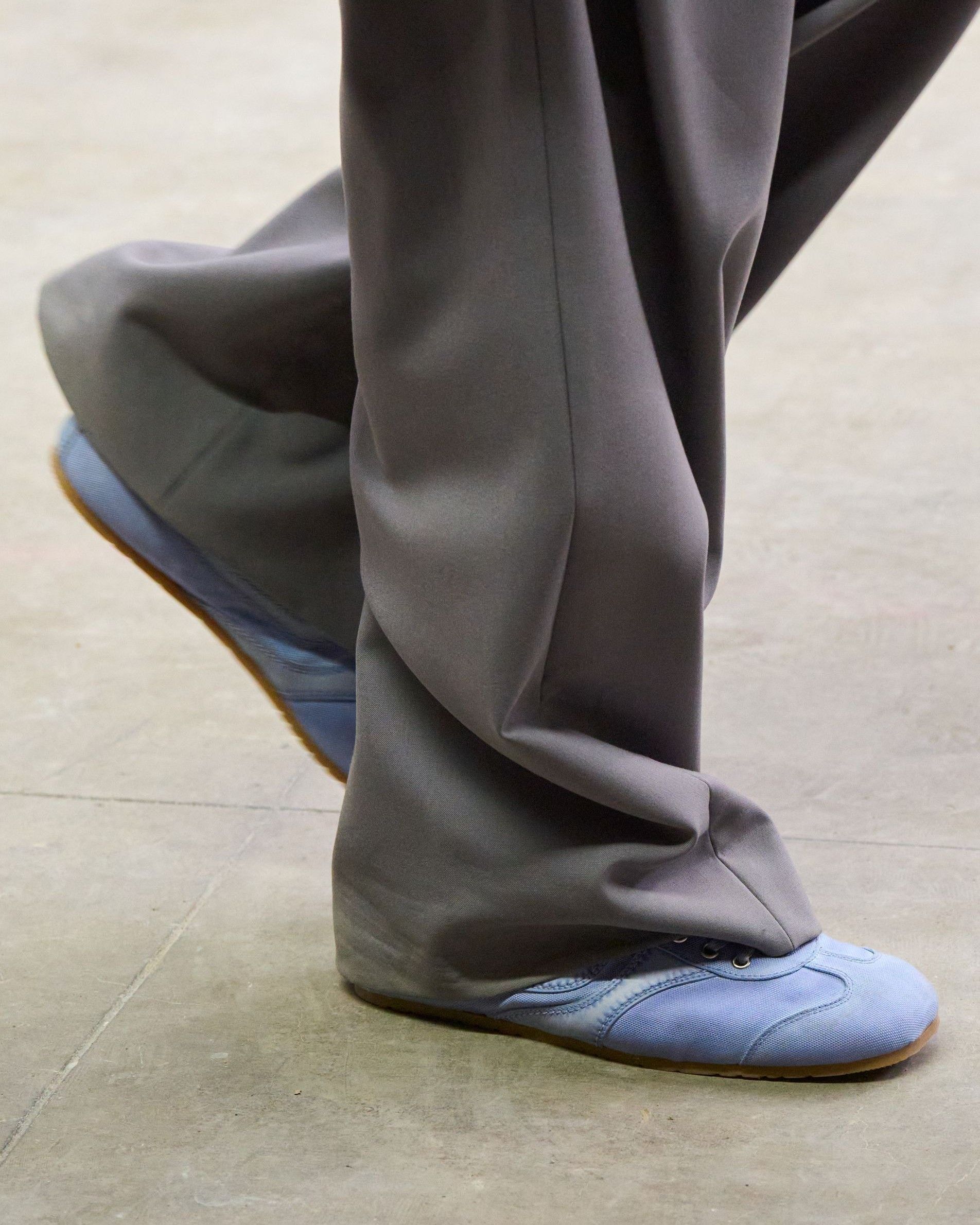
Are slim sneakers here to stay? Their popularity indicates a shift in culture
From chunky to slim
It was 2017 when Balenciaga launched onto the market the now infamous Triple S. The sneaker, like the Frankenstein monster of Jacob Elordi, was imposing, composite, and utterly fascinating. After the initial sense of awe, they became a hit. A few months later, every brand was producing big and bulky sneakers (Gucci's Flashtrek and adidas x Raf Simons' Replicant Ozweego are the best examples) and an entire brand, namely Naked Wolfe, was built around it. Today, things are going differently.
After getting tired first of chunky sneakers, then of dad sneakers and then of mules, we have returned to classic sneakers, which however are now very thin and vaguely retro. In 2020, Wales Bonner launched the first collaboration with adidas which included two Samba models and Balenciaga presented the Zen. Then in February 2022, it was Miu Miu's turn with its collaboration with New Balance.
And the story repeated itself: thin soles everywhere, silhouettes designed both for the masses and for fashion insiders (respectively the Samba and Dries Van Noten's Suede) and a fever that seems to have infected the market. But this time things are different: slim sneakers seem here to stay. But why?
A market of cultural niches
Before Demna, the planetary success of Virgil Abloh, Yeezy, and in general before 2017, one didn't reflect excessively on sneakers. They were bought and worn without considering too much their cultural baggage. Today things are different and each sneaker has ended up playing a role in some cultural niche. Naked Wolfe, for example, are hugely popular among techno lovers; the Nike Tn are the shoes of the maranza, the Nike Dunk those of the normies; the adidas adizero EVO and the On distinguish runners between fuckboys and actual running enthusiasts, the Salomon those of outdoor lovers, climbing and natural wines, and so on.
This happened because the market has evolved beyond the taste for generic sneakers and sensational releases (which has brought some difficulties to Nike) and has however left a sort of void at the center of the Cartesian diagram on which we could position every popular sneaker today. In other words, the zero point is missing, namely that universal reference sneaker against which all others would position themselves culturally, establishing their own identity. Now it's as if each subculture with its sneaker existed in a void, there are too many permanent centers of gravity and they cancel each other out.
It's a void that we don't know how to fill. In fact, in the past it wasn't occupied by a single model but, substantially, by a single brand, namely Nike, with all its galaxy of models. Today, however, the world is more fragmented and the sneaker multiverse can no longer have a true center. And as Vanessa Friedman argues in the NY Times , perhaps it is the slim sneakers, regardless of the brand, that occupy it and become the «new normal».
Are slim sneakers the new benchmark?
In her article, Friedman doesn't talk about slim sneakers but about retro sneakers. All these sneakers in fact (except Nike's Cortez) are a variation on the theme of the German Army Trainer namely the shoes with which Bundeswehr soldiers trained during the Cold War, from which adidas Samba and Margiela's Replica were born. We in fact define these sneakers “slim” to distinguish them from the bulkier and more solid silhouette that became the norm in the ’80s and ’90s and all subsequent years.
But in fact, perhaps it is the low and thin silhouette the true archetype. From 19th-century plimsolls to Spalding canvas basketball shoes to the first Converse Chuck Taylor of the 1910s and the Adi Dassler's Waitzer Model of 1928, sports shoes have always been slim sneakers. Perhaps, now that each sports discipline has its own dedicated model that has become a true tool for each sport (think of soccer boots with studs or running models), the true original model is reclaiming the place it deserved. And therefore, orthopedics aside, we can truly say that slim sneakers are here to stay.
Takeaways
- Slim sneakers represent a natural evolution from the 2017 chunky boom towards retro and minimalist silhouettes, such as adidas Samba or Balenciaga Zen, which are conquering both the mass market and fashion insiders.
- Today the sneaker market has fragmented into cultural niches, where each model symbolizes a specific subculture, leaving a void at the center that slim sneakers fill as the new universal "zero point," surpassing Nike's past dominance.
- Inspired by German Army Trainers and the historical archetype of thin sports shoes, slim sneakers return to orthopedic and functional origins, distinguishing themselves from the bulky shapes of the '80s-'90s. Therefore, it seems that slim sneakers are here to stay, as the new archetype in a fragmented multiverse.
What to read next

Miu Miu's Bubble Shoes are back
The iconic '90s style has been reimagined with a lighter, more functional design
Moncler Presents "CityTrek"
The brand reimagines vintage trail shoes with technical materials and refined details
New Balance unveils The Flimby Garden
A garden dedicated to all the people who contribute to the brand's Made in UK