































Do fashion schools still teach craftsmanship? In Italy, the future of traditional techniques such as moulage lies in the hands of the academies
While the luxury sector underlines the need for at least 270,000 specialist figures in manufacturing, to be trained by 2028, fashion is asking itself how to bridge the generational gap between the few remaining master craftspeople and young talent. Just over a month ago, we analysed the growing weight that craft work is taking on in luxury, highlighting the lights and shadows, opportunities and limitations of the manufacturing sector for the new generation. Faced with this scenario, it is natural to ask what role Italian fashion academies play in passing on this precious know-how and, above all, how the new class of textile artisans is being trained.
The centrality of textile culture in academic training
In speaking with several prominent figures within the academic sector, one common denominator emerged above all: the centrality of craft knowledge in training tomorrow's creatives. The educational offering of the Italian institutions we interviewed (Accademia Costume & Moda, IUAD, NABA) is distinguished first and foremost by its ability to guide students through a journey of both theoretical and practical discovery of the behaviour of materials, their intrinsic characteristics and their interaction with the human body.
This approach places material at the heart of creative language: according to Santo Costanzo, Head of the Fashion Department at Accademia Costume & Moda (Rome), it is indeed «impossible to imagine volumes or design a garment without a deep knowledge of textile fibre». In the classrooms of the Roman academy, this awareness translates into hands-on experience in an in-house fabric library, where students can touch and compare yarns and fabrics to understand their expressive potential.
This centrality of experimentation also finds full convergence in the practice-based model of the Nuova Accademia di Belle Arti (NABA) in Milan: as highlighted by Professor Alessandro Manzi, Fashion Marketing Management Course Leader, the institution adopts a radical method based on "learning by doing" that extends the study of raw materials all the way back to their biological origins. Through circular projects such as a dye garden and the exploration of experimental bioplastics in the laboratories, students engage with textile manipulation and material culture in a cross-disciplinary way.
New and old techniques
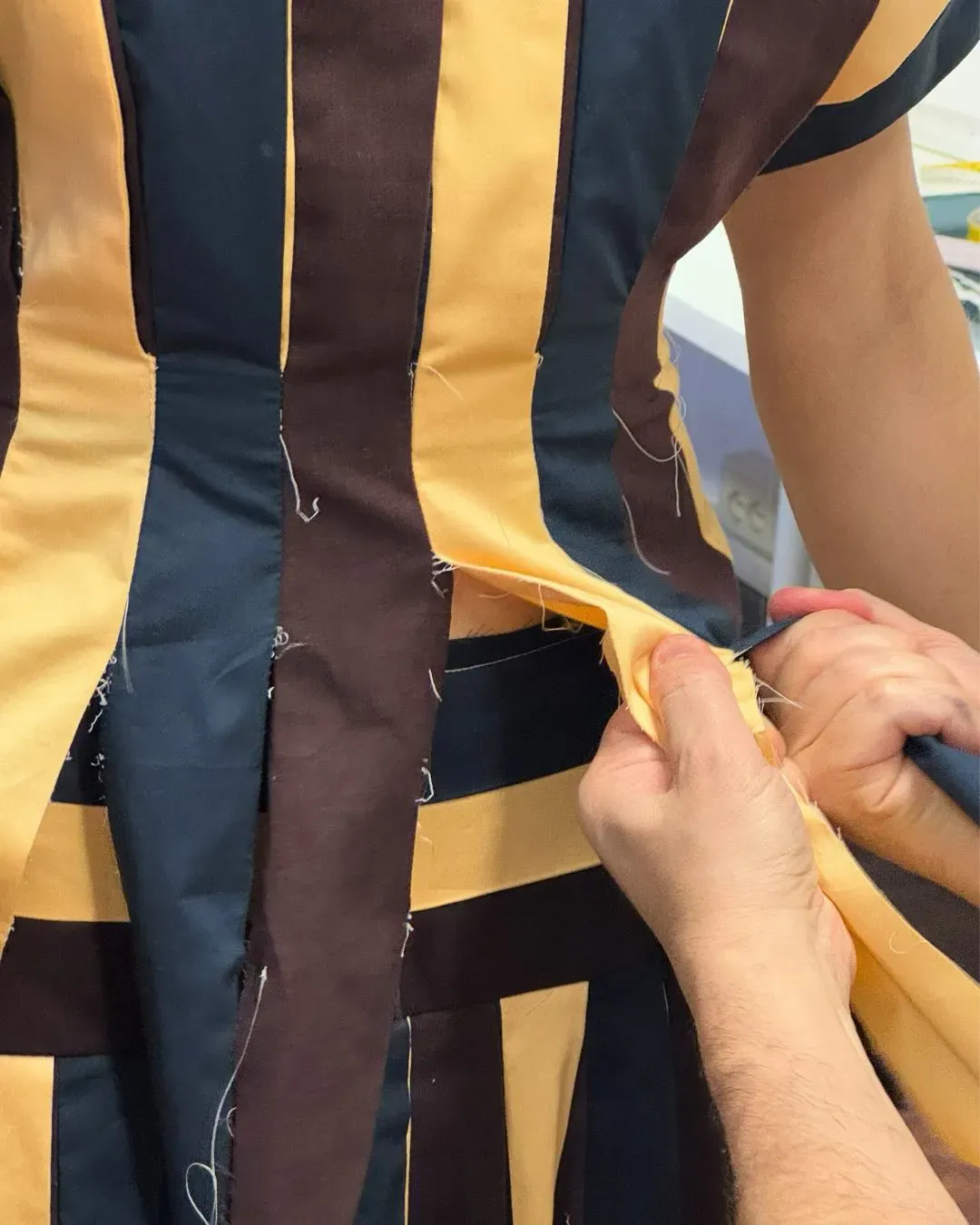
In students' training, the step following the physical and biological understanding of materials concerns their concrete transformation: a process that today requires the ability to bring historical knowledge into dialogue - such as the teaching of moulage, weaving, and techniques ranging from devoré to screen printing - with the digital innovation of 3D prototyping.
According to Michele Lettieri, President of IUAD in Naples, the coexistence of manual skill and digitalisation in professional training programmes must be realised as «a necessary continuum». Lettieri emphasises how learning flat pattern cutting and draping on the mannequin is the only way to give meaning to digital modelling, which would otherwise risk becoming an empty tool.
In this view, «technology must accelerate, not replace, sensitivity» and it is precisely through this educational model that these academies seek to preserve a culture of imperfection. Manual error is therefore understood not as a limitation, but as a genuine competitive advantage. In a market saturated with geometrically flawless products, «craft - to quote Professor Manzi - is both expertise and embodiment», that is, it is a practice of knowledge through the body and of expressing one's creativity through the hands.
This profound need for uniqueness and reconnection with the art of making is directly reflected in a new vision of sustainability, understood no longer merely as a choice of materials, but as a culture of quality, time and responsibility. Lupo Lanzara, President of Accademia Costume & Moda, told us that «technical quality is one of the most concrete forms of sustainability» and that today «teaching the value of conscious construction becomes fundamental». Lanzara also added that next year the academy will see the first graduates of the three-year First Level DAPL in Fashion and Costume Crafts, dedicated to Pattern Making, Tailoring, Prototyping and Historical Cutting: a programme that expresses, on the part of the new generations, «an ever deeper need for concreteness and authenticity».
Academy and academies: collaboration or competition?
In the face of the proliferation of schools founded within major maisons, from Bottega Veneta to Golden Goose's HAUS, one wonders what relationship exists with traditional academies. Through the reflections that emerged from conversations with faculty, academic institutions do not appear to perceive this phenomenon as a competitive threat at all; on the contrary, drawing on a solid and structured ecosystem of partnerships developed over the years directly with companies in the sector, they position themselves as a complementary model that responds to different logics and objectives.
In this sense, a clear demarcation emerges between corporate verticality and academic horizontality. While these in-house schools are created to meet immediate industrial needs through rapid entry into the workforce and technical specialisation focused on specific stages of the supply chain, the role of academies operates on a decidedly broader, more systemic horizon and, above all, one oriented towards the human formation of the individual, even before that of the professional. What emerges is a genuine assertion of the school as a democratic incubator of possibilities, standing in sharp contrast to those training programmes that limit themselves to transmitting purely executive skills shaped around the identity-driven needs of a single brand.
Young designers' aspirations go beyond hierarchies
The focus inevitably shifts to how much this defence of flexibility and the uniqueness of training pathways is truly changing the aspirations of the new generations. As emerged from conversations with academic institutions, there is a growing sense that young designers are looking beyond the hierarchies that continue to persist between management and workforce, between design offices and workshops.
In sharp contrast with a system that in recent years has been witnessing the erosion of the figure and centrality of the creative director, academies and universities are confirming their role as ideal spaces for dismantling these old logics, becoming places in which to activate genuine processes of reconstruction and re-education in the way fashion's spaces are inhabited. The valuable work of fashion schools in championing craft risks remaining isolated without the timely support of national and European institutions. Only through this synergy will it be possible to initiate a real reorganisation of the supply chain aimed at promoting a culture of work that is less hierarchical and more humane.