




























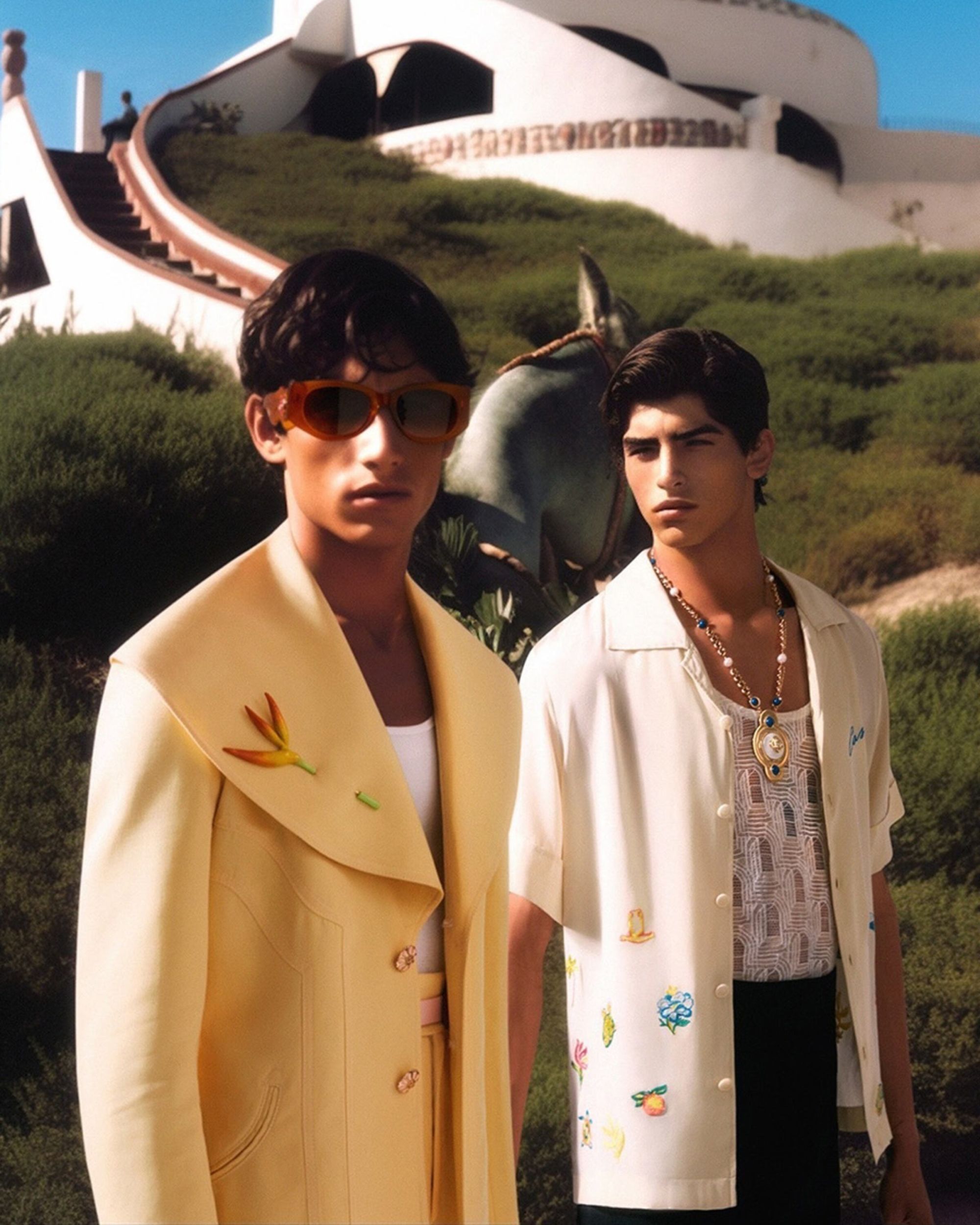
Who's afraid of AI in fashion? Between risks of industrial bubbles, estimates to be revised, and a certain timid optimism
2025 is the year in which AI entered our lives. Its potential is enormous for everyday life, but above all it has created much fear for its impact on a job market that is already quite difficult. This is doubly true for the world of fashion, which has been hit by a very tough crisis that is leading to a new mentality of efficiency and numerous layoffs. To these problems is now added another: the very future of the AI market, which is growing tumultuously pushing many companies into a mad race for the acquisition of raw materials and especially energy sources capable of powering them.
In recent weeks, among experts and commentators in the sector, the awareness has begun to emerge that that of AI could be a speculative bubble: a rapid and irrational rise in the prices of an asset fueled by collective enthusiasm and market speculation, rather than by the actual value of the assets, inevitably followed by a crash. All this at a time when AI is not bringing the fabulous profits that many hoped for.
The problem is understanding what would happen if the bubble were to burst. The risks actually concern the giants of Silicon Valley, but a possible market collapse could damage an already fragile fashion industry? There is a lot of talk and even more fears, but for fashion in particular, it is essential to distinguish real risks from simple fears that a new medium inevitably arouses. But first of all, let's understand what this "AI bubble" is.
What is the AI bubble?
To put it very briefly, in recent months chip manufacturers, data center owners, and tech companies have continued to invest money in each other's companies, increasingly raising prices. OpenAI, for example, has never recorded a profitable quarter: it has been in loss since 2022. Only between July and November of this year it burned 12 billion dollars and according to general estimates it will not reach profitability for another five years. This is because the costs of servers and research far exceed the earnings. But then how does it sustain itself?
Since all tech service providers need AI services, investors step in. Companies like Microsoft prefer to pay OpenAI rather than having to build everything internally, thus pumping billions into the company to make it grow. OpenAI in turn buys Nvidia's chips, necessary to train and develop algorithms. Nvidia then reinvests other billions directly in OpenAI or other startups like CoreWeave or Nebius, to build data centers full of its own chips.
Meanwhile, OpenAI needs to host its own data, so it pays Oracle which, in turn, buys chips from Nvidia. In this way, money bounces from one company to another, inflating market values (Nvidia at 4.5 trillion, OpenAI at 500 billion) without there being literally any trace of real profit. Everything revolves around the fact that OpenAI has years of advantage in AI development, so these companies, plus a very high number of investors, funds, and banks, are betting on its future role.
As we were saying, the problem is that at the moment OpenAI is in heavy losses and the demand for Nvidia's chips is entirely artificial because the entire ecosystem is circular. As long as it remains a closed circle, everything could go well, but the moment a recession occurs, a geopolitical regulatory obstacle intervenes like a trade war, the "force" of the bubble would fade and it itself would collapse under the crushing weight of 1.5 trillion in debt which, according to Morgan Stanley, will accumulate over the next three years.
Last Tuesday, Barclays lowered the rating of Oracle's stock, one of the heavyweights in the sector that has invested enormously in data centers in recent times accumulating equally enormous debts. To understand how indebted Oracle is, just think that for every dollar of company assets, five are in debt to be repaid. The current debt is 111.62 billion dollars. In the same week, Sam Altman of OpenAI failed to explain how to cover the 1.4 trillion dollars in computing spending for which he had made agreements with suppliers and the shares of the startup CoreWeave fell 22% in a week.
Sometimes, we see bubbles.
— Cassandra Unchained (@michaeljburry) October 31, 2025
Sometimes, there is something to do about it.
Sometimes, the only winning move is not to play. pic.twitter.com/xNBSvjGgvs
What we are telling you are all cracks in a system that requires trillions of fixed investments, at a time when no one has enough money to invest - a kind of big poker game where the stakes keep rising but no player could really pay. The burst of the bubble would destroy Nvidia or Palantir shares, which would fall 20-30%, obliterating about 40 trillion dollars in value from the stock market.
Recently, the hedge fund manager Michael Burry (the one who predicted the collapse of the real estate market in 2008 and inspired the film The Big Short) announced that he has bet against Nvidia and Palantir shares, writing on X: «Sometimes we see bubbles. Sometimes there is something to do. Sometimes, the winning move is not to play at all». Today, Burry confirmed the bet: he bought 9.2 million put options (whose value increases as the asset price decreases) which, if the bubble were to burst, would translate into a gain of 240 million, with an absurd return of 2600%.
Burry then closed and deregistered his investment fund just as he had done in 2008. A signal that the Australian author Shanaka Anslem Perera has defined in his Substack the “Cassandra protocol”, with a nod to the mythological prophetess of misfortunes that Burry himself mentions in his X nickname which would be "Cassandra Unchained". But what does fashion have to do with it?
How much is AI used in fashion?
According to a report by The Business Research Company from last September, the AI sector in fashion was worth about 1.26 billion dollars in 2024 and was supposed to rise to 1.75 billion dollars by 2025, with a staggering growth rate of 39.2%. Another analysis, this time by MarketsandMarkets, predicts an average annual growth of 41% and yet another by Precedence Research of 40.8%. From whichever side you look at it, the sector has on paper the potential to multiply by tens of times in the coming years, a change that many await but which has not yet fully occurred.
Rereading the report The State of Fashion 2025 by McKinsey, it reads that 50% of fashion company executives consider generative AI a key element for discovering and developing innovative products. According to the report, other categories in descending order of importance in which AI will see developments are marketing, design, user recommendations, online shopping, and logistics and supplies. Closing the ranking are customer experience optimization and returns automation.
Even among consumers, 82% would like AI to make shopping faster, reducing the time spent browsing catalogs or looking for deals. But beyond simple expectations, how is fashion using AI today?
What is AI used for in today's fashion
In a recent article by Vogue, it discusses how AI is finding application in the major groups in the sector. The two biggest players using it, LVMH and Moncler, are still exploring its potential in data management and operations and to improve the e-commerce experience. Moncler has used it so far to create 3D product videos which, based on initial tests, should increase consumer engagement by 49%. Even Swarovski has gathered all the data necessary for the brand's operations (from customers to creative assets) to create a generative AI portal with Google tools accessible to employees for marketing and customer service.
For LVMH, the strategy is different. At the moment, the group is figuring out how to use this technology based on the data at its disposal: all customer data is already in a large unified database. Currently, its potential lies in recommendation algorithms both for e-commerce and for in-store sellers. More interesting, as read in Vogue, is its ability to «suggest the customers with the highest potential to contact» and to «provide recommendations with different levels of granularity, indicating for example which areas are most suitable for certain products and which stores».
The most “elevated” functions of fashion that many believe could replace flesh-and-blood workers, however, do not seem ready to be entrusted to AI. On the contrary, scrolling beyond those of Vogue, even the pages of BoF, the final impression is that the much-feared AI will be used for those tedious and mechanical tasks that normally would fall under the name of “bureaucracy” and “ingrate work”. Which in truth is good news for smaller brands, which can save time and resources on inventories and planning.
Google Pixel and Golden Goose partner to bring AI to global ateliers https://t.co/tkjlA2rytv pic.twitter.com/TEKXv6heuz
— Asif Patel (@A51FR3D) November 13, 2025
Just these days, then, Golden Goose announced a collaboration with Google Pixel through which the company's AI will be integrated into the artisanal customization process for which the brand is already famous. The idea is a brilliant variation on the theme of customer involvement through technology, but it should be noted that its implementation still involves the brand's artisans, making AI a tool to give much more freedom of customization to customers. Therefore, it should be noted that the principle, as in other cases, is that AI improves, expands and speeds up existing processes, without however replacing them.
«We want to become as efficient as possible in operational processes and business activities that do not directly concern customers, so that we can invest more in the emotional engagement of our audience, both in the digital world and in real life» said to BoF Nick West, co-founder and CEO of Bandit Running, summarizing a bit the general feeling encountered online.
Despite the great fears expressed by the press and investments, the truth is that AI does not seem ready to supplant either fashion design or marketing. In short, it won't be a version with runway shows from 2001: A Space Odyssey. However, this does not mean that AI is not here to stay. And this was recently explained by Jeff Bezos.
Industrial bubbles and financial bubbles
The risk of a speculative bubble, as we said earlier, essentially consists of waste of resources and loss of capital that is capable of bringing entire companies to collapse more or less rapidly with disastrous chain effects on jobs. A speculative bubble is in all respects an economic collapse whose shock wave can cause even serious damage. But not all bubbles are the same: the 2008 one was an economic bubble, it involved banks and houses and put countless “normal” individuals in its blast front.
That of AI would concern a single extremely inflated sector and would thus be a so-called “industrial bubble”, just as it was defined last month by Jeff Bezos at the Italian Tech Week: «Industrial bubbles are not so harmful: they can turn out to be positive, because when the situation stabilizes and we see who the winners are, society benefits from those inventionsi», said Bezos.
According to the Amazon founder, probably there is no way to stem the course of events regarding what is happening in Silicon Valley, nor can the increasingly frenetic cycles of investments, indebtedness, and spending be stopped. But it seems that everyone has realized that a bubble exists. When (and if) it explodes, a lot of money will be lost, there will be closures and fortunes overturned but what will remain will be the AI infrastructure, integrated into almost every aspect of our lives and our work, fashion included.
Cautiousness and trust
Cautiousness and trust seem to be the two opposite feelings with which CEOs, internal sector professionals, and even big players like LVMH are facing the arrival of this new technology. Staying only in the fashion realm, the cautiousness derives from the fact that AI can help with many things, but beyond making certain progress more efficient or optimizing customer engagement, there is not much it can do to replace real jobs. On the contrary, certain predictions from two or three years ago on how AI was supposed to add hundreds of billions to fashion profits are turning out to be overly optimistic.
This is also the reason why an AI investment like the one made by LVMH concerns the construction of a library of modular algorithms, which we could imagine as a kind of “toolkit” to be used alone or in combination for specific needs of the various brands. Even here, nothing that directly concerns design, creativity, or the tangible aspect of the experience that customers have with the brands. Which is then what independent brands do, which use AI as a brain to process and interpret data and inventories. Everything else that is said, from digital wardrobes to cybernetic designers, is more or less still in the realm of science fiction.
Trust, and this is the fundamental note, derives from the fact that certain internal functions, supply chain management and production can really be simplified by AI. This technology is viewed optimistically because, a bit like a new medium, on a par with Instagram or the Internet in the past (there too there was a disastrous bubble, the dot-com one) it will be able to change forever how large empires and small projects are managed. It will obviously be necessary to first solve the environmental and resource problem, but it does not seem that AI will lead us to a less human or less interesting fashion than the one we know. For that, businessmen are responsible. In the end, fate drags those who do not follow it.
Takeaways
- In 2025, AI entered our lives, creating enormous potential for everyday life but generating fears for its impact on a fragile job market, especially in fashion hit by a very tough crisis with layoffs and a new mentality of efficiency.
- The AI speculative bubble emerged as an irrational rise in prices from collective enthusiasm, followed by a crash, while AI did not bring the hoped-for profits.
- Chip manufacturers and tech companies invested in each other inflating prices; OpenAI never recorded profits, burned 12 billion between July and November 2025 remaining in loss since 2022, with server and research costs exceeding earnings.
- Microsoft pumped billions into OpenAI for rapid growth, OpenAI bought Nvidia chips which reinvested in startups like CoreWeave, creating a circle that inflated values (Nvidia at 4.5 trillion, OpenAI at 500 billion) without profits, based on years of AI advantage.
- Nvidia demand was artificial due to the circular ecosystem; a recession or trade war collapsed the bubble under 1.5 trillion in debt within three years (Morgan Stanley), with Barclays lowering Oracle's rating (debt 111.62 billion, 5:1 debt-to-equity) and Altman unable to explain 1.4 trillion in computing costs.
- Michael Burry bet against Nvidia and Palantir with 9.2 million put options for 240 million gain (2600% return), then closed the fund by deregistering it as in 2008, calling it "Cassandra protocol".
- The AI fashion market reached 1.75 billion in 2025 (39.2% growth, The Business Research Company), with McKinsey finding 50% of executives favorable to generative AI for innovative products, prioritizing marketing, design, and logistics.
- 82% of consumers wanted AI for faster shopping; a group like LVMH used AI for unified data and recommendations, Moncler for 3D videos (+49% engagement) and Swarovski for generative portals, simplifying bureaucracy and supply chain without replacing creativity, offering small brands more time for emotional engagement.
- Bezos defined the AI bubble as "industrial" and potentially positive: burst, it left winners with durable infrastructures integrated into life, including fashion.
- Caution and trust guided the sector: AI simplified internal functions like supply chain, but predictions of hundreds of billions in profits proved overly optimistic; it required first solving the environmental impact, leaving human responsibility to businessmen.
What to read next

"Maxxing" has been named the word of 2026
The announcement was made by Dictionary.com, which every year draws up a ranking of the latest linguistic trends
Why are there so many AI political propaganda videos?
We asked Donatella Della Ratta, communication professor at John Cabot University