
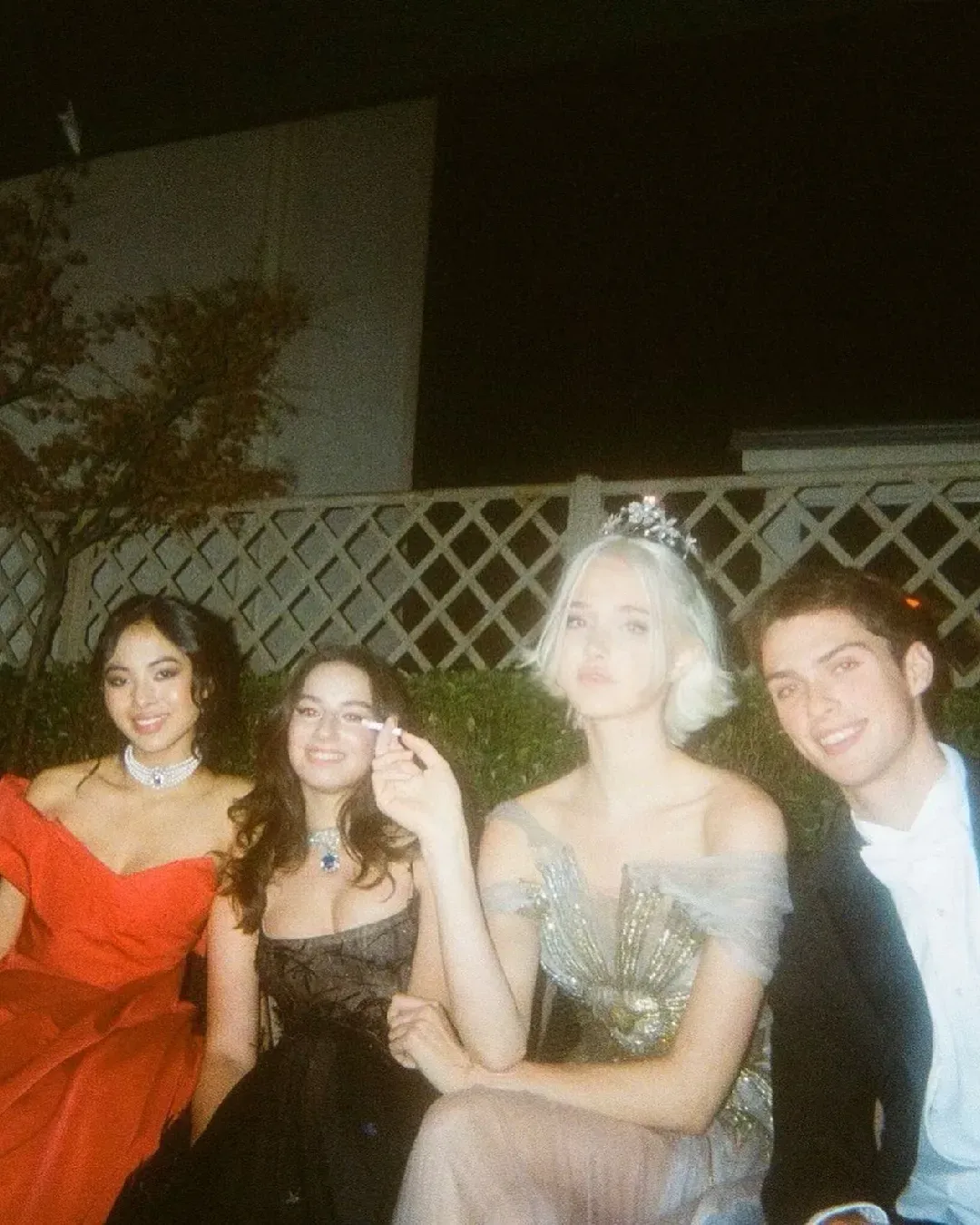
Understanding the success of blue-blooded influencers How princesses became the stars of fashion shows and brand collaborations, and why audiences love them so much
What are real princesses doing sitting next to celebrities and content creators in the front rows of Parisian fashion shows? Maria Chiara di Borbone delle Due Sicilie, a descendant of the dynasty that ruled southern Italy until 1861, photographed at Iris van Herpen; Alexandra of Hanover, daughter of Caroline of Monaco, a fixture at Chanel; Olympia of Greece, a habituée who moves from Dior to Bulgari, from Gucci to Tiffany. They are not the typical influencers with whom audiences love to identify — if anything, they are their exact opposite. And yet they work, and increasingly so.
The age of nepo babies
In an article titled The Rise of the Aristo-Influencer, journalist Milena Martins-Alexandre traced the phenomenon for Vogue Business, primarily from an industry perspective. The analysis goes like this: in luxury, where today anyone with enough money can buy the outward signals of status, the only form of prestige that remains structurally off the market is precisely the genealogical kind.
In the age of anti-elitism and the eat-the-rich attitude, these figures might seem controversial, but for the maisons — especially those operating in the jewellery sector, where much of what is sold doesn't even carry a signature and the appeal to the past has become a competitive lever — they offer a pretext for seeking proximity to the families that have embodied that status for generations. We see it at Dolce&Gabbana with Lady Kitty Spencer, Diana's niece; at Boodles with Lady Amelia Windsor at the Chelsea Flower Show; and in the capsule collection of embroidered clutches that Olympia Le-Tan designed together with Maria Chiara di Borbone, inspired by the Gulf of Naples and Sicilian folklore.
The logic, according to experts cited by Vogue Business, is one of association: aligning with a historic name transfers to the maison an aura that no advertising budget alone could buy. But there is an angle that analysis leaves out: why now? And above all, why precisely at a moment when the generation that should be consuming this content is, at the same time, declaring war on content itself?
The paradox of desired disconnection
your digital detox lasted 48 hours and you posted 14 stories about it, that's not a cleanse, that's content with extra steps
— zeroOne (@AI_MechE) July 22, 2026
Among Gen Z and younger Millennials, a growing intolerance for digital overexposure is circulating. It comes up everywhere: from the return of wired headphones, to social media detoxes framed as wellness achievements, to a rediscovered enthusiasm for analogue activities (physical books, photographic film, deliberately offline weekends). It is as though young people share a desire to escape the logic of perpetual visibility, to reclaim an intimacy that the algorithm has laid bare for everyone. Which sounds particularly paradoxical, given the growing obsession with people who do exactly the opposite — those who monetise precisely that everyday life apparently not designed to be watched.
Because, of course, the aristocrat who posts a video while arranging flowers in her family villa is not necessarily creating content in the traditional sense: she is simply living her life (the fact that this life happens to involve collaborating with luxury brands is another matter entirely). This is the illusion that makes the phenomenon so powerful, and it is also why it is profoundly contradictory: we are trying to step away from the screen by watching, through the screen, someone who seems not to be actively seeking our attention. As if The Truman Show had made peace with the audience's voracious voyeuristic tendencies.
Beyond the hunger for more real (and dissociated) content, the other reason why the lives of blue-bloods are so popular is that they somehow represent the last conceivable form of authenticity in an ecosystem that has exhausted every other kind. You cannot buy it, you cannot obtain it with a good media kit, you cannot learn it in a personal branding course: it is structurally unmatched, and for that reason it is the only thing that still feels real to us.
What remains to be invented
The aristo-influencer trend does not emerge from nowhere, of course. As people say online, nepo babies and the old money aesthetic (dominating Pinterest and TikTok with cashmere jumpers, pearls and family furs) walked so that aristocratic influencers could run. But nepo babies and the old money aesthetic share a structural limitation: both are, at bottom, imitable. Anyone can buy a beige jumper and call themselves quiet luxury, just as anyone can accuse a successful actor of riding on their parents' coattails — but that accusation still assumes the nepo baby is at least trying to compete, in appearance, on the same playing field as those without such advantages.
The aristo-influencer eliminates even these fictitious limits, replacing them with a more structural and irreplicable one: they need not win any competition, nor prove their talent. They simply need to exist, and their existence is certified by a family tree that becomes the sole credential of success they require. It is nepotism taken to its most honest conclusion — paradoxically harder to criticise using the same arguments levelled at actors who are children of actors. They do not claim to have "earned" their place, because they openly reclaim it as an inheritance.
What could come next? Assuming there is no rung higher than hereditary aristocracy as a guarantee of authenticity, it is hard to imagine an even more extreme trend emerging in the same direction. But an equal and opposite reaction, yes: the return — a genuine one this time — of radically ordinary content, devoid of any inherited symbolic capital, as the last remaining frontier of genuineness. The early signs are already visible in the emergence of "boring content" on social media. The question is whether this next wave will last longer than quiet luxury, or whether ordinariness, too, the moment it becomes a trend, immediately ceases to be one.
What does our fascination with a life different from our own really cost us?
Beneath all of this lies a dynamic older than social networks: the fascination with lifestyles we perceive as unattainable and, implicitly, better than our own. It is not an invention of Instagram — what changes is only the speed of access: once, you looked at a photograph in a magazine once a month; now you watch the same person brush their teeth in a Palladian villa in real time, with the feeling that you know them. According to Olivier Billon, founder of Ykone, aristo-influencers exist on the tension between dream and distance, and they work when they make the people who follow them dream without excluding them: they sell an imaginary world to an audience that knows it does not belong to that world, yet chooses to consume it anyway.
This simulated intimacy is what makes the phenomenon more insidious than its previous incarnations. We no longer admire a life from afar: we try to inhabit it vicariously. And the more we desire to step back from our hyperconnected lives, the more we seek refuge in the lives of others that appear less mediated than our own. Understanding the success of blue-blooded influencers therefore means understanding something more uncomfortable than a simple luxury marketing strategy: it means admitting that our exhaustion with being online does not stem from a genuine desire to leave, but from the desire to find, within that same screen, someone who seems never to have needed to enter it in the first place.
What to read next

Can Gen Z Really Get Rich with Vinted?
A new business model is emerging, tax-free and learnable through an online course
5 trends that Trainspotting anticipated Back in 1996
There is much more to the film than the famous Helmut Lang tank top