
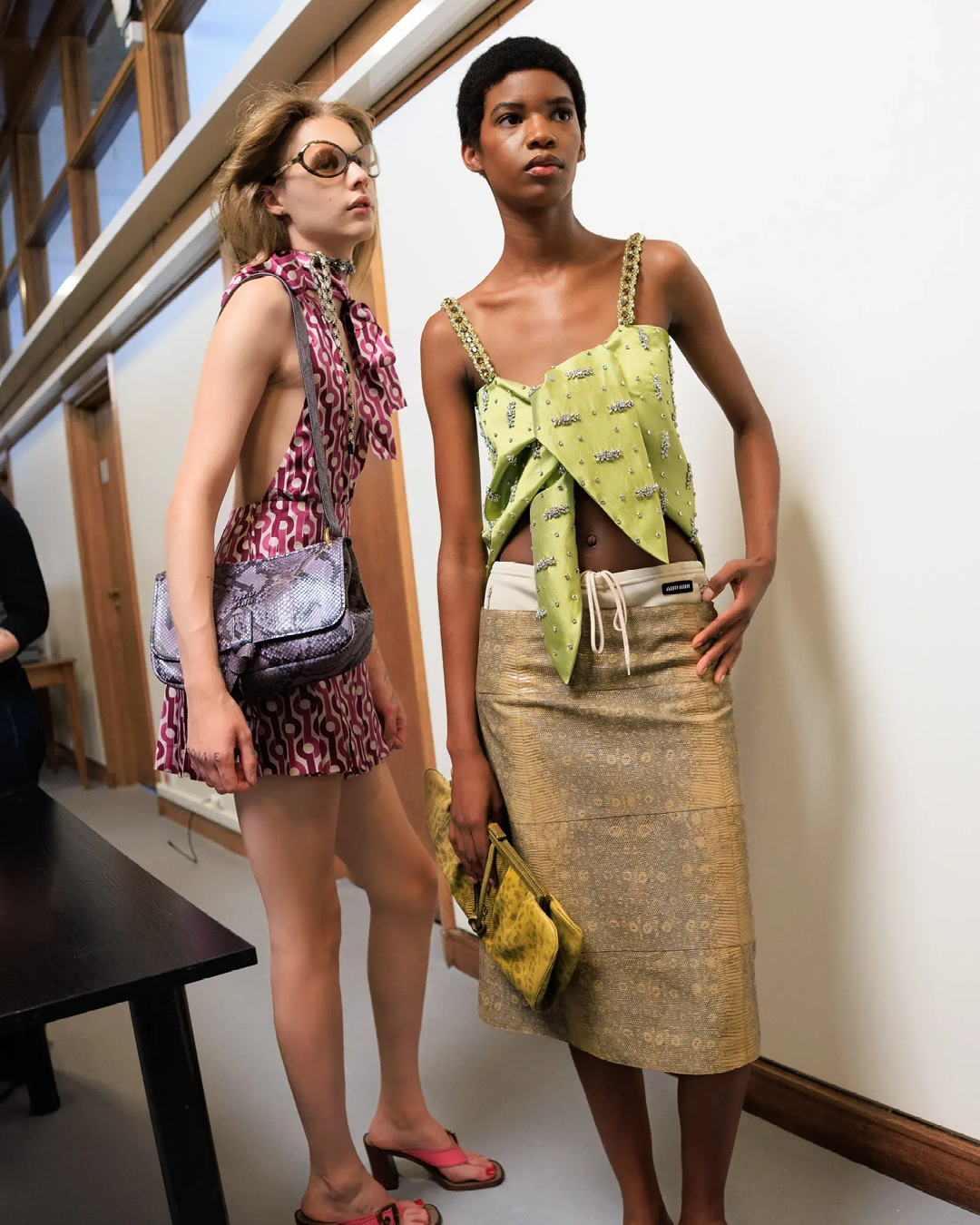
Miu Miu's commercial boom is coming to a halt The rest of the Prada Group, however, is holding up well
The results of the Prada Group for the third quarter of the year were released today, showing an organic revenue increase of 1%, matching the same growth rate as LVMH. The key point, however, is that this growth was driven by Prada itself, because after four years of uninterrupted success, Miu Miu recorded its first decline. Overall, though, in the first nine months of the year, consolidated revenues reached €4.54 billion, up 12% compared to the same period in 2024. Excluding Versace's contribution (€441 million) and at constant exchange rates, organic growth stands at 4%, in line with analyst expectations.
In terms of sales, Prada posted +1% for the quarter and +2% over the nine months, driven by strong performances in the Americas and the Asia-Pacific region (primarily China), with stability in Europe and Japan. Miu Miu, on the other hand, saw retail sales fall by 3%, bringing its 2026 growth so far to a modest +1%. To put the setback in perspective, last year the brand's sales had grown by 41% in the first nine months and by 29% in the third quarter alone. But which market is responsible for this slowdown?
The root of the problem
While both LVMH and Hermès have struggled due to spending in China and, more broadly, across Asia, Prada is not suffering particularly in that region: yes, sales in mainland China have dipped, but in South Korea, Hong Kong, and Macau (the latter two being duty-free destinations, meaning Chinese shoppers have likely simply redirected their purchases there), spending has remained stable — so much so that, overall, revenues in Asia rose 10% in the first nine months of the year. In Japan, growth at constant exchange rates was 5% (€424 million), although at current exchange rates a 6% contraction was recorded.
Despite its historically weak performance, sales in Europe grew 4% to reach €1.18 billion, while the real boom came from the Americas, where growth hit +29%. The real problem lies in the Middle East situation, where the group's retail sales collapsed by 23–25% in the first nine months of 2026, weighing heavily on Miu Miu in particular due to the sharp drop in tourist flows caused by the war engulfing the Gulf. Local consumption is keeping the region's business afloat, but the absence of wealthy tourists is being felt. And this, then, is the root of the problem.
And what about the future?
The real pivotal moment in the coming months will be Pieter Mulier's debut at Versace, which will take place next year alongside the full integration of Versace into the rest of the Group. Another significant investment by the group — already completed, but one that should prove highly beneficial going forward — is the Piancastagnaio production hub in Tuscany, dedicated to leather goods. Looking ahead, we can expect an expansion into hospitality, as the report highlighted the strong success of Prada Galleria in Milan and the opening of the Miu Miu lounge at Shanghai IFC.
Both CEO Guerra and Chairman Bertelli described, in their own words, a challenging quarter marked by volatile and complex conditions and the need for discipline. And there is no doubt that the difficulties Prada has faced are ones affecting the entire sector. On the whole, however, the results confirm the Prada Group's place among the "winners" of this quarter — a position that, unfortunately, not all luxury groups have managed to secure.
What to read next

5 Style Lessons We Can Learn from Jeff Goldblum
How to put together a look inspired by the iconic actor
Kartik Kumra is the second guest designer of Pitti Uomo 111
Indian craftsmanship and modernity come together for the next edition of the event
Fashion Graduate Italia presents “Speak Up”
A new edition dedicated to young future professionals in the fashion world