
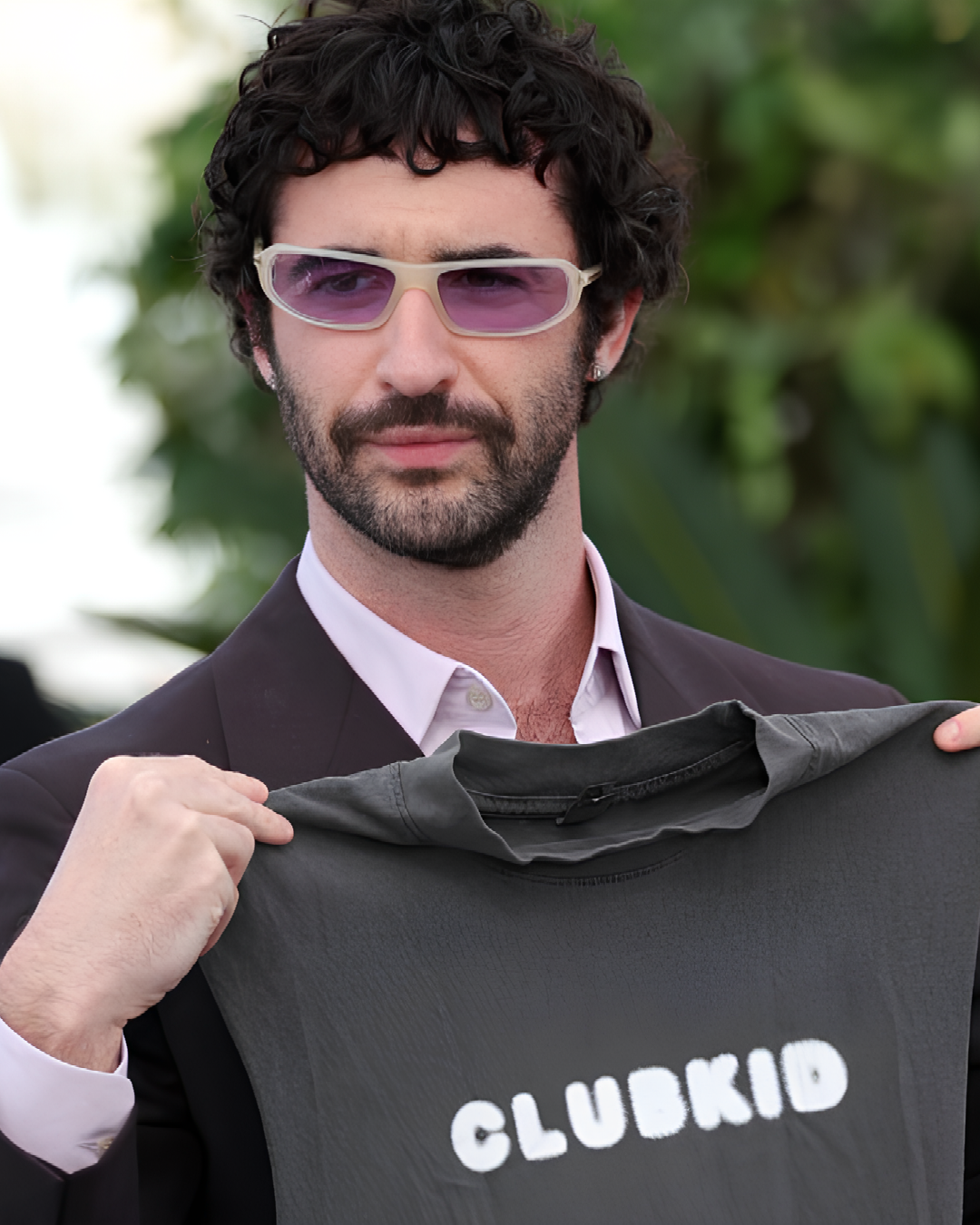
«Club Kid is a once-in-a-lifetime opportunity», interview with Jordan Firstman Everything about the directorial debut of the American actor and screenwriter
Club Kid is the feature directorial debut of Jordan Firstman. Five short films prior, an acting career and a few episodes written for television, with a debut at the Cannes Film Festival in the Un Certain Regard section and a fierce bidding war over the rights to the first feature (with A24 emerging victorious).
The story follows Peter, played by Firstman, a queer figure well known on the nightlife scene of the Big Apple, who discovers he has a son, British teenager Arlo (Reggie Absolom). For the protagonist, the news is shocking, but it can also be a beginning. A way to get his life in order, ease up on the drugs, and figure out what he wants from the future. A coming-of-age story set in adulthood, as the filmmaker describes Club Kid, and one of the most vital and tender films of the season, releasing in Italy on December 3rd.
How do you know when you've become an adult?
I don't think you ever really do. It's one of those unspoken truths of society, where everyone pretends to be an adult while trying to figure out what they're supposed to be doing, all the while thinking: "What is going on?" Some days I feel like a full-time thirty-year-old, other days only halfway there. Sometimes I'm someone who likes his life to be in order, other times not at all, or I simply don't see myself that way. I mean, sometimes my apartment is a mess, I can't manage to wash the dishes or put things away. Other days I feel at peace with who I am and what I do, I tell myself I'm working, I'm earning money, I'm doing everything I want to do. So I don't think there's a morning when you wake up and think: "I'm an adult." It's the small changes you notice in everyday life that make you realize you've grown up.
And when you're grown up, how do you balance responsibility with fun?
I think everything in life comes down to moderation, but I also believe that in a life worth living, you have to have fun. We're on this earth to enjoy good times, to laugh, to love, to savor all the wonderful things that come our way. You can do it all, just without going overboard or burning out too fast. You need to learn to keep yourself in check and listen to your body. I certainly never want to stop having fun, partly because fun isn't the opposite of seriousness. Though honestly, I'm not sure I even want to be serious.
There's a line in Club Kid that goes: "He's the why." It refers to Arlo, Peter's son, the reason the protagonist is trying to put the pieces of his life together. So what's the why behind this film? What drove you to make it?
Honestly, and this might sound a little presumptuous, I think I made Club Kid for myself. I chose myself, I bet on myself. Nobody asked me to make this film, truly nobody. There are production companies that commission projects from people, but in this case no one came looking for me, and no one asked me to write it. I had to believe in myself and in the story. And then see it through, because it wasn't easy, starting with the way I wanted to shoot it. I was after realism, real parties and real locations, but nobody wanted it shot at actual events. I had to push myself and stay convinced that I could pull it off. That the story mattered. In the end, I think that conviction is what got me through.
Another striking moment in Club Kid is when Peter opens up to Arlo and admits that he doesn't always like himself and that he struggles with self-esteem. How did you work that feeling into the film?
It's a special scene. Reggie, who plays Arlo, was so present, I could feel how sorry he felt for what I was saying. There's something moving about that moment. Peter is someone who doesn't know how to open up to others, he can't manage it. He carries a weight of emotions inside him that he never shares with anyone. Arlo is the first person with whom he experiences a sincere, authentic connection, and he understands this because Arlo has probably never felt that same kind of love either, especially not consistently. That's what makes the scene an exchange between equals.
It's a scene full of truth, as, in the end, is all of Club Kid. You almost feel like you know you after watching the film, like you've caught a glimpse of your personality.
Writing this way comes naturally to me, it's my creative process. I know it comes from a very personal place, but I also know it's the only way I can work. I know how to apply myself to it, and I know that I give a great deal of myself back to the world. That can make me vulnerable, which sometimes invites negative criticism, but other times allows me to be understood by others, even loved. It's like any relationship: the more open you are, the better the outcome; the more you hide, the more distance grows between you and the audience. So I decided to treat the viewer with as much honesty as possible, hoping they can accept me, both my good sides and my bad ones.
If you've put so much of yourself into Club Kid, and it's your first feature, what should we expect from your next project?
That's the question that keeps me up at night. I think this film is a once-in-a-lifetime opportunity. The way we shot it, the authentic footage that came out of it, the sense of community. There are so many things that can never be repeated. I'm eternally grateful for that, but I still feel I have a great deal more to say, especially from an artistic standpoint. I hope to find, once again, those things inside me that I can pour into my work.
The community you mention, and that we see in the film, has many dimensions, from queerness to generational bonds. Tying all of these aspects together is music. How did you use it in the film, and how much of a social glue is it for you?
It's like Madonna says: "music makes the people come together." Music really does bring people together. And, as much as I hate to admit it even to my fellow filmmakers, music holds far greater power for me than cinema. It's the most constant thing in my life, a fundamental part of it. I listen to music all day long, it shapes my mood and informs what I love and what I learn about life. It's a more direct way of accessing your emotions, even the deepest ones. Music is everything to me, and that's why I wanted it to be an element of sharing in the film, a bridge between Peter and Arlo that would allow them to understand each other, to reveal who they are to one another without having to put it into words. It's not always easy to have honest conversations with your family or your partner, but you can always send them a song to show them how you feel.
At the start we asked you when and what made you realize you'd become an adult. Club Kid is a way of discovering that together, for the protagonist and for the audience. Were there any films that helped you understand what it meant to be an adult? To be a person?
For a long time I was obsessed with I Am Sam. I've always loved crying at films, and that one triggered exactly the right reaction in me. In some ways I even see parallels with Club Kid, even though the issues it deals with are very different. Then, when I turned fifteen, Vicky Cristina Barcelona came out and I watched it practically every day for an entire year. It was the period when my parents were going through a divorce, and I felt a connection to it because it dealt with unfulfilling relationships. There's something about that film that made it essential to that chapter of my life, it hit me deeply. Watching it, I felt like I was growing up.
What to read next

"Cambogia" teaches actors that you have to care about your own characters
Valerio Lundini's directorial debut premiered at the Rome Film Festival
In "The Debut" Julianne Moore gives a masterclass in acting
The film, premiering at the Rome Film Fest, hits theaters on January 1, 2027
"Masterplan" is everything a heist movie shouldn't be
The film starring Stanley Tucci, Simona Tabasco and Victor Belmondo is available on Prime Video