
How much did the Milan protests cost local shops? With Via Montenapoleone on lockdown and sales lost, some estimates put "damages" at 4 million euros
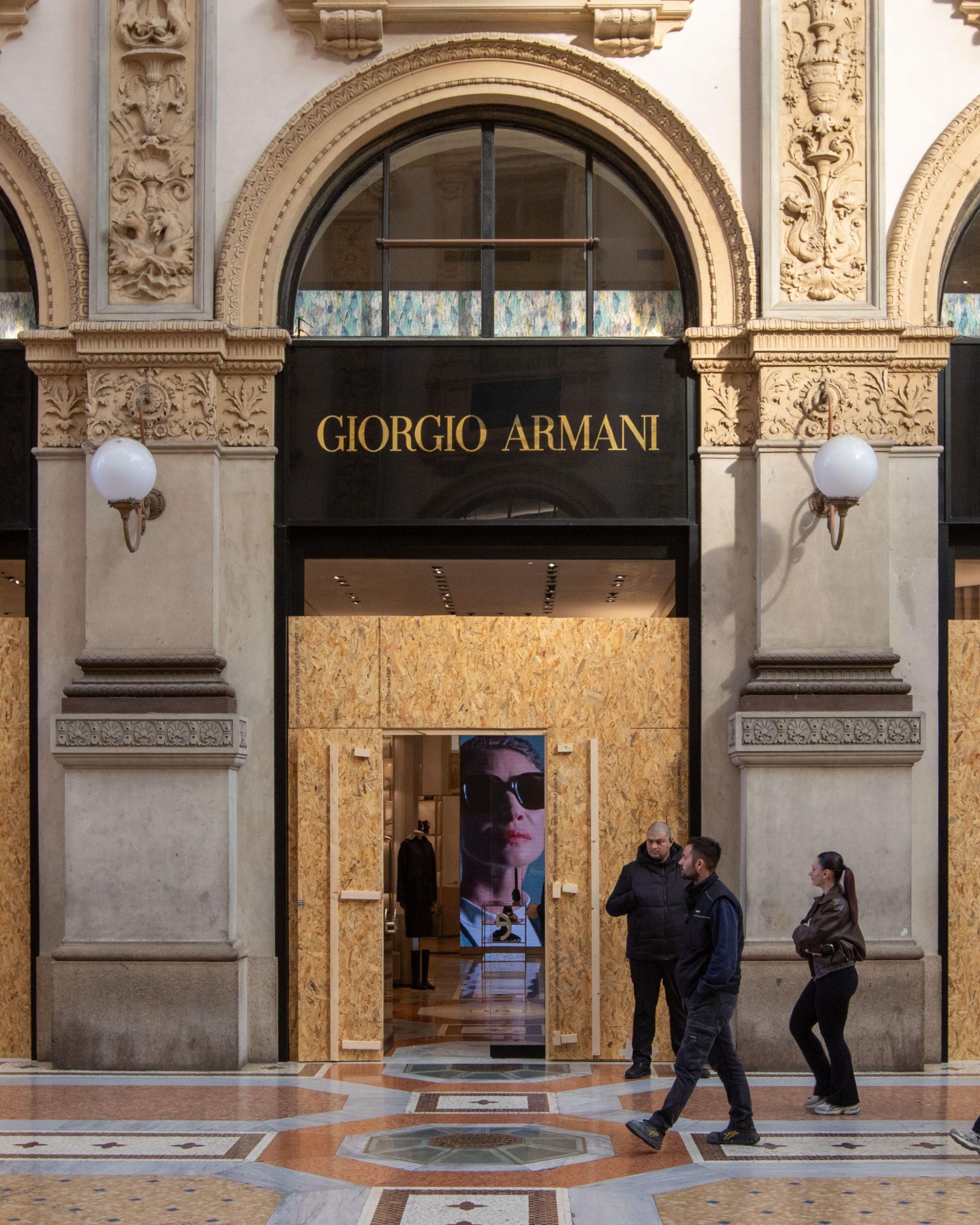
Last weekend, in Milan's Fashion Quadrilateral, fear was in the air. As early as Thursday evening, images had begun circulating of crews at work, busy covering the windows of Montenapoleone boutiques with chipboard panels, shutters pulled down, products hidden from view. All precautionary measures taken in the wake of the October 17th lootings (which did not, in any case, affect Montenapoleone), events that utterly shocked the Italian collective conscience. According to Confesercenti, however, last Saturday seven out of ten businesses remained open. But how much does it cost luxury brand boutiques to stay closed? And how many actually did close?
Shutters Down
Despite Milan mayor Giuseppe Sala's appeal to stay open, a great many luxury stores implemented a "self-imposed curfew" last weekend. As ANSA reports, in Milan Hermès, Chanel and Pomellato closed at two in the afternoon, La Rinascente at three, while Goyard and Apple did not open at all. Many others, especially the boutiques in the Galleria, remained open but "locked down", while stores belonging to younger-skewing brands such as The North Face, Footlocker and Orefici 11 kept their doors shut. It is safe to assume that last weekend was far from the best for sales.
At present, as reported by WWD, a single figure gives some measure of the economic damage in central Milan, though it relates to Saturday, October 17th, not the 24th. Marco Barbieri, secretary general of Confcommercio Milano, estimated the bill for the first weekend of clashes at over one million euros, between structural damage and lost revenue from early closures. In France, as BoF reports, an initial damage estimate stands at 1.5 million euros, and the Hermès boutique in Marseille will remain closed for the foreseeable future. For Saturday, October 24th, when Via Montenapoleone and the surrounding streets remained on lockdown without any serious incident occurring, no official estimate yet exists.
Saturday and then Sunday proved, in any case, calmer. No new lootings were recorded in Milan, where around 10,000 people demonstrated peacefully. Elsewhere the situation was more tense, with clashes in Turin, Bologna and Rome, where around 50 young people, among 4,000 protesters, briefly entered the Colosseum, and in Florence, where some individuals attempted to access Via Tornabuoni.
What Did It Really Cost?
According to Il Giorno, which in its Sunday edition focused specifically on the commercial impact of these closures, a study by Unimpresa is cited stating that «the cost of closures and the extraordinary measures adopted could generate a gross impact of over 14 million euros (11.76 million attributable to potentially lost sales and 2.37 million to the protective installations) across Italy's major cities». For Milan specifically, the figure cited is «approximately 4.05 million in lost revenue».
If we were to calculate how much a day of closed boutiques "costs" a brand on a weekend, we could start from available data on the average transaction value — that is, the value of a single average purchase in the area, not to be confused with daily takings. On the pages of Corriere, one Via Torino retailer said they expected to take in half their usual revenue. As Il Sole 24 Ore explained last March, in 2025 the average transaction value in the district reached €2,630, nearly three times the city-wide average of €990. The figure is based on Global Blue data on tax-free purchases by non-EU tourists. This average transaction value has in fact grown over the years: according to Il Giornale, in 2024 it stood at €2,525, meaning it is about 4% lower than today's figure.
Of course, we cannot know how many individual purchases were made or at what value. But knowing the average transaction price allows us to do some rough calculations. With an average transaction value of €2,630, if 100 purchases were missed, the lost revenue would amount to around €263,000. With 300 missed purchases it would rise to around €789,000, and with 500 it would exceed €1.3 million. Clearly, this only accounts for non-EU tourists claiming tax refunds, and therefore does not represent the entire customer base — but it certainly captures the largest single slice of the clientele.
Furthermore, a portion of the missed purchases may not be lost but simply deferred to other days. Finally, the estimate does not include the costs of boarding, staffing and security, which are added on top of lost revenue. The brands will in all likelihood never disclose how much keeping their shutters down actually cost them — but taking into account roughly half of fashion stores being closed for part or all of a day, and an average transaction value this high, it becomes clear that just a few hundred missed purchases can push the bill for a single "locked-down" day from several hundred thousand euros to well over a million.
What to read next

Calvin Klein has opened a Denim Kiosk in Piazza Castello in Milan
Here is what went down at the opening event
Data centers are invading our cities
The more demand for artificial intelligence grows, the more everything needed to make it work grows too
Salomon brings the race back to Milan
The September 2nd conference, between what remains of the Winter Games and an app for women to run alone safely