
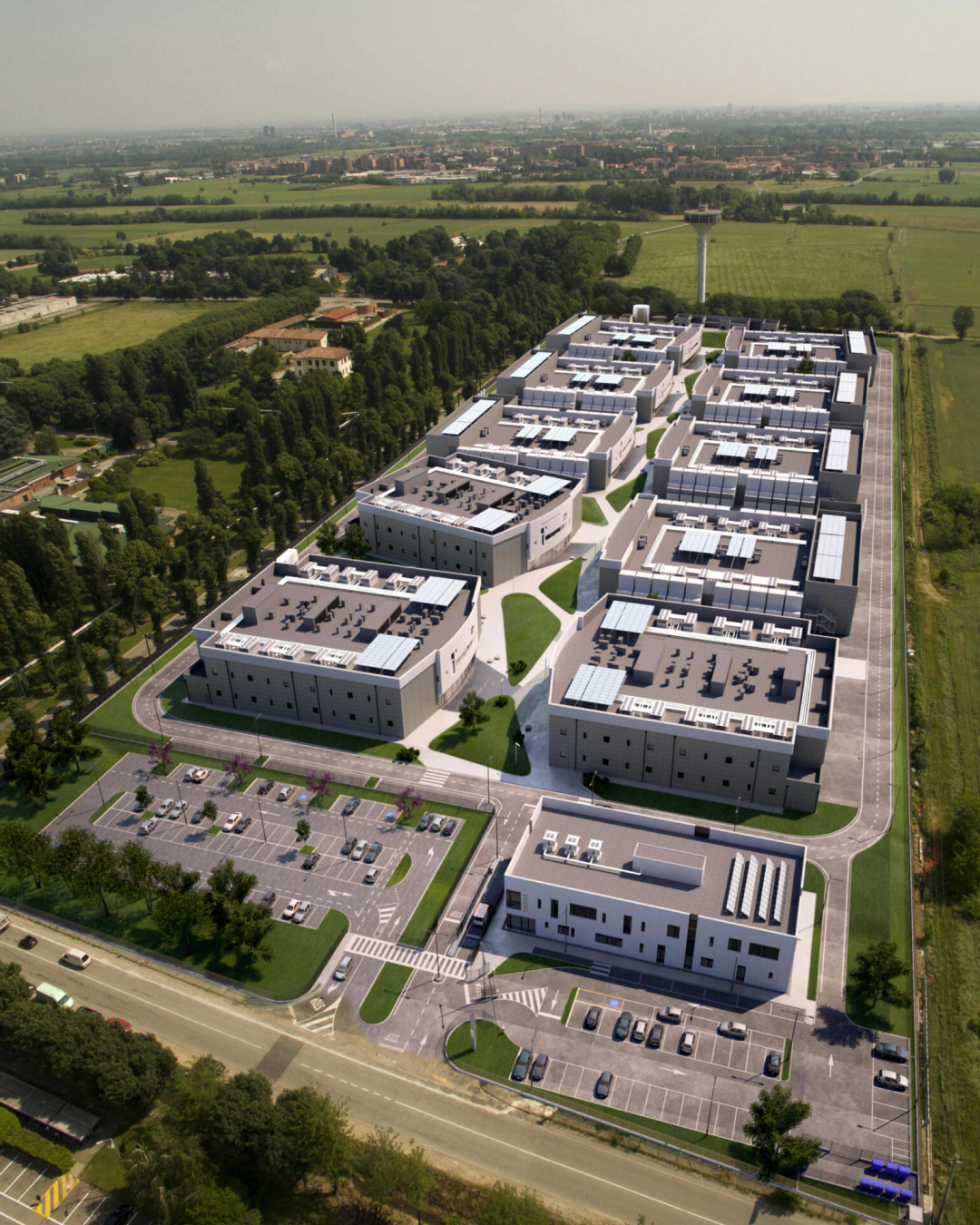
Data centers are invading our cities The more demand for artificial intelligence grows, the more everything needed to make it work grows too
Behind a simple request to the most popular chatbots lie enormous buildings packed with servers, miles of cables, cooling systems, electrical substations, and infrastructure that takes up an ever-growing amount of space. According to the International Energy Agency, by 2030 the global electricity consumption of data centers could exceed 945 TWh per year — more than Japan's current electricity consumption. AI will be the primary driver of this growth, and the servers used for new computing workloads are set to consume ever-increasing amounts of energy.
This infrastructure is also becoming an architectural and urban planning issue. Data centers require large surface areas, fiber connections, continuous access to electricity, and systems capable of dissipating enormous amounts of heat. The location of such a building therefore depends on the energy grid, available water, land, surrounding infrastructure, and the distance from the users it will serve. Elements that until a few years ago seemed to belong almost exclusively to the world of IT are beginning to make their way into cities' urban development plans.
Why Milan is becoming Italy's data center capital
Milan is already one of the best places to observe what is happening. A study by the Politecnico di Milano published in February catalogued 33 active data centers in the Metropolitan City, another 10 under construction, and 23 under evaluation. Those already in operation account for approximately 68% of the installed nominal capacity at the national level. New projects are also considerably larger than previous ones and are pushing toward the data center campus model — complexes made up of multiple buildings capable of reaching very high power outputs.
The impact is visible directly on the city map. In Rubattino, for example, a project is currently under review that designates an area of approximately 66,000 square meters for the construction of a data center. The City of Milan's plan calls for a large rectangular volume approximately 25 meters tall, along with the energy and access infrastructure required for its operation. Part of the transformation also involves public space and connections to Lambrate station. The data center thus becomes part of a broader urban project, alongside cycle paths, green spaces, mobility, and services.
The scale of these projects also inevitably raises questions about land use. In the same mapping exercise, the Politecnico identifies 13 data centers under construction or evaluation in the Milan area that are planned on land that is still permeable or agricultural: together they would cover approximately 120 hectares, the equivalent of around 160 football pitches. A significant portion of the projects make use of former industrial sites, but the largest facilities tend to require ever-greater surface areas.
How much land and energy do data centers consume?
A typical large data centre consumes approximately 20 to 50 megawatts of electricity continuously (equivalent to powering 20,000 to 50,000 average homes) while the largest hyperscale facilities operated by companies like Google and Microsoft consume over 500 megawatts each.
— World of Engineering (@engineers_feed) September 14, 2026
This…
Then there is the question of energy. In London, this relationship has already become an urban problem. In 2025, the London Assembly explained how the growth in electricity demand — driven in part by the heavy concentration of data centers in the west of the city — had contributed to saturating parts of the grid. In some areas of Hillingdon, Hounslow, and Ealing, the shortage of available capacity even slowed the connection of new homes. Housing and digital infrastructure thus end up competing, at least temporarily, for the same resource.
Cooling raises another issue. Servers generate heat continuously, and keeping them at the correct temperature requires systems that can use energy and water in very different quantities depending on the technology, the climate, and the location where they are installed. A study by Lawrence Berkeley National Laboratory found enormous differences in the water consumption of data center workloads, demonstrating how the choice of server, cooling system, and even local electricity grid can change the overall footprint of the same digital operation.
Location therefore becomes part of the design. Where to build, how much energy to use, how to cool the machines, what to do with the heat produced, and which land to occupy are decisions that now involve local authorities, urban planners, designers, and citizens.
Europe wants to build ever more data centers for artificial intelligence
Europe is accelerating in precisely this direction. With the Cloud and AI Development Act, presented in June, the Commission aims to at least triple Europe's data center capacity over the next five to seven years. Key elements of the proposal include faster procedures for building new facilities and improved access to energy, land, and water. In parallel, the EU is developing AI Gigafactories — infrastructure designed to bring together more than 100,000 advanced processors and train next-generation models.
In Lombardy, the phenomenon is already large enough to have prompted specific legislation. Regional Law 11/2026, passed in June, governs the construction and expansion of data centers and introduces criteria relating to land consumption, water resources, the redevelopment of disused areas, energy efficiency, and heat reuse. In August, the Region also defined new settlement and energy-environmental priorities for future projects. The issue has officially entered the realm of territorial planning.
The heat produced by servers could become one of the most interesting aspects of this new architecture. In Finland, Fortum and Microsoft are integrating two large data centers with the district heating network of the Espoo, Kauniainen, and Kirkkonummi area. The project aims to recover the heat generated by the servers and use it to heat buildings and domestic water; at full capacity it could cover approximately 40% of the area's district heating demand. The first heat production infrastructure came online in May 2026.
How AI data centers are changing cities
@ground.level.livin Turn your volume up. This is what some people say it sounds like to live next to a large AI data center—day and night. In Dowagiac, Michigan, residents sued after alleging a nearby data center operated continuously with noise levels reaching around 78 decibels outside their homes. According to the lawsuit, instead of addressing the noise, the company offered to buy some homeowners' properties. One family says they've lived on that street for nearly 100 years. And it's not the only community raising concerns. In Wisconsin, Microsoft is facing a proposed class-action lawsuit over noise from a data center that nearby residents say can be heard from more than a mile away. In Northern Virginia, where one of the world's largest concentrations of data centers is located, many facilities are built close to residential neighborhoods, prompting ongoing debates about noise, land use, and quality of life. The conversation around AI infrastructure is often focused on jobs and economic growth. But for many communities, the discussion also includes 24/7 industrial noise, increased energy demand, water consumption for cooling, diesel backup generators, and the long-term impacts of living next to this type of development. From water concerns in Oregon, Georgia, and California to utility costs in Louisiana, and now noise complaints in Michigan and Wisconsin, more communities are asking the same question: Should neighborhoods bear these impacts so the rest of us can use AI? #DataCenters #ArtificialIntelligence #AI #Michigan #NoisePollution original sound - Ground Level Living
This is a possibility that also changes the way we think about these buildings. A data center can become a component of an urban energy system, occupy a disused industrial area, supply its heat to the surrounding neighborhood, and share certain infrastructure with the local territory. The quality of the design will increasingly depend on these relationships. For years, the architecture of technology remained almost invisible. We watched smartphones get smaller and smaller, computers grow thinner, and digital services faster, while the buildings needed to support them grew progressively larger — and AI is accelerating this divergence.
In the years ahead, part of its growth will pass through buildings tens of meters tall, new substations, hundreds of hectares of land, and energy networks designed around computing power. In Milan, the process has already begun. Artificial intelligence is therefore entering cities even before it becomes visible in robots, transportation, or smart buildings. It is doing so through the infrastructure required for it to exist. And it may be precisely that infrastructure — far quieter and far less spectacular — that proves to be one of the architectures that will most profoundly reshape the landscape of the coming years.