
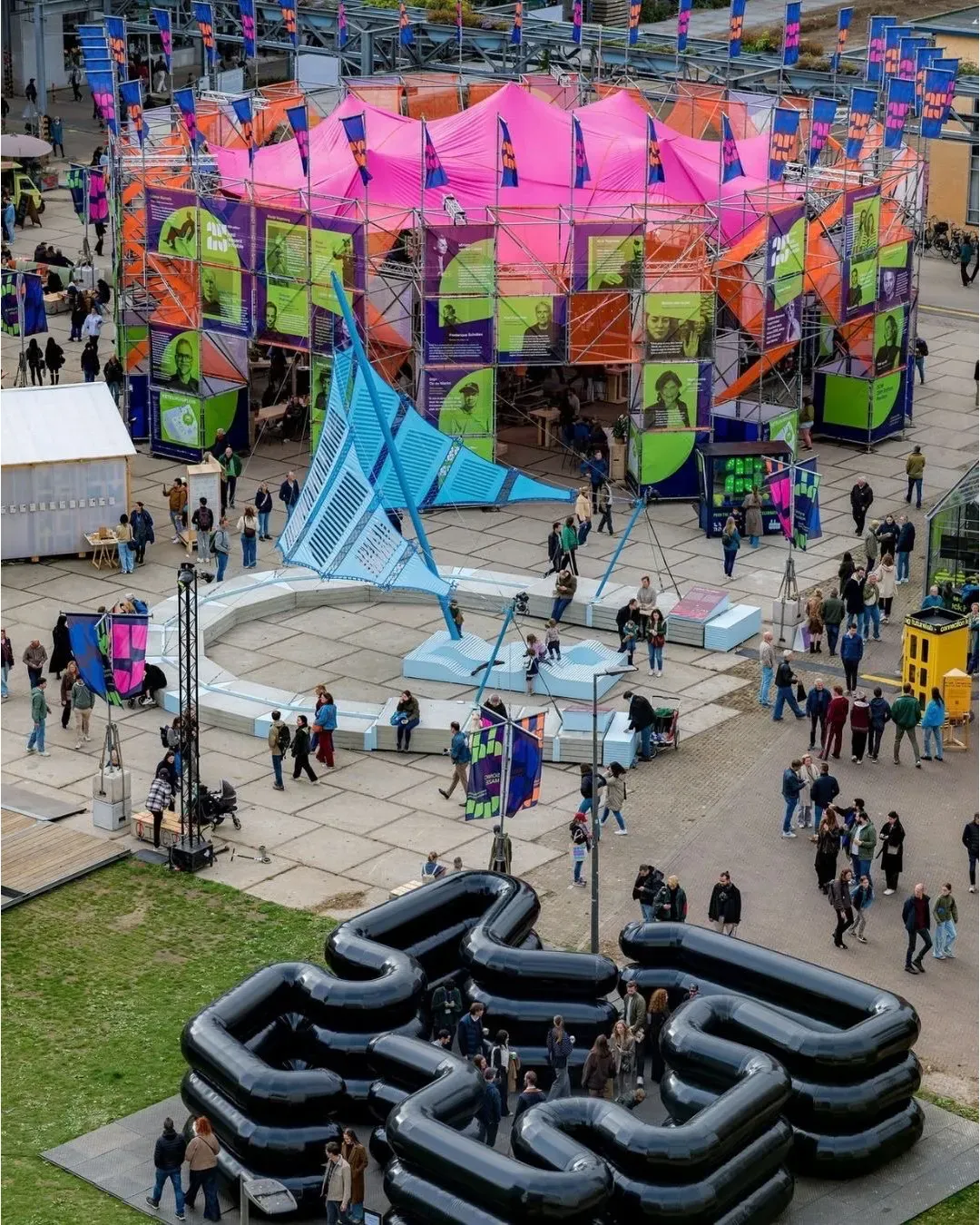
What can Milan learn from Dutch Design Week? R.A.W. has just wrapped up, marking a new edition of the design week in Eindhoven
The Dutch Design Week wrapped up this week, after nine days during which Eindhoven did something that, viewed from Milan, seems almost strange: it filled the city with design without worrying about whether everything looked ready to be sold.
The theme chosen for 2026 was R.A.W., an acronym for Rebel Authentic Worth, and the organisation openly stated its intention to place at the centre what is still raw, experimental and unfinished.
The numbers
The numbers remain those of a major international event. The 2026 edition brought together around 2,500 designers across a hundred venues scattered throughout Eindhoven, with an expected turnout of approximately 350,000 visitors. But it is above all what is on show that makes the DDW different. The official programme featured projects related to artificial intelligence, privacy, biodesign, new materials, energy and experimental textiles, alongside things that are much harder to define as simple "products." Some seem almost like questions transformed into objects.
Mees Boeijen's transparent.citizen, for instance, turned the designer's daily life into an experiment on AI-driven surveillance. Emma van der Leest's Biodesign Warehouse gathered biological applications attempting to move beyond a purely experimental dimension, while TAM Industries' House of Lights showcased a façade printed as a single element in recycled plastic, designed to be recycled again.
This becomes even clearer in the Graduation Show of the Design Academy Eindhoven, with more than 200 Bachelor and Master projects presented during the Design Week. Objects, films, performances, interactive systems, research into materials and behaviours coexist without any obligation to look like the prototype of the next lamp destined for production.
Eindhoven vs Milan
Milan Design Week 2026 moved enormous numbers: the Fuorisalone recorded over 1,300 events and more than 500,000 visitors, while the Salone del Mobile welcomed 316,342 visitors from 167 countries, with more than 1,900 exhibitors. It would be fairly absurd to ask the Salone to stop doing what it does best. Part of the story of Italian design was born precisely from the ability to bring designers and industry together, turning an idea into something that can be produced thousands of times over. The problem arises when this logic spills out of the fair and begins to occupy almost the entire week.
During Design Week, Milan becomes an attention machine. A room must become a post, an installation must draw a queue, a brand must have something to launch, and every space seems to need to justify its presence by generating images. On nss we had already reported how the 2026 edition had felt more measured compared to previous years, with fewer loud activations and a more evident return to the product. But the difference with Eindhoven remains.
Milan tends to show us the finished result. At the Dutch Design Week, on the other hand, what can be most interesting is precisely what has not yet found a definitive form. The organisation itself describes how some projects return across multiple editions, allowing the public to follow their evolution.
This does not mean Milan does not engage in research. SaloneSatellite in 2026 hosted over 700 under-35 designers and students from 39 countries, with projects working on regenerated materials, craftsmanship, new technologies and the circular economy. Outside the fair, there are also schools, collectives, galleries, Alcova and dozens of organisations that experiment continuously. In Eindhoven, however, this dimension seems to sit at the heart of the event's identity, whereas in Milan it must coexist with a far larger industrial and commercial machine.
The history of the two cities probably plays a role as well. Eindhoven grew up around Philips' technology industry and continues to exist within an ecosystem where research, universities, companies and design are in constant contact. Milan, by contrast, built a system capable of transforming design into industry, communication and a global market. These are two different forces, and it would not make much sense to declare which is superior.
The beauty of the ugly
Milan does not need to become Eindhoven, because it would lose an enormous part of what makes it central to the world of design — but it could afford to create a few more spaces where a project does not have to arrive already polished and Instagram-ready. Where something can be shown that perhaps does not work yet, has no market, or will look completely different in two years' time. Making room for an ugly object — incomplete or still without a clear function — can be a countercultural gesture.
Perhaps a Design Week should serve this purpose too. Not only to show us which chairs we will be buying next year, but to let us see ideas that today seem strange, useless or unresolved, and that in ten years' time might become entirely normal.
What to read next

How much did the Milan protests cost local shops?
With Via Montenapoleone on lockdown and sales lost, some estimates put "damages" at 4 million euros
Calvin Klein has opened a Denim Kiosk in Piazza Castello in Milan
Here is what went down at the opening event
Data centers are invading our cities
The more demand for artificial intelligence grows, the more everything needed to make it work grows too