























Are sneaker collaborations making us dream again? When fashion goes in search of accessibility
Some trends don't die — they reinvent themselves. The sneaker collaboration is one of them. When it exploded ten years ago alongside the streetwear phenomenon, the collaborative sneaker was simply great business: its announcement generated hype, it was built on pre-existing shoe models that simplified the design process, and the mark-up was staggering. Minimum investment, maximum return. The problem was that over the years the footwear industry took advantage of it: between daily releases, far-fetched collaborations, and reseller bots that made the market inaccessible, the phenomenon collapsed. The Nike x Tiffany collaboration was the last straw. But this year, at Paris Fashion Week, sneaker collaborations came roaring back, driven by a wide range of different brands.
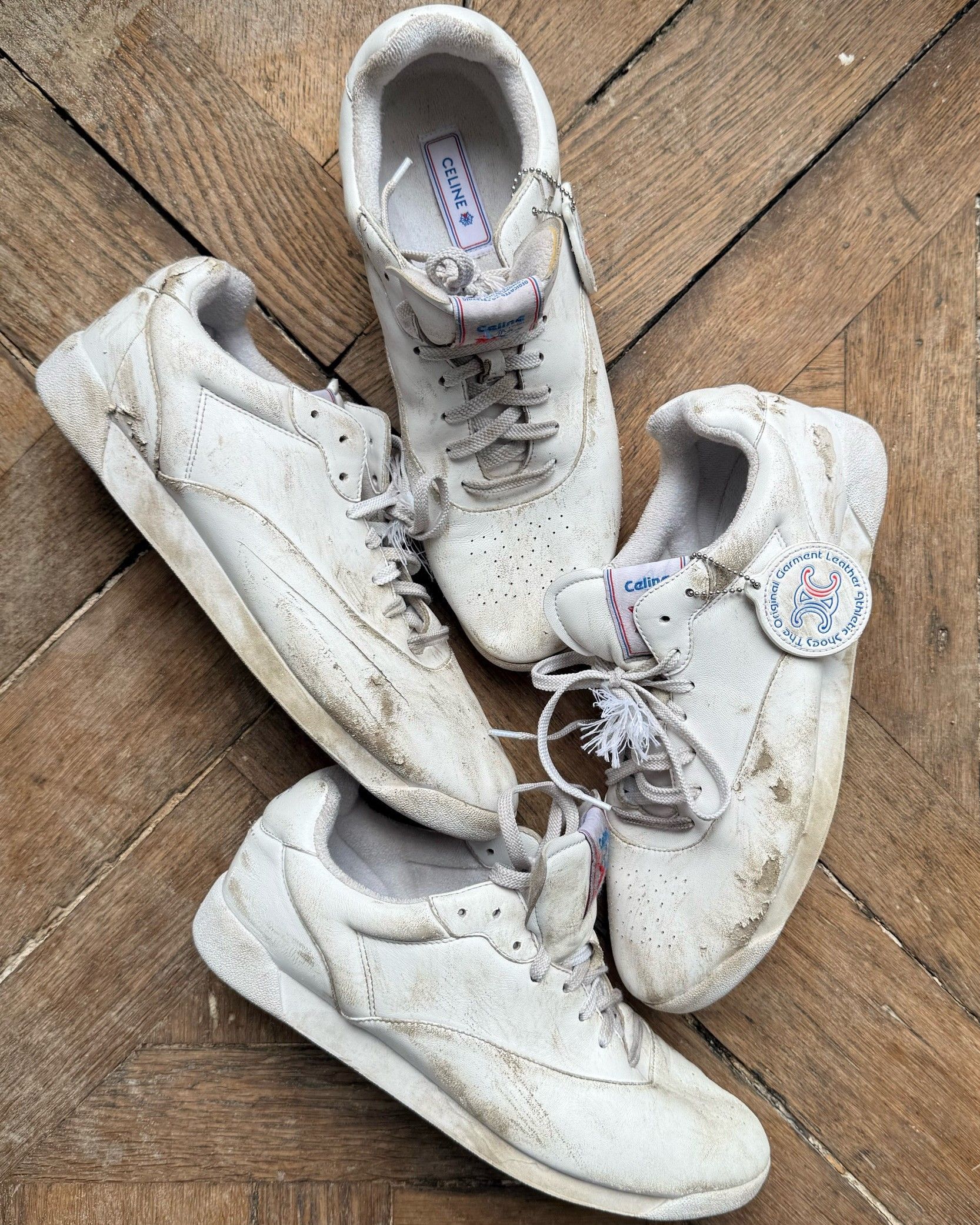
The one that stole the spotlight from everyone was Celine x Reebok, presented in a distressed version. But we also had sacai x Birkenstock, Rick Owens x adidas, Kenzo x Paraboot, Nahmias x Puma, Mowalola x Air Jordan, and Auralee x New Balance, while Willy Chavarria presented not one but two: one on the runway with UGG and another, worn by himself for the final bow, continuing his ongoing collaboration with adidas. Meanwhile, this year has seen — or will see — the releases of Versace x Onitsuka Tiger, JW Anderson x Diadora, Vans with Undercover and 424 — following the collab with DSM Kei Ninomiya presented at Pitti — and Salomon with MM6 Maison Margiela and A-COLD-WALL. So what's going on?
A business operating under the radar
One couldn't say the sneaker collaboration business has disappeared. It has rather sunk out of sight, continuing with what are presumably large volumes — though lower than in the past — and with the celebrity-collaborator business, which includes names like Bad Bunny, Travis Scott, Pharrell, JJJOUND, and J Balvin. All releases that make news within that specific market without actually breaking out of it. At the same time, brands like Nike or Vans are producing more avant-garde models — square-toed Air Force 1s or Bottega Veneta-style woven Vans — to attract, beyond NBA fans or other sports niches, fashion insiders looking for everyday shoes with a "special" edge.
A different conversation applies to luxury sneaker collaborations, which have instead become perhaps rarer but by no means absent. Miu Miu x New Balance, Vans x Valentino, Wales Bonner x adidas, and Loewe x On are all collaborations from recent years that have been widely copied, yet they have not colonised the market and the general conversation with the same forcefulness as Nike x Off-White in the days of Virgil Abloh. The last ones to have a true runway debut, moreover, were the Miu Miu and Valentino collaborations. In the case of the Miu Miu and New Balance link-up — the most ongoing of the bunch — the schedule of presentations and releases has unfolded in parallel with the shows but without overlapping.
This menswear season, however, the desire seems to be the opposite: to optimise media and public attention around the shows, to incorporate more balanced collaborations into the brand ecosystem, and to build anticipation for the inevitable sale. There is no question that a collaboration works better than producing one's own sneaker: beyond the immense success of Dries Van Noten's, both the Valentino sneakers presented for FW26 and the Dior Ribbon shoes that returned to the runway for SS27 were met with a shrug. But why this two-track approach?
Visibility, accessibility, availability
@ludwiglvkas Celine x Reebok freestyle #fashiontiktok #sneakers #streetwear original sound - Lukas Ludwig
The news of the Celine x Reebok collaboration was, objectively, the most talked-about story of the entire week. It helped that the brand helmed by Michael Rider is currently a fashion darling, unanimously loved by audiences and critics alike, with a singular sensibility applied to both the presentation and the product itself. But the exciting part of this collaboration, beyond the purely marketing-related data, is that now, to achieve that nonchalant-yet-chic Celine look, you can wear a Reebok Freestyle. Even better if it's completely beaten up. The power of this notion lies in its ability to make the brand's world symbolically accessible.
And accessibility does seem to be the key to this flowering of sneaker collaborations seen in recent days. Now that luxury brands cost what they cost — which is to say, too much — and the unwritten rules of fashion impose an absolute veto and a terrible anathema on lowering prices that have already been raised, collaborating with a more "popular" brand on a sneaker means putting a product on the market that is still expensive but nonetheless more open to the aspirational customer — the one who today has fled after years of wild, unjustified price hikes. Even an ultra-indie brand like Rier has collaborated with Salomon to break out of its bubble.
Another important thing to note is how all these collaborations are very, very low-key: minimal, logo-free, focused on silhouette and materials and an if-you-know-you-know vibe. Even Rick Owens' adidas boots, in their extreme deconstruction, come across as understated in their own way, while the new Louis Vuitton sneaker that "remakes" Vans in a luxury key — prompting Vans itself to comment on Pharrell's post — is indeed made of crocodile leather but remains relatively simple in its conception. In short, the only effect being sought on the viewer is the impulse to buy: these need to be easily "digestible" products, far removed from the visual noise of certain viral collaborations of the past.
But will they succeed in their aim?
The Miu Miu x New Balance dainty sneaker/double lace combo trickle down effect. Two years & going strong. pic.twitter.com/ZUqv8VAlIZ
— Jordo (@veryADVANCED) May 19, 2026
Whatever anyone says, in the world outside the fashion bubble sneakers remain one of the top spending categories for customers of all ages and all price points. The fact that Jil Sander x Puma, released last October, costs half the price of Jil Sander's in-house sneaker says it all: the aspirational customer who cannot buy a €890 shoe can certainly spend €430 without a second thought, without disrupting the brand's price homeostasis. At the same time, Miu Miu x New Balance costs at least €100–200 more than the brand's other in-house sneaker models, which might even suggest that the strategy is to price the collaboration so high as to nudge customers toward buying the self-produced sneakers instead.
A brand like JW Anderson, on the other hand, doesn't even have in-house sneakers: the shoes it produces are all considerably more expensive, even when it comes to flip-flops, while the collaborative sneakers are the most "normally" priced items available in its store. Versace, meanwhile, which has a more varied sneaker price mix, has positioned its Onitsuka Tiger collaboration in an intermediate spot within its price range — which makes sense for a very limited edition that has already sold out.
In general, the price of all these collaborations is relatively more accessible when compared to the average across the rest of the footwear offering, even if it is clear that, when a collaboration is a one-off, the sales boost will only be momentary — whereas strong in-house sneakers like those of Dries Van Noten or even Maison Margiela are the classic "gift that keeps on giving." The interesting point is a symbolic one: could this boom in sneaker collaborations be ushering in an era in which fashion extends an olive branch to its customers? Stepping down from one's pedestal is, after all, much easier in a pair of sneakers.