.gif 2000w)
























That time Barack Obama wore a beige suit And sent the United States into a meltdown
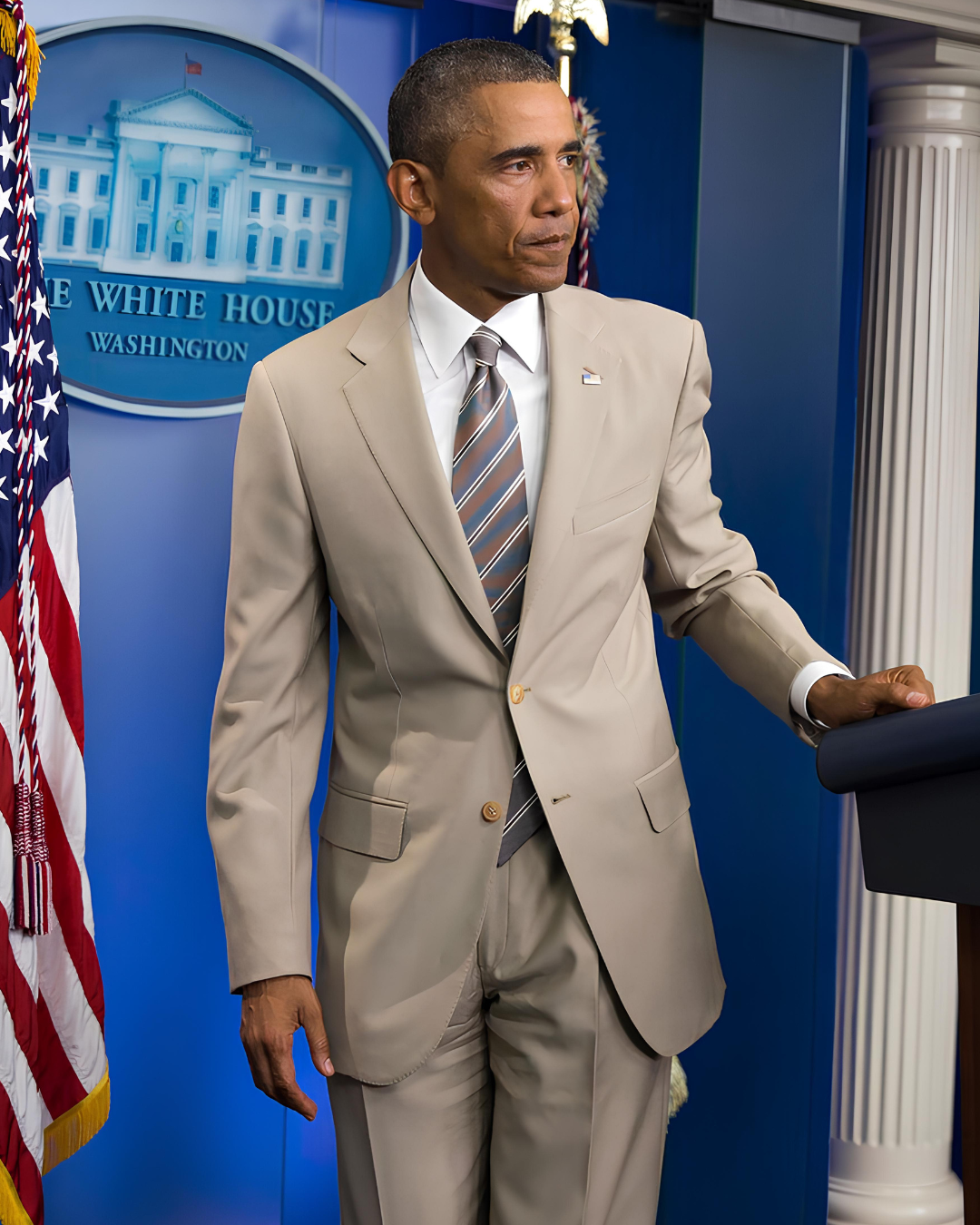
An American president can declare wars, sign healthcare reforms, negotiate nuclear treaties: what he apparently absolutely cannot do is wear beige. Barack Obama discovered this on August 28, 2014, when he appeared in the White House press room in Washington to discuss the Syrian crisis. The only thing America wanted to talk about from that meeting was his suit.
On the 65th birthday of the former American president, it seems fitting to recall that episode.
The Beige of Discord
That Thursday in late August, very little of Obama's words about a possible American military response to the Islamic State survived in the public debate. What monopolized the headlines was the light-colored suit, in a shade halfway between beige and khaki with a classic cut, worn with a white shirt and a striped tie in a matching tone — a novelty for a president who had made sobriety his trademark. In six years at the White House, dark blue had been practically the only option permitted in his official wardrobe. Never mind that in Washington, lighter colors were considered a summer custom.
It must be said that, in part, the controversy surrounding the suit had some basis in reason: it was perhaps not the happiest choice for the occasion, nor for announcing a possible military campaign against terrorism. The shade of the suit created a contrast that was rather difficult to ignore, since the public expected a grave register from such a speech, starting with the suit being worn. The context, in short, worked somewhat against him. Nevertheless, the reaction far exceeded the offense. For Republican congressman Peter King, appearing dressed that way was downright unworthy of the office such a color, he argued, was inadmissible in the eyes of the world.
On Twitter, the hashtag #YesWeTan exploded a wordplay inserting the offending color into "Yes We Can," the slogan that had accompanied Obama's first presidential run and become the symbol of his promise of change. Dedicated accounts were also created for the suit, such as @BarackTanSuit, which tweeted jokes in the first person as if the suit itself were speaking, though it was short-lived and suspended just days after the press conference. Journalists, commentators, and comedians renamed the episode by playing on the title of Obama's most famous book, transforming The Audacity of Hope into The Audacity of Taupe.
In Defense of the Tan Suit
@kkxsperr_ Bro had everyone pressed over a suit Twicith: kasperr556 #foryoupage #fypシ゚viral #fypシ #iknowimugly #fyppppppppppppppppppppppp original sound - speblack
In the face of the criticism raining down on the suit, the White House intervened officially, and the day after the press conference, spokesman Josh Earnest assured the press room that the president felt perfectly comfortable with the choice he had made. Designer Joseph Abboud came to his defense as well he had already made several suits for Obama and defended a president's right not to dress the same way every single day. In the days that followed, several media outlets pointed out that light-colored suits at the White House were nothing new: Franklin D. Roosevelt often wore white in summer, more than one president over the decades had been photographed in tan, and Obama himself had already worn that very suit without incident.
In short, the real defendant was perhaps not the suit itself, but rather the occasion for which it had been chosen. It is also worth remembering that late August is the dead season of American news the so-called silly season a limbo in which newsrooms desperately search for something to report. In any other week, the tan suit would probably have gone unnoticed, but that particular week it became the only story available.
From Political Controversy to Collective Ritual
How it started. How it's going.
— Barack Obama (@BarackObama) August 28, 2024
Ten years later, and it's still a good look! https://t.co/NKXRGNgJPv pic.twitter.com/KeI1gn7HSg
Over the years, the tan suit has completely changed its role. During the Trump presidency, critics of the tycoon cited it as a benchmark: if a color had been enough to trigger days of outrage under Obama, why did far more serious violations of political norms generate less uproar? In 2021, during the very week of Obama's sixtieth birthday, Joe Biden appeared at a press conference in a beige suit, and everyone read it as an ironic tribute to the former president.
In 2024, Kamala Harris opened the Democratic convention in a tan suit, while Obama celebrated the tenth anniversary of the episode by posting his outfit alongside Harris's on social media. Perhaps it was a questionable style choice, perhaps the reaction was truly excessive, but twelve years on it hardly matters: revisiting it today feels almost like a privilege the privilege of returning, if only for a day, to a time when a simple beige suit could occupy front pages around the world for weeks on end.