


























In 2026, we like pop stars a little more when they're not American What happens when globalization no longer runs through the United States?
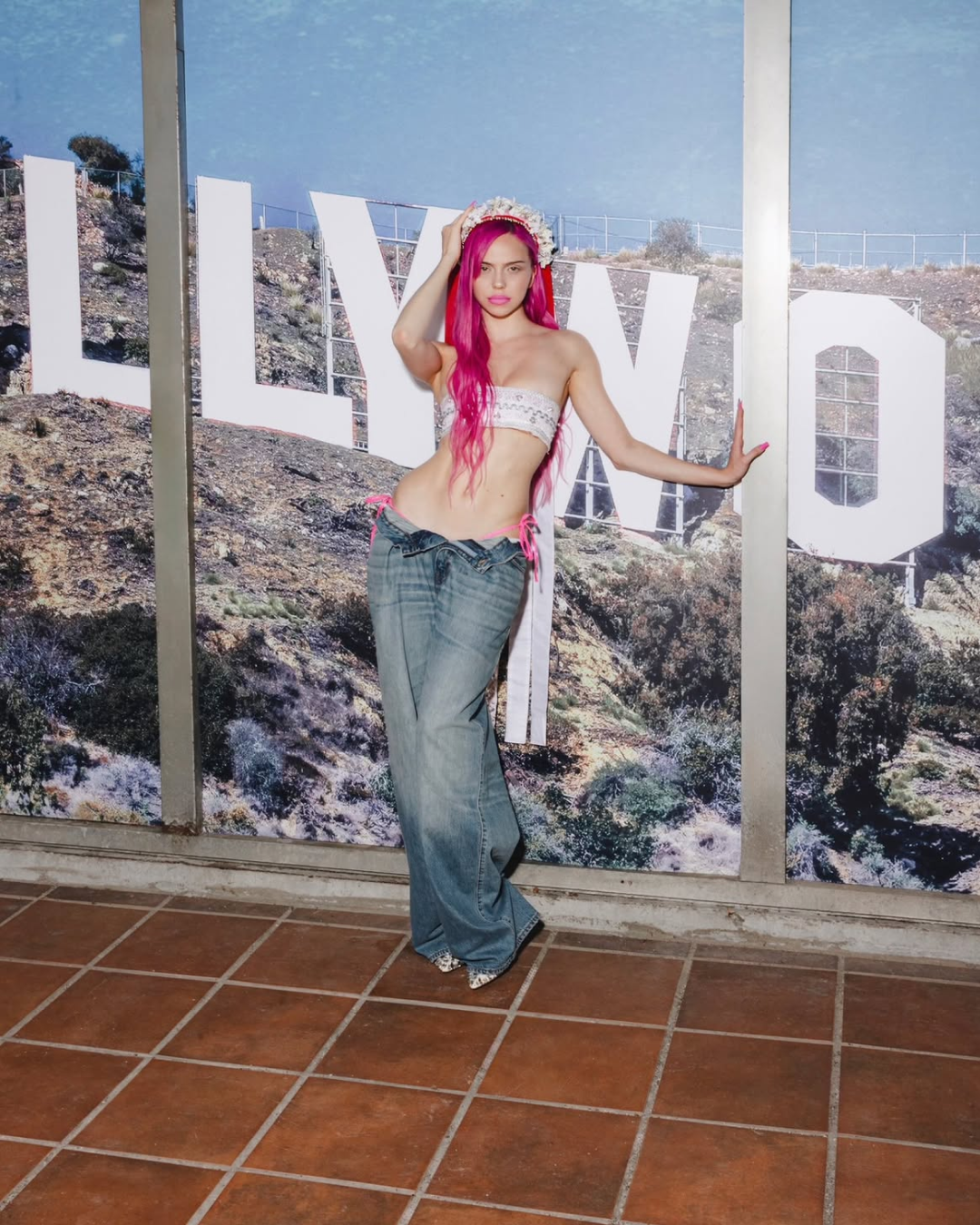
A fuchsia poster, with writing that looks like it was made with a marker, reads: «the baddest bitches are in Bratislava». Ain't in LA by Adéla was the anthem of the summer, not because it was a particularly fitting soundtrack for the hottest season, as is often the case with earworms, but because it reminded millions of young people around the world that success no longer necessarily requires chasing the American dream. In fact, today it might be far better to walk away from it.
The case of Adéla — a new Slovak pop star who, before singing the praises of her hometown, still had to move to Los Angeles — is not an isolated one. It fits into a broader shift running through the music industry. Bad Bunny, Zara Larsson, Lisa, Katseye: some of the names that have defined the pop of 2026 have little to do with the traditional idea of the American pop star. And, more importantly, they don't seem particularly interested in fitting that mold.
Bad Bunny and the end of American-style global pop
GOD BLESS AMERICA #SuperBowl pic.twitter.com/XZLqBYo8p0
— introvert (@introvertsmemes) February 9, 2026
Until not so long ago, the most obvious path for an international pop star ran through the United States. You had to sing in English, move to Los Angeles, sign with an American major label, and make your origins universal enough not to be an obstacle. There was even a word to describe the moment a non-American artist finally made it: crossover.
The crossover, however, presupposed the existence of two clearly distinct sides. On one side was the local market; on the other, the American market, which by extension became the global one. Shakira could be a massive star in Latin America, but her transformation into a worldwide pop star was certified by Laundry Service, an album recorded predominantly in English. In 2026, by contrast, there is Bad Bunny, who in February became the protagonist of the apotheosis of American culture — the Super Bowl — bringing to the stage a show that was deeply Puerto Rican and predominantly in Spanish. Six months later, that same halftime show won seven Emmys, including Outstanding Variety Special (Live), putting the artist halfway along his path toward an EGOT.
Lisa's success tells the story of a new globalization of pop
The first great cultural globalization worked primarily in a one-directional way, from the center to the periphery. The rest of the world watched American sitcoms, listened to American pop, and learned, in the process, to desire a certain version of American life. In 2026, however, the movement seems far harder to trace. Just look at Lisa: a Thai artist becomes famous through Blackpink, a Korean group, builds a solo career in the United States, and uses that same platform to export images of her own country to tens of millions of people.
Her new single, SaWaDiKa — named after the Thai greeting — racked up approximately 70.8 million views in its first 24 hours, marking the most-watched music debut of the year on YouTube. But more interesting than the number is what those millions of people actually watched. Nan Nist, Lisa's stylist, recently shared on Instagram the sketches of the outfits worn by the superstar in the music video, revealing how carefully each look was built around precise cultural references: the wild orchid, one of the country's symbolic flowers, engravings from the baht, Thailand's currency, the colors of tuk-tuks, and the Muay Thai uniform are just some of the inspirations that helped construct the video's visual world.
Where is the center of global pop?
#KATSEYE: the global it girls representating all sorts of different nationalities and races are coming to take over the WORLD. pic.twitter.com/PXPnGtVFD1
— KATSEYE DEBUT (@katseyye) November 22, 2023
Then there is the case of Zara Larsson. Here too we are talking about a European artist — Swedish, to be precise — who in 2026 managed to build a truly global success without the United States necessarily being its center. Larsson is certainly not a new pop star; her first hit, Lush Life, is over ten years old, and Sweden has been exporting pop music long before TikTok existed. But in this career renaissance that has taken shape over the course of the year, Larsson has managed to sell out shows in cities far apart from one another, taking the same show from Europe to São Paulo and all the way to Bangkok.
Katseye perhaps represent the next stage of this transformation, because in their case looking for a geographical center becomes almost pointless. The group was created by HYBE and Geffen Records by combining the training system developed by the Korean industry with the distribution power of an American major label. The members, in turn, come from different cultural backgrounds. In August, their second EP, WILD, debuted at number one on the Billboard 200 with 170,000 equivalent units in the United States. But calling them simply an American girl band would be almost as reductive as calling them K-pop. Katseye were built from the outset so that neither definition would be sufficient. The product is international from the start — it is Puerto Rican-Cuban, Indian, Filipino, Korean, Swiss-Ghanaian, and Chinese.
The crisis of American soft power runs through pop music too
It is no coincidence that this is happening in 2026, a historical moment in which America seems to be having a harder time selling itself. According to the Global Soft Power Index 2026 by Brand Finance, the United States remains the country with the strongest soft power in the world, but recorded the largest decline among all 193 countries analyzed: 4.6 points in a single year. America's reputation dropped eleven places, while China surpassed the United States for the first time on the reputation metric itself.
This does not mean that American cultural hegemony has suddenly come to an end. In the same index, the United States remains first in the world for influence, familiarity, and arts and entertainment. It is precisely this contradiction that is interesting: we continue to consume an enormous amount of culture through American infrastructure while seeming to be less drawn to America as an idea. After all, Adéla releases music on Capitol Records, Lisa on RCA, Katseye are a project half-owned by Geffen, Bad Bunny is distributed by Rimas — yet their success still flows through global charts.
Even this new geography of pop risks quickly becoming a formula, because if local identity drives engagement, the industry will find a way to package it, optimize it, and repeat it until it is hollowed out. Not everything that appears culturally specific is automatically more authentic, just as not everything that is global is necessarily more inclusive. Rather than a reverse globalization, then, this is perhaps a globalization that has simply stopped having a clear direction. It is no longer just the world becoming a little more American. We have all become a little Korean, a little Puerto Rican, a little Thai, a little Swedish — and, of course, still very much American.