




















5 Bad Bunny Looks with a Hidden Meaning How the Hero from Puerto Rico Is Changing Fashion
Bad Bunny is the phenomenon of the moment. Not only for his music or for the DeBÍ TiRAR MáS FOToS World Tour, which sold out in minutes and became a global event capable of drawing in celebrities, politicians, and even Pope Leo XIV, but also for his ability to turn every public appearance into a personal aesthetic manifesto. The success of Benito Antonio Martínez Ocasio is built not only on collaborations with prestigious fashion houses or accessible brands, from Schiaparelli to Zara, by way of Jacquemus , but on the way he uses fashion as an extension of his own artistic language.
Every look becomes a piece of a larger narrative that speaks of Puerto Rico, identity, belonging, and memory. While his choices may appear to be flawless marketing strategies, they never come across as devoid of meaning. For Bad Bunny, fashion is not mere styling, but a political and cultural tool capable of reflecting the very same themes that run through his music.
Here, then, are 5 Bad Bunny looks with a hidden meaning.
Zara x Bad Bunny - "BENITO ANTONIO"
The collaboration with Zara, created alongside his longtime creative director Janthony Oliveras, is arguably the most personal "fashion project" Bad Bunny has ever put his name to. The BENITO ANTONIO capsule, comprising around 150 pieces, blends tailoring, oversized essentials, and references to Puerto Rican aesthetics. What truly stands out, however, is the campaign. Benito appears alone on the open sea, on a small raft built from the very garments in the collection: shirts become sails, clothes become shelter. It is not the story of a hero returning home, but of a man who carries home within himself.
It is the same idea that runs through DeBÍ TiRAR MáS FOToS, with an element as debated as it is meaningful - the casita - which represents not merely a dwelling, but an emotional place, a symbol of one's roots. A concept that takes on even greater weight in an album that denounces the gentrification of Puerto Rico, the consequences of American colonialism, and the island's progressive loss of identity. In this collaboration, fashion becomes an archive of memory. The clothes do not simply convey a style, they safeguard a culture, and the baggage Benito carries with him contains not garments, but Puerto Rico.
The 2026 Super Bowl Halftime Show
The first Latin artist to headline the Super Bowl Halftime Show did not simply bring Latin music to America's most-watched stage, he transformed the performance into a cultural and political declaration. The entire show was built around the world of DeBÍ TiRAR MáS FOToS, an album that celebrates Puerto Rico through salsa, plena, bomba, and reggaeton, making room for local musicians and asserting the importance of the Spanish language. The symbol of the casita also returned to the stage, having become a metaphor for a homeland that continues to exist even when one is forced to leave it.
The looks, developed with his creative team and a preview of the subsequent Zara collaboration, were garments designed to tell the story of a community. At a historical moment marked by tensions around immigration and a heated debate over Latino identity in the United States, Bad Bunny chose to turn fashion into a tool of cultural resistance, placing Puerto Rico at the center of the country's most-watched television event.
The full Zara look at the 2026 Met Gala
For the 2026 Met Gala, Bad Bunny surprised everyone by appearing as a future version of himself. The prosthetic aging, created by makeup artist Mike Marino, accompanied a custom black tuxedo co-designed with Zara rather than a luxury fashion house. The look engaged with the evening's theme through an oversized bow inspired by Charles James's iconic Bustle dress of 1947, held in the Costume Institute. But the real message lay elsewhere.
Choosing Zara on fashion's most exclusive red carpet means calling into question the idea that creativity belongs exclusively to luxury. Bad Bunny thus continues his dialogue with Inditex, demonstrating that the value of a garment does not depend solely on its price, but on the story it tells. It is a form of democratization of fashion and an invitation to remember that talent and identity matter more than the label sewn inside the jacket.
Schiaparelli Haute Couture FW26
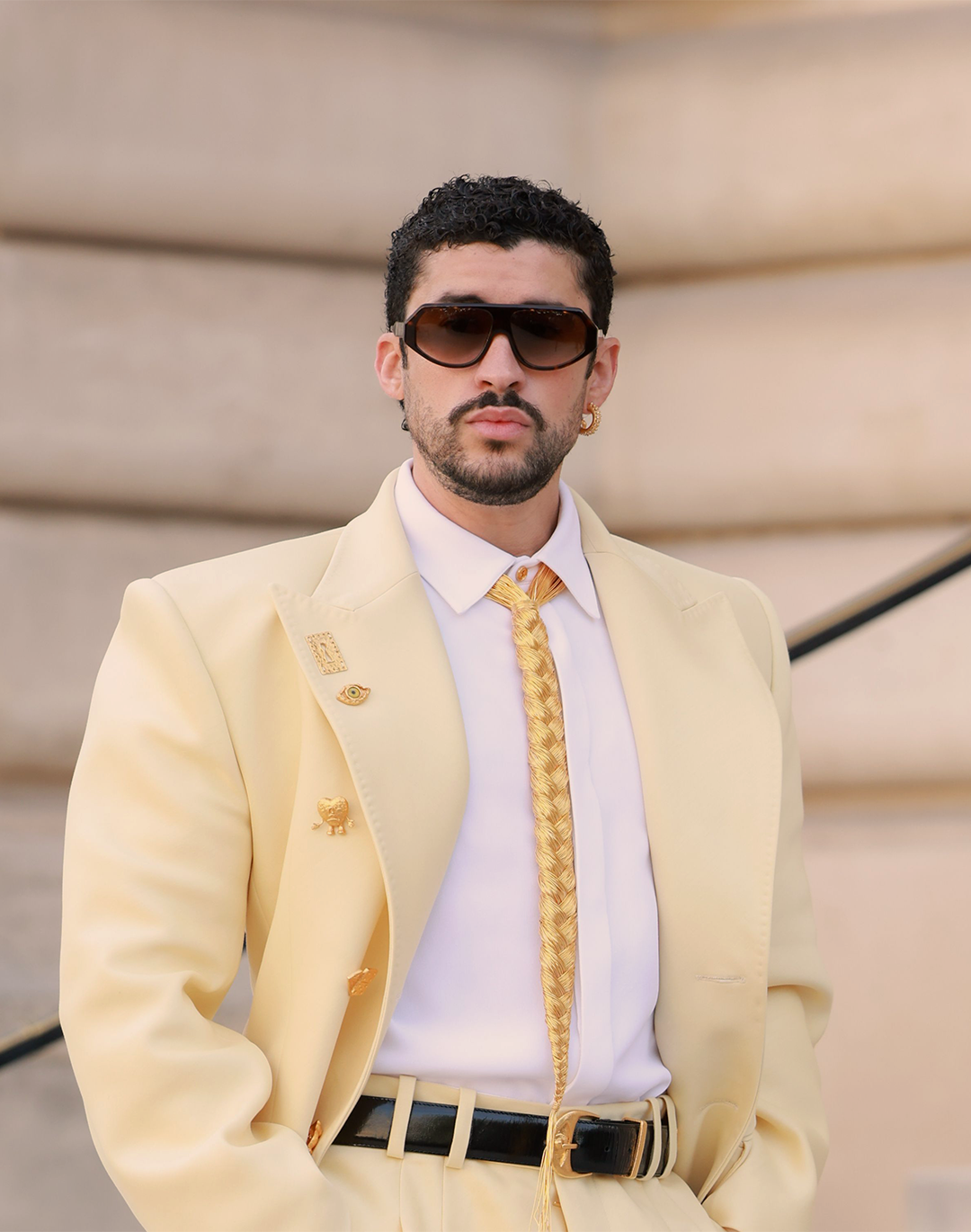
At the Schiaparelli Haute Couture FW26 show, Bad Bunny wore a butter-colored double-breasted suit by Daniel Roseberry, elevated by a spectacular braided golden tie. The accessory echoes one of the house's most surrealist ideas: the celebrated hair tie introduced in the FW24 ready-to-wear collection. In the version worn by Benito, however, the provocation takes on a different meaning: a thread binding past and present, memory and future.
On the jacket's lapel appear pins drawn from his own imagery and origins: the frog from DeBÍ TiRAR MáS FOToS, the broken heart from Un Verano Sin Ti, and other symbols belonging to the house. A dialogue between Schiaparelli's surrealist universe and the singer's autobiographical one. Once again, the look is not constructed to astonish, but to tell a story.
Bad Bunny x Jacquemus - "Les Sculptures"
The relationship between Jacquemus and Bad Bunny is by now a creative partnership that has taken shape on multiple occasions. In the Les Sculptures campaign by Jacquemus, produced for the SS24 collection, Benito is photographed as a classical statue, motionless on plinths reminiscent of a museum. The message goes beyond Simon Porte Jacquemus's minimalist aesthetic. The rigorous, architectural silhouettes engage with the singer's body, transforming him into a living work of art. The Puerto Rican artist, often far removed from traditional masculine stereotypes, thus becomes the symbol of a new idea of beauty — more fluid, more sensitive, and less bound by conventional codes. It is no coincidence that Jacquemus continues to choose him as the face of the brand. Both share a vision in which fashion serves not merely to dress, but to express identity, vulnerability, and creative freedom.