






















The flight of European models to Asia, explained Behind the scenes of the market explained by those who know it best
There are countless stereotypes and assumptions surrounding the modeling profession. In the collective imagination, models are impossibly beautiful, extremely tall, magnetic figures living miles away from us mere mortals under 180 cm. Adelaide Mati, whom we met over a videocall from Tokyo, is indeed a model, but her title comes with an asterisk: she is 162 cm tall, and much closer to the rest of us than the stereotype suggests.
Among all clichés, one reigns supreme: the idea that modeling is easy, almost a natural gift bestowed on those born with long legs and perfect symmetry, a job requiring no effort, no preparation, no commitment. “People assume that short models have it easier, when in reality the measurements are even more restrictive. You have to be even more proportionate to look good on camera,” explains Mati, a petite model and content creator who stumbled into this career almost by accident.
In 2021 she did a collaborative shoot — a simple test shoot — with an amateur photographer and discovered she had a natural presence on camera. Despite agencies repeatedly rejecting her because of her height, Mati refused to give up and eventually made it. “I thought: if a model is well proportioned, and if curvy models are now embraced, why can’t shorter models prove they belong in front of the lens? I may be short, and I’m the first to say that runway proportions matter: seeing a 1.80 m model followed by a 1.58 m one isn’t exactly harmonious. But there are plenty of jobs where height doesn’t make a difference.” Today, Adelaide Mati works in Japan, where height is not an issue.
Living and working as a model in Japan
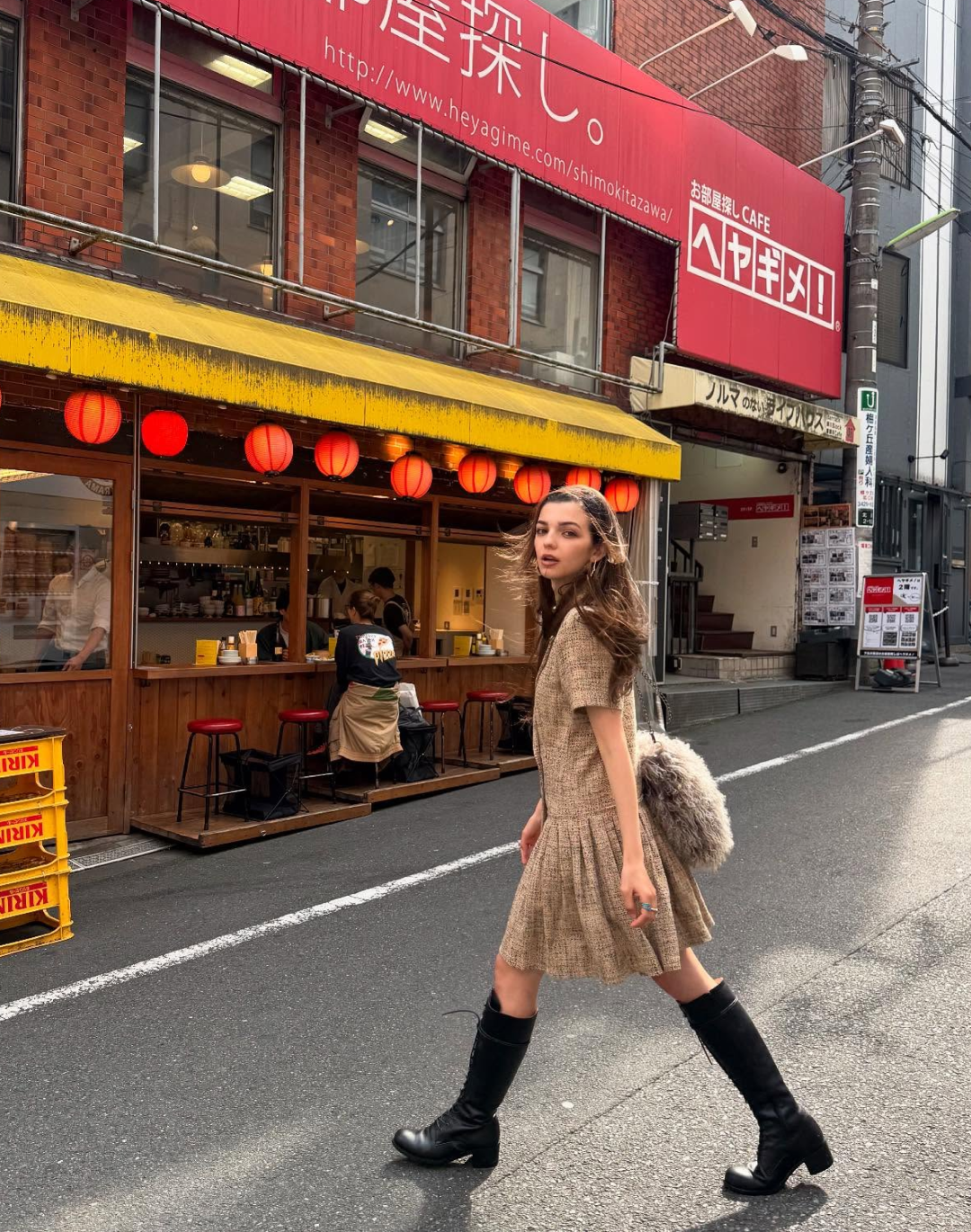
What is life like for an Italian petite model in Tokyo? According to Adelaide Mati, most of her bookings involve e-commerce, lookbooks and photo shoots for beauty and lingerie brands. “I’ve often done castings for major international brands because they say outfits look better on shorter models. In Japan, tall models struggle because trousers end up too short, so brands prefer slightly shorter profiles.” Her words suggest that in the Land of the Rising Sun, modeling is taken very seriously — far from being some effortless gift from above.
Mati’s story is particularly successful. With a tight-knit digital community, she shares her daily life in Tokyo on TikTok and Instagram, offering insights into her job and her style with a genuine and transparent tone that breaks down the distance between models and audiences. This approach led her to launch Artemisia Magazine, an editorial project designed to bridge Japan and Italy. “I wanted to show that we can still be curious, informed, and enjoy reading — even if my generation isn’t very into print. We can scroll for fun but also read meaningful content.” She adds: “There’s a huge fascination with Japan in Italy, but it still feels distant — partly because it’s not easy to travel here, and partly because there is so much art, yet very little of it is discussed in Europe. Japan is much bigger than what Europeans think they know.”
Asia as Europe’s new modelling hub
@vakulann Taiwan wait for me!! Babushka clothes mommy is coming back soon #model #modeling #fashionweek #milanfashionweek #parisfashionweek While her experience is unique, Mati is far from an isolated case. In recent years we have seen a constant flow of European talent moving to Asia, to the point that during the last Milan Fashion Week many models joked about an impending “mass migration.” Mati explains: “Even if the currency isn’t ideal, there are so many brands here, which means endless lookbooks and e-commerce shoots. In Italy I see clients hiring non-professional models without paying them rather than booking through agencies. Here, brands still work with agencies as the norm. Plus people still buy a lot of designer clothing. There’s budget because clients actually purchase.”
Donald Braho, Head of Men’s Division at Wonderwall Management, gives us a clearer picture of the attractiveness of Asian markets. “It’s not a new phenomenon. Models have been working in Asia for years, first mainly in China and now increasingly in Korea and Japan, which have become extremely strong markets. Korea in particular is booming thanks to emerging designers supported by public and private funds. Contracts are seasonal (from one to three months) and provide safer conditions: flights covered, drivers, accommodation, advances. And beyond the money, models here build their image, their book and their professional development.”
The scenario emerging from their accounts is far from positive for Italy. In Milan competition is extreme — as shown by endless casting queues and overcrowded model houses — while job opportunities fluctuate, concentrated around Fashion Weeks and followed by long dead periods. Two dynamics that make it almost impossible for models to live off their work. “Companies book models in quantity rather than quality. Many told me the same thing: in Milan you’re just another face easily replaced by the next girl. Here in Japan they also rotate models, but there are far fewer of us at castings, so we have better chances. And most importantly, you can build a life with loyal clients. In Europe many models end up quitting because they face absurd rents without stable work,” says Mati.
Rates in Italy are among the lowest compared to Paris, New York or emerging Asian markets. Braho confirms this, adding that in Italy “talking about pay is almost a social taboo: those who speak up risk exposing the privileges of those who have earned money for years off others’ backs. This mentality affects fashion too. There is transparency within agencies and casting teams, but rates remain low. The real issue is systemic: unless modeling is legally recognised and protected, the Italian market will keep losing ground.”
Here lies the rotten core of Italy’s modeling system: the job of being a model is not legally recognised as a profession, causing bureaucratic issues and a total lack of protections. “In France you need a state license to work during Fashion Week: the state protects the market. In Milan it’s a ‘bloodbath’, where international agencies enter and take market shares that should belong to Italian agencies. There are no rules, and this affects wages,” Braho adds.
Economic power, fashion capitals and the role of model agencies
And the situation is even more complex than it appears. The exodus from Milan is not only a result of competition or lack of regulation, but also of a profound shift in the economic dynamics of modelling across the major fashion capitals. “Paris remains one of the strongest markets: high rates, solid clients and legislation that protects workers. London, after Brexit, has lost much of its weight and many agencies have shifted toward influencers and content creators or editorial work. Milan is unstable: highs and lows caused by constant creative director changes and overall uncertainty.” Today, power is once again consolidating in Paris, while Milan and London lose ground, and New York — affected by tariffs and internal crisis — no longer holds the dominance it once had. Meanwhile, Asia keeps expanding.
Speaking of influencers, Braho has a clear view on social media and digital-first models. The decline in model fees stems largely from a Milanese attitude that prioritises so-called “exposure”: “Many big brands in Milan no longer pay like they used to, claiming that working for them brings visibility. It’s a toxic and outdated approach. Smaller agencies often accept these terms, undermining the real value of image. This creates a vicious cycle where fees keep dropping. Paris and London still maintain higher budgets, but in Italy the situation has reached embarrassing levels. The issue is worsened by agencies — both big and small — accepting everything, losing quality and control over the market.”
@calumharper18 On a real I’m obsessed with Tokyo #tokyo #model #modeling original sound - Calum Harper
The fundamental role agencies play in defining models’ careers emerges clearly from both interviews. For Mati, a strong relationship with her agency has made her job more sustainable over time — despite the physical demands and the risk of unhealthy habits: “When they told me Japan isn’t very body-positive and that I would need to slim down to maintain proportion, I panicked. As a woman, your body changes week by week. It’s impossible to stay the exact same size. But here I feel much better than in Europe. My agency weighs me every three or four months at most — not weekly.”
Likewise, agencies insist that transparency and mutual respect are essential to protect their talent, especially abroad. “No agency sends a model to a foreign market without a clear agreement. Every talent has a different value depending on the market, and our job is to negotiate so that value is respected,” says Braho.
No one knows what the fashion system will look like tomorrow, but a few predictions can be made. “The real challenge today is maintaining ethical standards in a system that changes rapidly. As for Milan, I believe Men’s Fashion Week will merge with Women’s because the men’s market is too weak to stand alone. Paris will keep growing, and Asia will bring more and more of its designers to Europe, but the heart of fashion will remain here,” predicts Braho. And we choose to believe him.
Takeaways
– Asia has become Europe’s new modelling hub, with Japan and Korea offering a more structured, better paid and more transparent market with steady demand for talent.
– Italy struggles with deep structural issues: Milan appears competitive only on the surface, with low rates, irregular work, lack of protections and the absence of legal recognition pushing many models elsewhere.
– Between foreign agreements, value negotiation and model protection, healthy agencies are the only safeguard against a system that increasingly relies on visibility, fast turnover and shrinking budgets.
What to read next
080 Barcelona Fashion Is Ready for Its 38th Edition
The Catalan fashion week is becoming increasingly international

Kris Jenner Steps Behind the Camera for Ferragamo's New Holiday 2026 Campaign
With The Joy of Loving, the Maison celebrates love and family bonds through an exceptional cast
ALO accelerates global expansion with two new flagships in Hong Kong and Berlin
The wellness empire expands
