























Why was a naked Trump golden statue displayed at the European Parliament? It's called "The Orange Plague" and is the latest work by Danish sculptor Jens Galschiøt
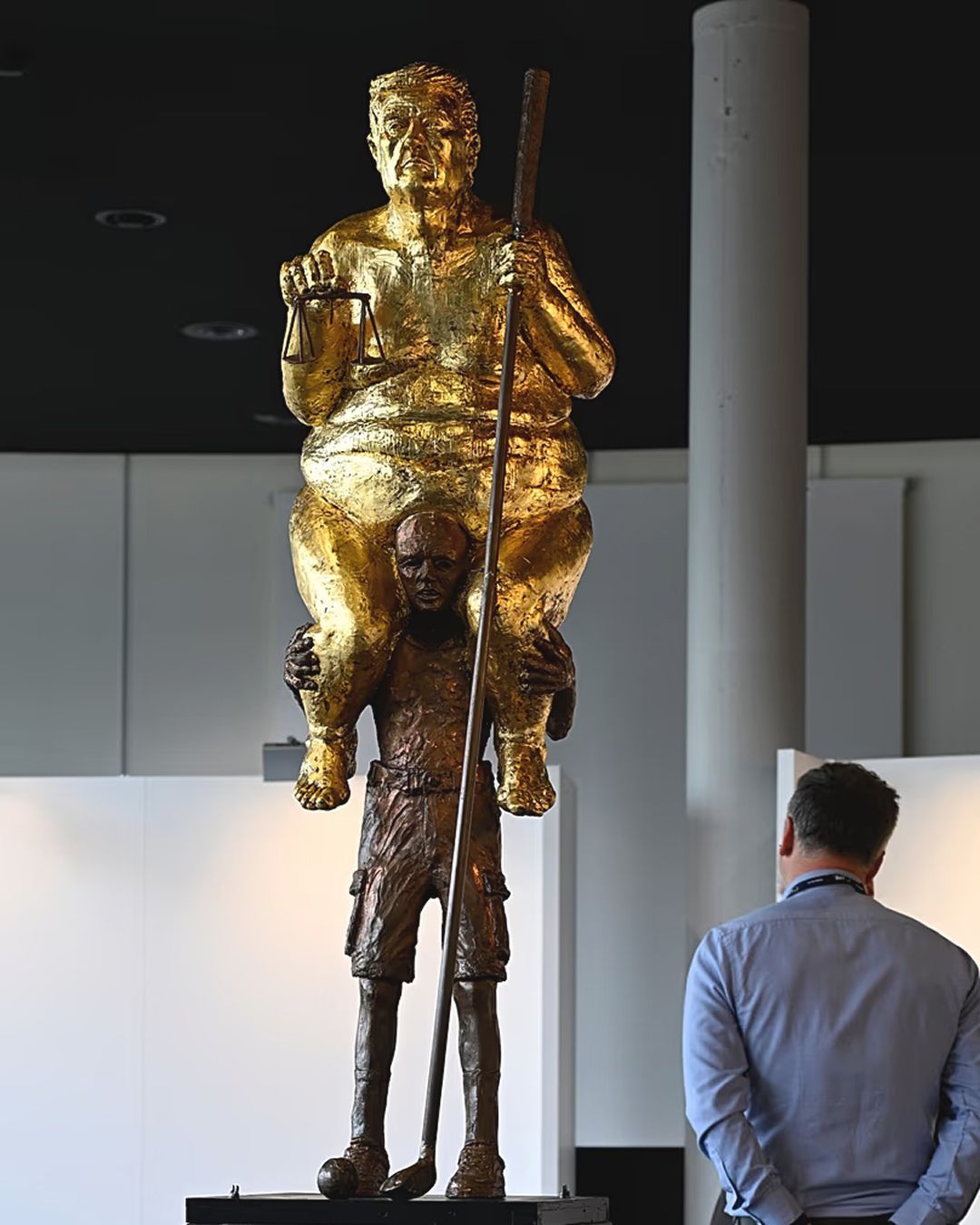
For several days, a roughly 2.6-metre-tall gold-covered sculpture depicting Donald Trump completely naked was on display inside the European Parliament in Strasbourg. In the work, the United States president is seated on the back of a slender man: in one hand he holds an oversized golf club, while in the other he holds the traditional set of scales with equal arms, one of the iconic elements conventionally used to depict justice. At the base of the statue is a golf-ball equivalent in the shape of a globe. The sculpture — created by Danish artist Jens Galschiøt — is entitled The Orange Plague.
The structure on which the work rests bears the inscription: "I am sitting on the back of a man. He is sinking under my weight. I will do everything to help him, except get off his back," signed by The King of Injustice, the other name by which the sculpture is known. The statue arrived at the European Parliament at the initiative of Danish MEP Per Clausen, a member of the The Left group, which brings together radical left-wing and ecologist parties from various European countries. As stipulated by the regulations governing this type of initiative, the work remained on display for three days, until 8 October.
What you need to know about "The Orange Plague"
@cnn Danish artist Jens Galschiøt unveiled a sculpture depicting a naked US President Donald Trump surrounded by golf equipment. It was unveiled on the grounds of the European Parliament building in Strasbourg.
original sound - CNN
The King of Injustice is made of copper and is partly covered with 23-carat gold leaf — a very thin sheet of gold that is 96% pure and is applied to surfaces in order to gild them. According to statements made by Galschiøt, the gold coating represents the concentration of wealth and privilege for the benefit of a small circle of people. The statue is also inspired by The Emperor's New Clothes, a fairy tale published by Danish writer Hans Christian Andersen in 1837, in which a ruler is persuaded to wear a suit that is invisible to anyone unworthy of him; all his subjects, so as not to contradict him, play along, until during a parade a child shouts that the king is, in fact, naked. The fairy tale is often used to describe situations in which people go along with those who hold power.
The European Parliament allows each MEP to sponsor up to two exhibitions or cultural events per parliamentary term — that is, over the course of their five-year mandate. Each individual proposal must then be approved in advance by the Quaestors — the members of parliament responsible for administrative matters concerning MEPs — who verify its compliance with the relevant rules. Specifically, the regulations state that artistic initiatives must not be "offensive or provocative in nature," nor contrary to the founding values of the European Union, and must not cause disruption in the exhibition spaces. The European Parliament has not disclosed how it assessed The Orange Plague, but it was likely deemed a satirical work, and therefore protected under freedom of artistic expression — one of the founding values of the European Union.
Who is Jens Galschiøt
Galschiøt has described The Orange Plague — which is not being exhibited for the first time — as a "satirical cry" about Trump's controversial policies. The sculpture draws on another well-known work by the Danish artist, Survival of the Fattest, in which an overweight woman sits on the shoulders of a visibly malnourished African man. Born in 1954, Galschiøt works primarily in sculpture, addressing themes of human rights, economic inequality and climate change; his works are often installed without authorisation in public spaces or at major international events. In 1993, for example, as part of the project My Inner Beast, he placed around twenty sculptures in as many European cities to denounce the rise of far-right movements.
Galschiøt's best-known work is probably the Pillar of Shame, a sculpture approximately 8 metres tall depicting around fifty bodies piled on top of one another: it was created to commemorate the victims of the Tiananmen Square crackdown in Beijing, China, in the spring of 1989. The Pillar of Shame is not a single work but a series of sculptures: the first was presented in 1996 in Rome; in subsequent years Galschiøt created three more: in Hong Kong, in Acteal, Mexico, and in Brasília, Brazil. A fifth sculpture was to have been erected in Berlin in 2002, but the project was abandoned due to lack of funding — a replica of the work was nonetheless put on public display for one month in 2023.