
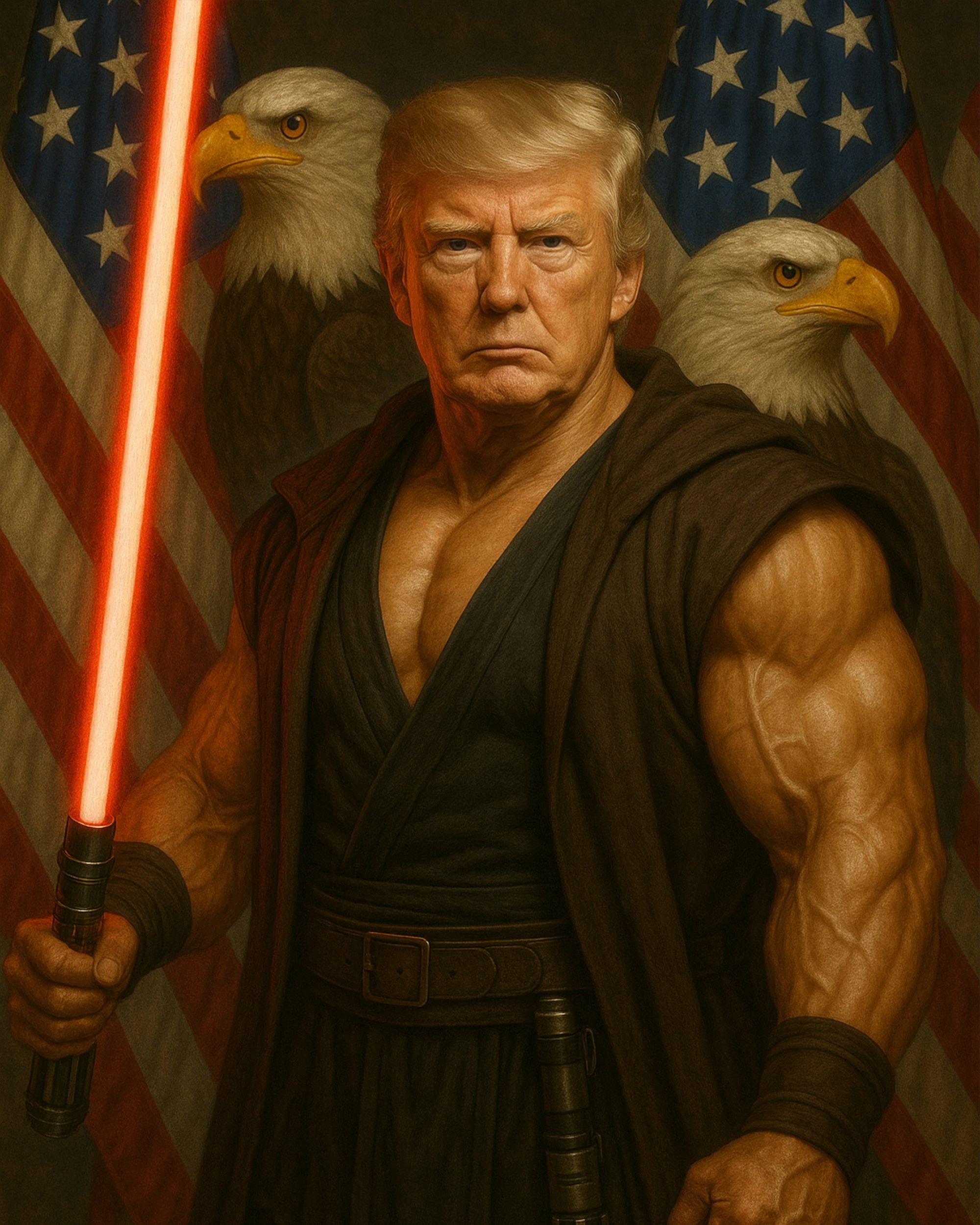
Why are there so many AI political propaganda videos? We asked Donatella Della Ratta, communication professor at John Cabot University
In recent times, our social media feeds have filled up with strange and often absurd AI videos that seem to bring to life the feverish fantasies of numerous right-wing politicians: Trump changing the name on the sign in front of Lake Ontario, Ben Gvir watching a conveyor belt full of Palestinian prisoners moving toward a prison, Roberto Vannacci playing a modern-day Batman beating up street criminals. Videos that Professor Donatella Della Ratta, a communications lecturer at John Cabot University in Rome who addressed the topic in her book Violenza speculativa. Come l'IA ci abitua all'orrore, published by Einaudi and out now, describes as "synthetic propaganda."
These videos share an invariably murky origin, an audiovisual narrative that stages political fantasies whose actual violence could never be openly voiced by those directly involved, as well as a degree of allegorical simplicity that makes them almost grotesque. "It is difficult to identify a single political figure who 'invented' the AI-generated political video," Della Ratta explains, noting that the emergence of these videos predates Trump's second presidency, even though "what changes radically with Donald Trump and the MAGA universe is the scale of distribution, the frequency with which this content is amplified, and above all the language." And indeed, today "the most powerful machine of political imagination produced through slop comes precisely from that universe." But how exactly do these videos work?
The power of the grotesque
@bloombergopinion AI-generated political ads are getting harder to spot. Mary Ellen Klas explains what that could mean for the upcoming elections. #AI #election #politics #midterms #US original sound - Bloomberg Opinion
As Della Ratta explains, the very fact that these videos seem so silly, so close to a cartoon, is precisely what makes them dangerous, because they catch audiences off guard: faced with their simplicity, not the slightest skepticism is exercised. "The Trumpian style is one of mockery, derision, and apparently absurd exaggeration," she explains. "We might dismiss all of this as bad taste, provocation, or simple trolling. My argument, however, is that this is precisely where its political power lies, and that all of it must be taken very, very seriously."
AI-generated political videos do not aim to explain or to be plausible — they aim to manifest a fantasy. They serve to give "an immediate, easily shareable visual form to ideas that, expressed in words alone, might appear extreme, unacceptable, or simply absurd," and by watching them repeatedly, "they become familiar, then thinkable, and, under certain conditions, politically actionable." This is the process Della Ratta calls "speculative violence": the capacity of images to visually anticipate extreme scenarios, bringing them into the realm of the visible and the thinkable before they actually come to pass, and demonstrating how "ideas that are sufficiently radical and irreverent" can, once they acquire a familiar visual form, "help destabilize the existing order and prepare the ground for another."
When in these videos we see "migrants in chains transformed into ASMR content, political opponents in mariachi sombreros and mustaches, racist caricatures, Trump himself cast variously as superhero, pope, emperor, or savior," the intent is to "prepare our gaze for the reality that may come." A modern application of the maxim attributed to Joseph Goebbels, Nazi minister of propaganda, that a lie repeated a million times will eventually become truth. "I no longer think the fundamental question is: Is this image true or false?" says Della Ratta. "The question is: what is it conditioning us to see? What future is it training us to recognize as possible?"
Is it just satire?
Politics in 2026 are just ai generating videos of different characters agreeing with you https://t.co/6Rj6nLnd8y
— wiltshireluvr34 (@SolomonsCause) October 7, 2026
"Many of these pieces of content evade traditional moderation mechanisms precisely because they make no attempt to pass themselves off as real," Della Ratta explains, citing as an example the videos in which Roberto Vannacci, dressed as a Roman emperor, sentences his political opponents to death in the Colosseum. "The fact that it is a fantasy does not mean it is politically harmless," because it "makes the elimination of the political opponent visualizable and, above all, introduces it into the order of the ordinary visible." The official excuse, used in this case by Vannacci himself, is that the videos are merely political satire. But is that really so?
The matter is not so simple, given that "this apparent unreality also constitutes a form of protection. You can show almost anything and then neutralize it by saying: it was a joke." However absurd a video depicting violence (in some cases even violence against women) may be, even if fictional, "the idea has been formulated, visualized, shared. It has entered the collective imagination." And it does not matter whether it is reshared to criticize it, to laugh at it, or out of genuine ideological conviction: the point is to circulate that image, regardless of the framing discourse surrounding it.
"These images, seen and seen again, sediment," Della Ratta explains, drawing on Walter Benjamin's concept of the "optical unconscious." "When a certain scenario reappears, perhaps in a completely different context or even in images of a real event, it can produce that sense of déjà vu that is central to my concept of speculative violence. It has not necessarily persuaded us: it has familiarized us." And their very artificial quality, so typical of AI photorealism, paired with an elementary narrative, "is becoming a shared visual language. Its artificiality can even function as a kind of pass: precisely because we know 'it's AI,' we are willing to accept representations that, in a different visual register, would strike us as far more disturbing."
Showing what cannot be said
The result is that "a politician can entrust to the synthetic image what would be far more difficult to assert literally in a speech: the elimination of the opponent, the deportation of the migrant, the punishment of the woman who does not conform to certain values." And their ambiguity allows them to evade both legal regulation and the social media moderation systems through which they spread. "A moderation system built around categories such as true/false, authentic/manipulated, information/disinformation," the author explains, "is structurally ill-equipped to deal with images whose power consists precisely in belonging to none of these categories."
The issue always comes back to visibility. "Speculative violence does not necessarily document a violence that has already occurred, nor does it merely fantasize about an impossible one," she concludes. "It works on the future. It makes visible today what would be politically unacceptable, so that tomorrow it may appear less alien, less unthinkable — even familiar."