





































How technology is changing the craftsman's work When 3D printing, scanners, and algorithms enter the ceramics studio
A traditional loom can work alongside modelling software, a ceramic piece can be born from a 3D printer, and a robot can learn to collaborate with someone who builds by hand. In contemporary design, these combinations are becoming increasingly normal. Technology has entered craft workshops and, at the same time, designers and researchers are rediscovering manual knowledge that industry had progressively pushed out of the production process.
September offers a fairly clear picture of this transformation. In Venice, Homo Faber 2026 brings together over 500 craftspeople from more than 70 countries and around 700 objects. The heart of the event remains the relationship between hand, material and skill, but the craftsmanship on display today looks less and less like something to be preserved under glass. Ancient techniques are being applied to new objects, materials and processes, while contemporary designers are increasingly entering workshops to develop languages that could hardly emerge through industrial production alone.
Japanese craftsmanship meets technological advancement
A few days later, the London Design Festival takes this relationship even further. Among the main projects of the 2026 edition is the Craft x Tech Tokai Project, hosted at the Victoria & Albert Museum: six Japanese craft practices are paired with international designers to work on Mino ceramics, washi paper, shibori dyeing, Owari Shippo enamel, Seto painted ceramics and Iga Kumihimo braiding. Among the designers involved are Bethan Laura Wood, Philippe Malouin, Lanzavecchia + Wai and David Caon.
The project stems from an interesting idea: treating craft as a practice capable of responding to the conditions of its own time. Craft x Tech founder Hideki Yoshimoto describes craftsmanship as something that, throughout history, has continually chosen what to preserve and what to transform in response to technological, social and economic change. A traditional technique survives precisely because it keeps evolving.
Other installations at the London festival follow the same direction. The Speaking Oasis, designed by Azaz Architects, uses the tradition of palm leaf weaving to explore new applications at the intersection of architecture and product design. A local practice thus becomes a starting point for conversations about materials, sustainability and contemporary construction.
The new 3D printing
The transformation becomes even more apparent when robotics and digital fabrication enter the picture. At ETH Zurich, the term "digital craftsmanship" is already being used openly. Research on Architecture and Human Augmentation explores systems in which digital technologies, augmented reality and robots collaborate with people during construction. The principle is to harness the precision of the machine while preserving human capabilities such as adaptability, experience and an understanding of materials. The university's laboratories also house industrial robots used to experiment with large-scale architectural fabrication processes.
The same cross-pollination is making inroads into territories even more deeply rooted in tradition. A research project at City University of Hong Kong uses 3D scanning and printing to study and reinterpret ancient Chinese ceramics. The forms of traditional objects are digitised, transformed and then brought back into physical matter through new production techniques. The printer thus becomes a new tool within a story that still passes through clay, surfaces, firings and knowledge of the material.
In July 2026, the MIT Media Lab also published research bringing together ancestral craft techniques, extended reality and material robotics. The project begins in the Amazon and attempts to build technological tools rooted in the knowledge and materials of the region, rather than applying the same digital systems everywhere. This is a significant step, as it shows how technology can take very different forms when it encounters different productive cultures.
3D printing is following the same trajectory. In the field of ceramics, it now makes it possible to work with geometries, layering and material combinations that are extremely difficult to achieve through conventional processes. In 2026, Hong Kong Polytechnic University devoted an in-depth study to the development of multi-material ceramic printing, in which different clay bodies can be combined within a single component. Knowledge of the material remains central; what changes is the way it is deposited and controlled.
Is it no longer "handmade"?
In this context, the figure of the craftsperson is changing radically. Alongside chisels, looms, moulds and wheels, their studio now accommodates 3D scanners, CNC machines, parametric software, robotic arms and algorithms. At the same time, the machine alone knows very little about the actual behaviour of a piece of wood, a fabric, the viscosity of clay, or the small variations that make every material process different from the last — and this is precisely where hands-on experience continues to hold value.
Twentieth-century industrial production built much of its efficiency on standardisation. Digital technologies are opening up a different possibility: producing variations, customised pieces and complex geometries while retaining some of the efficiency of machines. This is one of the reasons why the boundary between factory and workshop is becoming less clear-cut.
Even the concept of "handmade" may therefore become less useful for describing what we are seeing. An object can move from a digital model to a CNC machine, be worked on by a craftsperson, pass in front of a scanner again and receive a completely hand-finished surface. Determining which part is craft and which is technology says less and less about the final value of the work. The workshop of the future will probably still have a person standing at a workbench. At their side, however, there may also be a robot.
What to read next
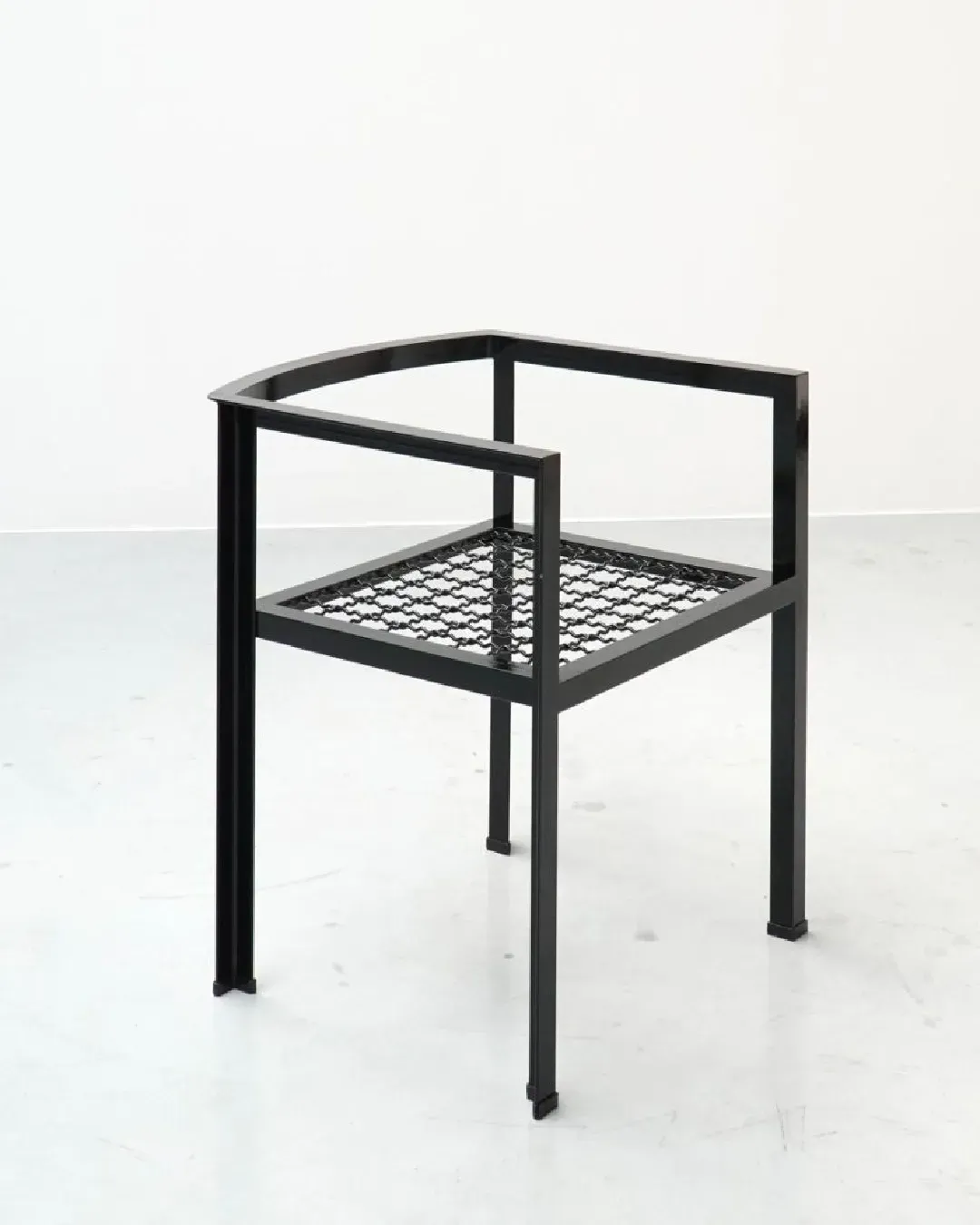
When Rei Kawakubo designed a furniture line
An experimental collection created by the designer in the 1980s for Comme des Garçons