
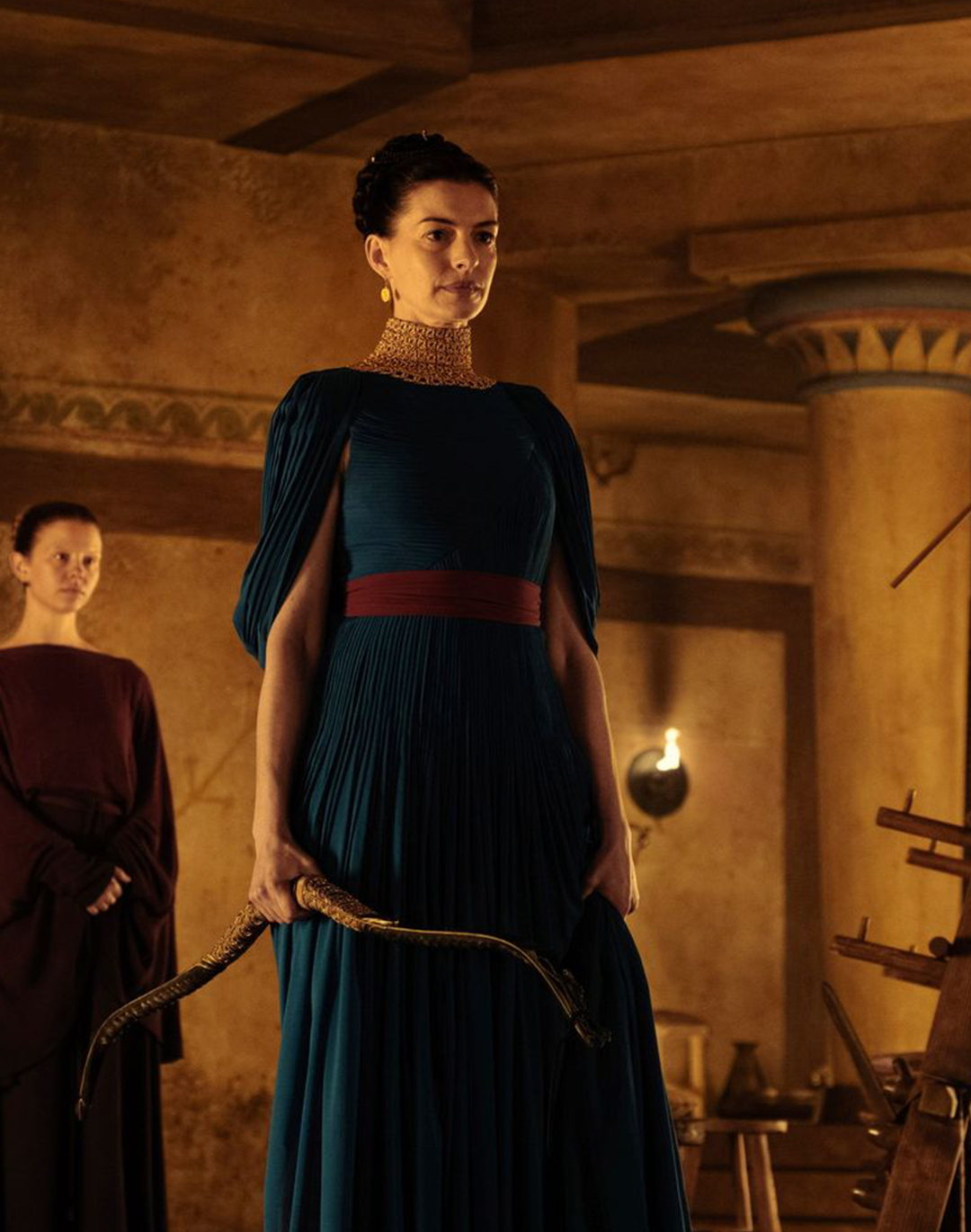
The translator of the "Odyssey" said she would be ashamed to have inspired Nolan's film But perhaps there is something positive about it
The Odyssey by Christopher Nolan continues to sit at the center of two opposing currents of opinion that show no sign of dying down: on one side are those who already consider it the film of the year, destined to win multiple awards, and those willing to make a heroic journey just to see it projected in IMAX. On the other side, a portion of audiences and critics has not welcomed the new adaptation of the Homeric poem with the same enthusiasm. Among the most prominent voices are those of Elon Musk and, above all, Emily Wilson, classicist and author of the celebrated English translation of the Odyssey published in 2017 who has inspired Nolan's latest project.
Wilson harshly criticized the film, arguing that it «has nothing truly compelling to say» and that it «lacks psychological, emotional, political, and ethical depth». Capping her verdict is a remark that calls into question not Nolan's talent but rather his approach to adaptation. In an essay published in the London Review of Books, she wrote that «Nolan's Odyssey reproduces his usual combination of grandiosity and superficiality». After all, when one takes on a work like Homer's Odyssey, pitfalls are inevitable and it is not always possible to emerge unscathed.
Whatever happened to the depth of the Homeric poem?
For Nolan, making The Odyssey likely meant reaching new creative heights: from the direction to the casting choices, to the construction of a memorable visual world. According to Wilson, however, what loses much of its power above all is the characterization of the characters: «The film's vision is too muddled and the characters are too underdeveloped to sustain what it promises in terms of big ideas. On the other hand, it is very good at showing big explosions and menacing giants.» What makes the Homeric poems immortal, and classical literature more broadly, is precisely the depth of their protagonists. The heroes and their adventures are not merely epic figures; they represent an entire culture, a vision of the world and of human beings. Their characterization is layered, the product of an oral tradition passed down through centuries, from one song to the next, from generation to generation.
However spectacular Nolan's rendering may be, fundamental elements such as the meaning of the journey, of love — including its erotic dimension, entirely absent from the film — or the relationship with one's companions, the hero's honor, and the return home end up losing much of their symbolic weight. «The characters lack the depth of Homer's. I found myself wondering: do I actually care whether this man makes it back to his wife? The film gives me no reason to care.» Indeed, the scholar's critique becomes even sharper when she examines the poem's themes: «Nolan's Odyssey is stripped of many of the elements that make Homer's text great. [...] It lacks psychological, emotional, political, and ethical depth. The narrative structure is a device that serves no end beyond itself, the writing is poor, and no character has truly convincing motivations. There are no sex scenes, and even the food looks terrible.»
A word of praise for Nolan
Despite her criticisms, Wilson, chair of the Department of Classical Studies at the University of Pennsylvania, also acknowledged the positive effects the film is already producing. In an interview with the Sunday Times, she said: «Emotionally it left me completely cold. And I think that is partly because, unlike Homer, it is not particularly well written.» Yet the classicist acknowledged that «the release of The Odyssey is still something to celebrate. This blockbuster is bringing audiences back to cinemas, translations of the Odyssey — including my own — are flying off the shelves, and perhaps it will persuade some university administrators not to cut departments of literature, languages, and history.»
Perhaps this is also the most interesting aspect of the whole affair. Even when an adaptation has obvious shortcomings, it can still manage to speak the language of a broader audience, one that often includes people who have never read Homer's poem. And if cinema can still spark curiosity, inspire, and bring the classics back to the center of cultural conversation, then its goal has been at least partly achieved. As Wilson herself concludes: «Nolan is doing his best to persuade the general public to go back to reading, and for that I am grateful to him.»
What to read next

"Wild Horse Nine" by Martin McDonagh is tender and ruthless at once
With an award-worthy John Malkovich
"Un tranquillo funerale di famiglia" is everything comedy should not be today
Massimiliano Bruno's film had its premiere at the Rome Film Festival
«Club Kid is a once-in-a-lifetime opportunity», interview with Jordan Firstman
Everything about the directorial debut of the American actor and screenwriter