






























The most innovative capsule hotels of all time How small can a hotel room get?
For a long time, capsule hotels were described as a Japanese curiosity. Rows of stacked pods, silent corridors, shared bathrooms, and a private space barely larger than a bed. From the outside, they can look like environments from the future or, in a far less glamorous reading, burial niches fitted with a mattress. Yet the most interesting thing about them is not how small they are. It is understanding how design managed to make desirable a space in which you often cannot even stand upright.
The history of capsule hotels: from their origins in Japan to contemporary design
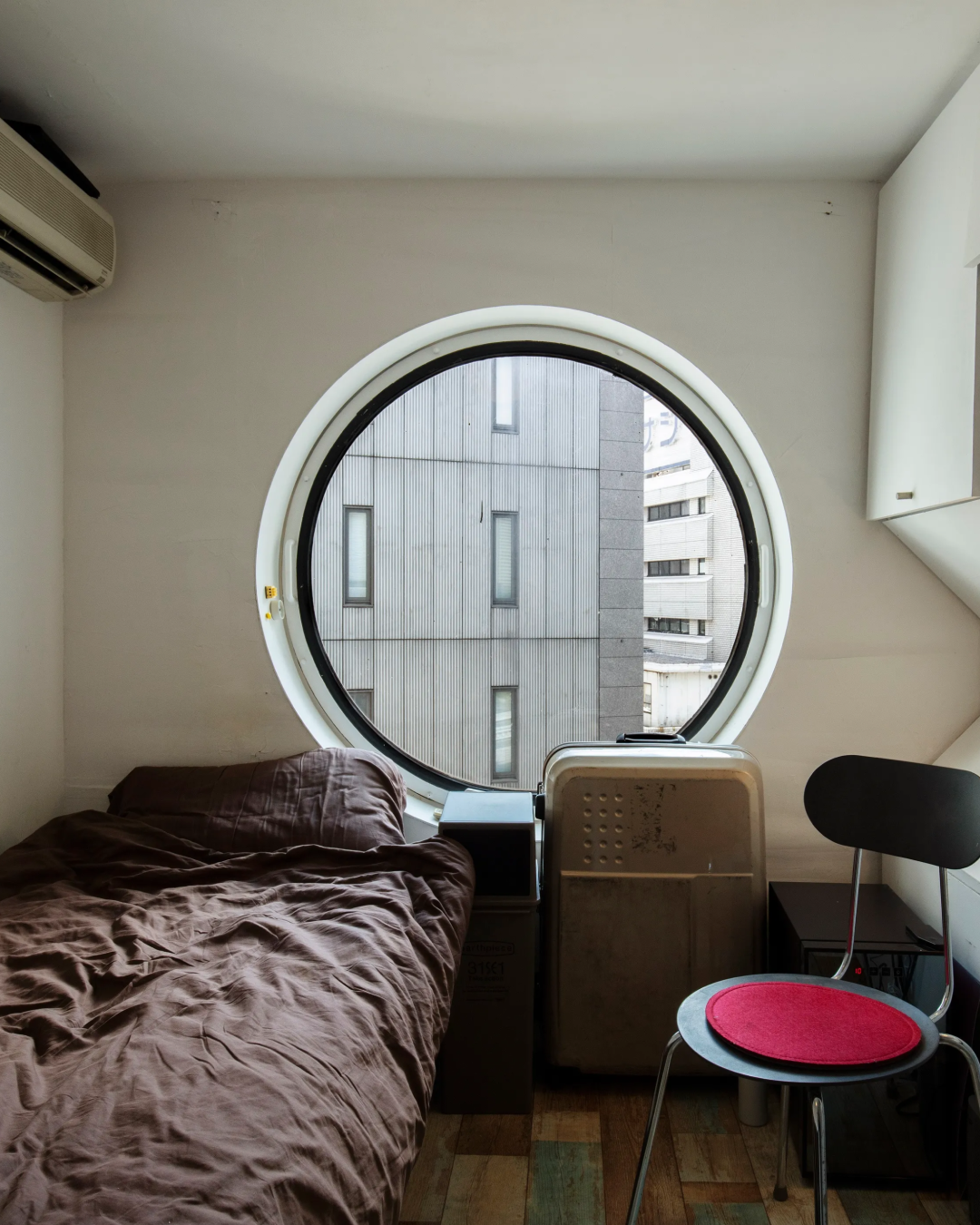
@form.community EDITORIAL | Lost Visions: Tokyo’s Nakagin Capsules (1972) This building was a stack of futuristic washing machines. In the heart of Tokyo’s bustling Ginza district, the Nakagin Capsule Tower stood as a testament to architectural innovation. Designed by Kisho Kurokawa and completed in 1972, this avant-garde structure defied convention. The tower comprised two interconnected concrete structures. Within these towers were 140 capsules, each measuring approximately 10 square meters. These capsules were prefabricated off-site and then attached to the tower’s framework. The idea was practical: replace capsules when they wore out, like changing a light bulb. However, reality didn’t quite align with the original vision. Over the years, the Nakagin Capsule Tower faced challenges. By 2012, only around thirty capsules were still inhabited, while others were used for storage, office space or abandoned. The tower symbolized Tokyo’s rapid growth and the need for efficient urban living. Yet, as time passed, its fate hung in the balance. In 2022, demolition began, dismantling the once-revolutionary capsules Discover the full edit at FORM.SPACE - - - - - - - #form #archive #archivefashion #artgallery #anndemuelemeester #helmutlang #maisonmartinmargiela #undercover #yohjiyamamoto #commedesgarcons #junyawatanabe #rickowens #rickowensarchive #rafsimons #architecture original sound - FORM
The first capsule hotel is generally identified as the Capsule Inn Osaka, which opened in 1979 and was designed by Japanese architect Kisho Kurokawa. The building translated into the hospitality sector an idea Kurokawa had been developing for years: treating the capsule as a self-contained unit, compact and insertable within larger systems. In 1972 he had completed the Nakagin Capsule Tower in Tokyo, made up of 140 prefabricated modules attached to two central cores. The units were meant to be replaced over time, allowing the building to transform almost like a living organism.
The tower was demolished in 2022 without ever fully realising that promise, but the idea of the capsule survived. In hotels it found a far simpler function: stripping the room of everything not needed for sleeping. No entrance hall, wardrobe, desk, or private bathroom. Just a mattress, a light, a power outlet, and a barrier separating the guest from the corridor. An extreme reduction that, precisely because it leaves so little room, forces every detail to work.
How capsule hotel design transforms a few square metres
In a traditional hotel room, a poorly placed light switch is merely annoying. In a capsule, it becomes impossible to ignore. The same applies to ventilation, noise, access to the bed, the positioning of personal belongings, and the quality of materials. When the entire space measures just a few square metres, every centimetre shapes the experience. This is why the most interesting capsule hotels are not necessarily the most unusual ones, but those that have understood that a minimal space cannot be designed simply as a shrunken version of a normal room.
Nine Hours is probably the case that has best translated this insight into a recognisable identity. The Japanese chain does not try to conceal the repetition of its capsules but makes it part of the design. The spaces are organised through clean geometries, minimal surfaces, highly visible signage, and a constant contrast between the bright white of the interiors and the darker structures that contain them. The name sums up the experience as a sequence: one hour to wash, seven to sleep, and one to get ready to leave. In some locations, Nine Hours has also introduced sleep analysis services, turning an overnight stay into a collection of data about rest.
Here the capsule makes no attempt to be welcoming in the traditional sense. There are no pictures, decorations, or objects simulating domestic intimacy. It feels more like a precise industrial product, almost a device you enter in order to switch off and recharge. It is the branding that compensates for the absence of space: the guest does not remember their room, identical to all the others, but the visual system within which they were placed.
The best capsule hotels that have revolutionised the overnight stay
@ciara.gan this capsule hotel is an ambiverts dream fr + it’s less than $35 a night !! The Millennials Kyoto (i am NOT a millennial okay ) booked via klook, use code CIARAGANKLOOK! #fyp #japan #hotel original sound - n 3^°7 !
The Millennials Kyoto takes a different approach. Its SmartPods measure approximately three square metres and contain a 120-centimetre-wide bed that can change its angle and transform into a kind of sofa. Lighting, mattress position, and the alarm can all be controlled through a device handed over at check-in, while luggage space is built in beneath the bed. The capsule remains minimal, but it becomes adjustable. During the day it can serve as a small personal seat; at night it reverts to a bed.
The design is particularly interesting for what happens outside the pods. The communal areas play a central role in the experience, hosting work, cooking, and socialising. Private space is reduced, but shared space gains in importance. In this way the hotel does not try to offer each guest a complete room: it distributes its functions across multiple spaces, leaving the capsule with the sole task of providing rest and isolation.
最高に幸せな寝る瞬間とは?11/5に開業する泊まれる本屋「BOOK AND BED TOKYO」を取材中 https://t.co/Wg6YdTUNkU pic.twitter.com/DToJsY4teO
— FASHIONSNAP (@fashionsnap) October 30, 2015
Book and Bed Tokyo takes this logic even further. It presents itself as a "bookshop where you can sleep" and integrates the beds directly among the shelves holding thousands of books. The capsule almost disappears into the installation, becoming a nook tucked between the volumes. Here too, what the room lacks is returned through a shared experience. What is being sold is not just a place to sleep, but a very precise image of reading until you fall asleep.
Design thus becomes a way of redirecting attention. The reduced dimensions are not perceived solely as a sacrifice, because they become part of a larger narrative. In a traditional hotel, identity is often entrusted to the furnishing of the rooms; in capsule hotels it can be built through a single gesture, repeated dozens of times and tied to a recognisable theme.
From Japan to the world: the evolution of capsule hotels
At the Tubohotel in Tepoztlán, Mexico, that gesture coincides with the use of large prefabricated concrete pipes. Studio T3arc transformed them into bare-bones rooms, arranging them in the landscape through stacked compositions as well. Inside, there is room for little more than the bed, while bathrooms and other activities move into the shared outdoor spaces. An element normally destined for infrastructure thus becomes a room, without entirely losing its industrial character.
More than a Japanese capsule, the Tubohotel is an interpretation of one. It demonstrates that the model does not depend on a specific form, but on a principle: reducing the private environment until it almost coincides with the body it is meant to accommodate. Everything else can be moved outside, as long as the context gives something back in return.
@ianinrealtime Staying at a capsule hotel in the middle of Piccadilly Circus in London. Always been intrigued by the capsule hotel idea. Bed isn’t uncomfortable, and I like the more modern look! #london #unitedkingdom #piccadillycircus #capsulehotel #travelhacks original sound - Ian
The Pangea Pod Hotel in Whistler, Canada, also works on this exchange. Its 88 capsules are distributed across eight shared suites, ranging from a minimum of six to a maximum of eighteen pods. The property describes itself as part hostel, part hotel: from the former it takes the sociability and more accessible pricing, from the latter a greater attention to privacy, materials, and bed quality. The capsule becomes the minimum boundary between the individual and the group.
The shift from niche experiment to mass urban product is plain to see in London. In 2025, Zedwell opened a property at Piccadilly Circus with nearly a thousand wood-lined capsules, housed within the historic London Pavilion. The scale changes entirely: this is no longer a small alternative hotel, but a system capable of concentrating hundreds of beds in one of the most expensive areas of the city.
Are capsule hotels really the future of hospitality?
This is precisely where the more ambiguous side of the phenomenon emerges. Design can transform a tiny space into a quiet, recognisable, and even pleasant environment, but it can also make a straightforward reduction in comfort look more appealing. Refined finishes, soft lighting, and words like "pod" or "cocoon" do not erase the absence of windows, the shared bathrooms, the noise from other guests, or the possibility of feeling shut inside a box.
The line between minimalism and deprivation depends on what the hotel gives back. A well-executed capsule reduces private space but offers a central location, a genuinely comfortable bed, ventilation, cleanliness, security, and well-designed communal areas. A less successful capsule simply packs more people into the same building, using design to make a question of density look like innovation.
stayed in a pod style hotel in Noida!
— Somya (@Somya_Crazy) September 21, 2024
more details tomorrow pic.twitter.com/ut1EOexCBz
These hotels also reflect a shift in the way people travel. For many guests, the room is no longer the centre of the stay but a temporary base in which to leave luggage, charge a phone, and sleep before heading back out. The city becomes the real living space, the bar replaces the lounge, and the workspace is shared with strangers.
The capsule does not necessarily represent the future of hospitality, nor is it a solution suited to every traveller. It is, however, one of the most extreme laboratories of contemporary interior design. In a space no wider than a bed, there is no hiding a weak design behind unused square metres. Everything must have a position and a purpose. The best capsules do not try to convince us that a pod is a real hotel room. Instead, they invent a new agreement between what remains private and everything we are willing to share.