

























Italian radical design has no need to change The most contemporary identities are often those that do not chase the present
Italian radical design has no need to change. Or rather: it has no need to change in order to chase its audience, because it is the audience itself that keeps chasing it. It is a subtle but fundamental difference. At a time when many brands are constantly reformulating their identity to remain legible, desirable, photographable and shareable, Gufram, Memphis and Meritalia® demonstrate something almost counterintuitive: some identities are so strong that they need not pursue the present.
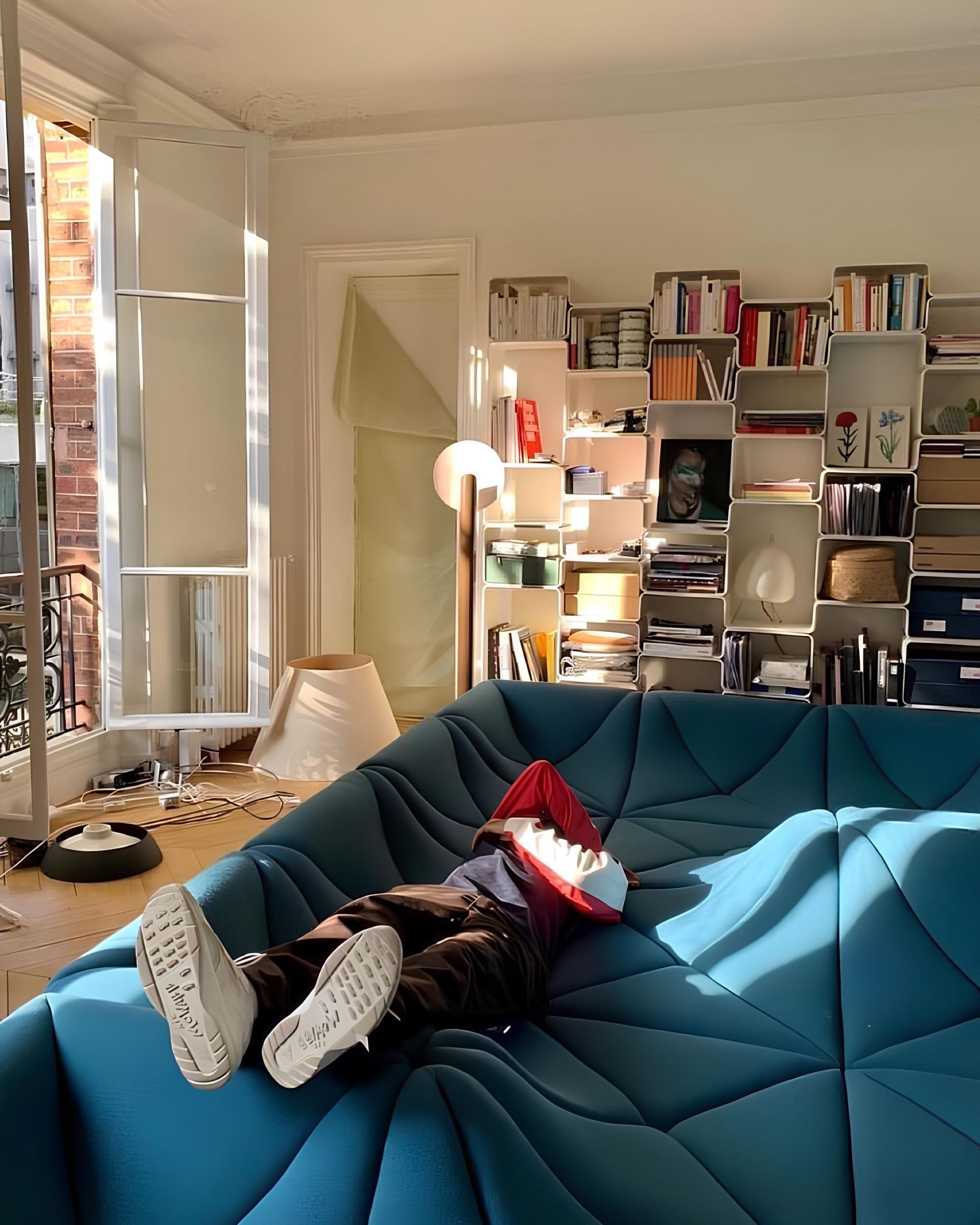
And that is why the three brands were brought together at last year's Milan Design Week in the Italian Radical Design stand, in an exhibition project conceived not as a simple succession of products, but as a home to be traversed both physically and mentally. The decision to move beyond single-brand areas and bring the three brands together was a highly interesting one. Gufram's irreverent surrealism, Memphis's chromatic and visionary charge, and Meritalia®'s free and irregular everyday quality are indeed capable of speaking to one another without losing their force. At a remove from the noise of Design Week, it is precisely this image that lingers: three historic languages that, rather than appearing preserved, seemed more alive than many "contemporary" aesthetics.
From this perspective, Italian Radical Design is not a nostalgic operation, but a project of active preservation. The group was born from the vision of Sandra and Charley Vezza, who have owned Gufram since 2012, with the aim of enhancing historic Italian design brands with a radical and nonconformist spirit. The acquisition of Memphis Milano in early 2022 and Meritalia®'s entry in 2023 transformed this vision into a broader cultural platform: not an archive to be kept under glass, but a system of languages still capable of generating friction.
Gufram: domestic sculpture as language
Founded in Turin in 1966 as a craft-based enterprise, Gufram is one of the clearest examples of Italian design capable of transforming the domestic object into a cultural icon. Its language emerges from the encounter between industry, artisanal experimentation and radical imagination, but the result is never merely formal. Gufram objects are not simply strange, playful or recognisable: they alter the way we perceive function.
The CACTUS®, designed by Guido Drocco and Franco Mello in 1972, is perhaps the most obvious example. A coat rack that does not want to look like a coat rack — a vegetal, sculptural and almost surreal presence. BOCCA®, PRATONE®, ANDY'S CACTUS® and the other pieces that have entered the collective imagination work in the same way: they hover between art and design, use and apparition, comfort and visual short-circuit. They are objects one remembers even without owning them.
The research into soft polyurethane and patented finishes is a fundamental part of this ambiguity. Many products appear rigid, sharp, unnatural, almost hostile. Then you touch them, use them, sit on them and discover that the image was lying. It is in that moment that radical design ceases to be mere provocation and becomes physical experience.
The reissues presented at Radical Home illustrated this well. Fachiro by Marzio Cecchi, designed in 1975, is a "spiked" seat that plays with the idea of danger and comfort: at first glance it seems to repel the body, but in use it welcomes it. Womb by Luigi Bistagnino, on the other hand, works on a more intimate dimension, born from the memory of the unquilted duvet on his grandparents' bed. If Fachiro destabilises, Womb reassures. Both, however, tell the same story: for Gufram, form is never just form. It is a promise, or a refutation, of the body.
When radical design meets A$AP Rocky
@cur8.fr ASAP Rocky a présenté sa nouvelle collection à Design Miami il a lancé son studio de design Hommemade il y a 2 ans et là il présentait ses nouvelles pièces réalisées en collaboration avec Gufram tout ça à la foire Design Miami qui a lieu en face de Art Basel pendant la semaine de l’art à Miami #ArtBasel #ArtBaselMiami #DesignMiami #ASAPRocky #Gufram #CUR8 son original - CUR8 — Arthur Hadade
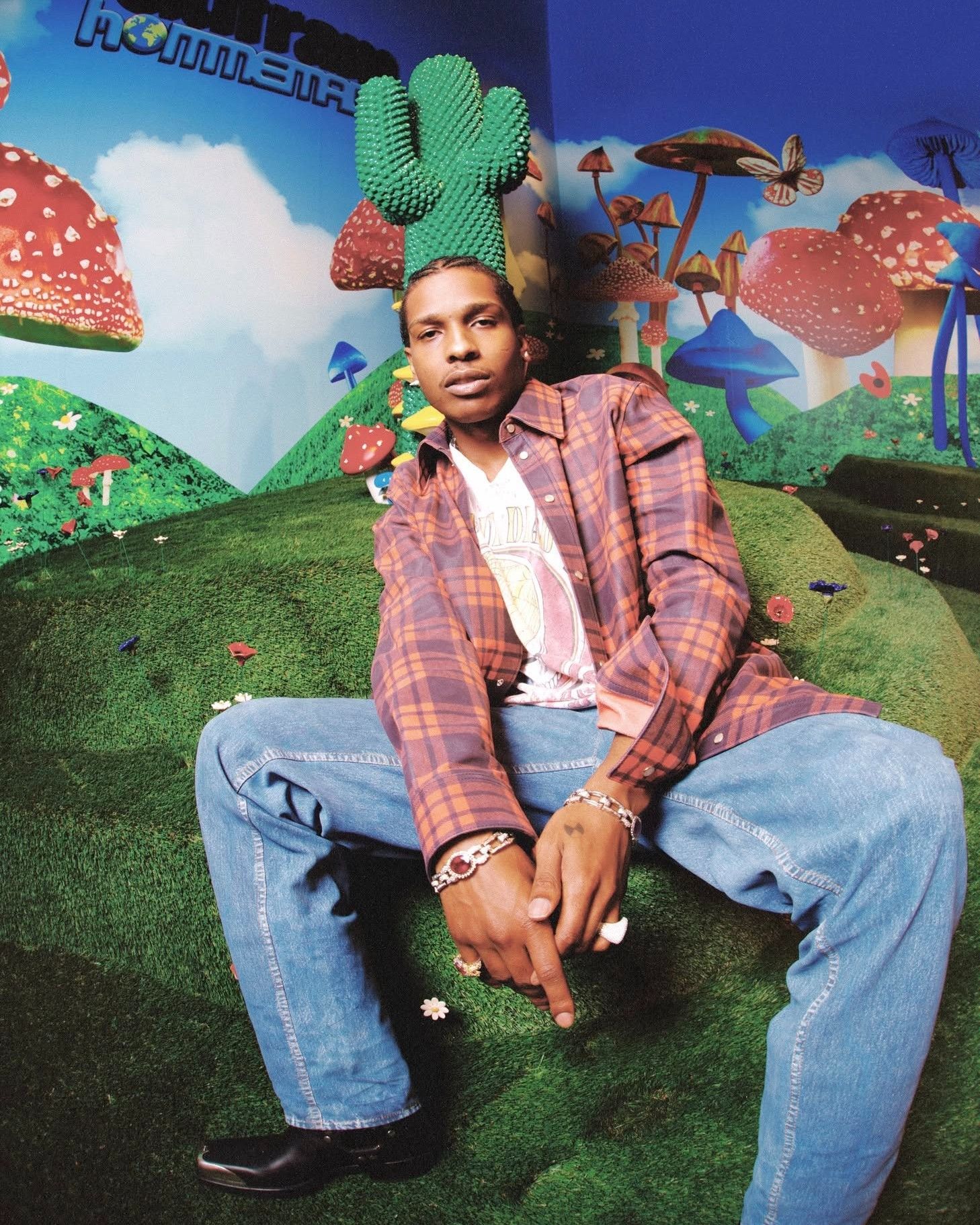
Gufram's capacity to live beyond the traditional boundaries of design emerges with particular force in the relationship built with A$AP Rocky. The collaborations between the brand, the artist and his studio HOMMEMADE do not seem like a simple encounter between celebrity and product. They form a coherent trajectory, developed over time, that begins with an icon and arrives at the construction of an environment.
In 2022, at Design Miami, Shroom CACTUS® reinterpreted the CACTUS® on the occasion of its fiftieth anniversary. Rocky intervened on one of Gufram's most recognisable symbols through a limited edition of nine pieces, causing hand-painted mushrooms to grow on the trunk and at the base, accentuating its already surreal nature and treating it almost as a living creature. The following year, Guframini Shroom CACTUS® reduced that same idea to a 1:8 scale, while the CACTUS® Fur Cover devised a fur cover that "dressed" the CACTUS®, transforming its appearance. In 2024, Skyline Carpet, inspired by the New York skyline, became an immersive and multifunctional surface, with buildings transformed into volumes, seating and architectural elements.
First Rocky intervenes on an icon, then reduces it to a collectible object, dresses it and finally builds a landscape around it. It is a way of working that transcends the logic of a signature applied to a product and brings design, fashion, music and culture closer together without forcing any of them to lose their own identity. A proximity that is no coincidence, given that Italian radical design and rap were born in different contexts and at different moments, yet share the capacity to break established codes and transform languages initially considered excessive, marginal or disreputable into culture. A force that springs from the construction of an imaginary sufficiently recognisable to compel dominant taste to change direction.
Rocky does not make Gufram contemporary. The collaboration demonstrates, rather, how much Gufram's language was already predisposed to dialogue with the present. The CACTUS® can enter the world of an artist who grew up in New York, cross fashion and music, become a miniature, wear a fur coat and transform itself into a landscape without losing what makes it immediately recognisable. It is precisely this elasticity, sustained by an utterly rigid identity, that explains why radical design continues to be pursued.
Memphis: inhabiting an idea
If Gufram transformed the domestic object into irreverent sculpture, Memphis transformed the act of inhabiting into a total visual language. Born in 1981 from an idea by Ettore Sottsass, together with designers and architects such as Michele De Lucchi, Aldo Cibic, Matteo Thun, Marco Zanini, Martine Bedin and Nathalie Du Pasquier, Memphis rapidly became a cultural phenomenon.
Its impact concerns not only design but the way of thinking about forms, surfaces, colours, patterns and materials, rejecting the composure of bourgeois good taste and opening a space in which the object could be ironic, graphic, exaggerated and contradictory. It had to function, certainly, but it also had to speak. And preferably speak loudly. Today that language continues to be read and reactivated because it seems to anticipate many dynamics of contemporary visual culture.
The idea that a piece of furniture can be simultaneously image, symbol, character and content does not belong solely to the 1980s, but to the way we relate to objects today. The compact version of Tawaraya Ring by Masanori Umeda, presented in 2026, reinterprets this legacy without turning it into quotation. The original 1981 project was conceived as a space that was simultaneously a furnishing element and an "intellectual wrestling ring": a piece of furniture, but also a place of confrontation. It does not simply design furniture, but possibilities.
Meritalia®: incoherence as method
Meritalia® enters this narrative with a different kind of force, less immediately codifiable and all the more precious for that reason. Founded in 1987, the brand is animated by a sense of freedom and a "consciously incoherent vitality." Incoherence here does not indicate a lack of direction, but a method: refusing a single formula, a single aesthetic and a single idea of comfort.
In the Meritalia® catalogue, everyday life is never neutral. Seating, tables, upholstered pieces and rugs become occasions to push the rules of function, seriality and material. The relationship with Gaetano Pesce is central. Broadway, designed in 1994, embodies his research into non-uniform seriality through chairs and tables that are replicable but never identical. The epoxy resin poured into moulds, the pigments that blend freely, the visible metal structure and the spring feet all oppose the idea of industrial perfection. Each piece belongs to a family, yet retains its own unrepeatable quality: they are both everyday objects and objects of spectacle.
The new pieces shown at Radical Home extended this direction without betraying it. Crease by Faye Toogood worked on the idea of an inside-out piece of furniture, like a jumper worn back to front. Bundle by Objects of Common Interest explored rhythm, compression and modularity. Hug by Cristián Mohaded interpreted sofa and armchair as open architectures, while Scoop by Philippe Malouin reduced the club chair to monolithic volumes, apparently rigid but soft in use. This is not a reassuring aesthetic coherence: it is a deeper coherence — that of freedom.
Not nostalgia, but permanence
The risk, when speaking of Italian radical design, is to treat it as a great repertoire of the past: a collection of icons to be celebrated, republished, photographed and protected. Radical Home showed something different instead. Gufram, Memphis and Meritalia® are interesting not only because they belong to history, but because they continue to challenge the present.
At a time when design often seems divided between reassuring minimalism, quiet luxury and sustainability transformed into a neutral aesthetic, these brands are a reminder that inhabiting can also mean excess, irony, colour, conflict and desire. An object can be comfortable without being discreet. A seat can look like a trap and then embrace you. A rug can become a space. A home can be a manifesto.
Perhaps that is why Italian radical design has no need to change. Its value lies not in constant adaptation, but in remaining legible without becoming predictable, maintaining a strong identity without turning it into a formula. Collaborations with figures such as A$AP Rocky do not represent an attempt to rejuvenate a historic language, but proof that that language still possesses the capacity to cross-pollinate without losing its own centre. Italian radical design has not become relevant again. It is the present that keeps catching up with it.