.gif 2000w)
























10 things to do in Venice during the Art Biennale 2026 Discovering the best attractions in town
Venice has always fascinated visitors from all over the world and, among all months, May represents a generative moment for the city: it is in fact the time when the Venice Art Biennale opens, with its pavilions and collateral events, establishing itself as one of the most relevant appointments in the international contemporary art scene. It is precisely the creative energy that flows through this event that reactivates Venice which, although immersed throughout the year in a suspended melancholy and an almost anachronistic romanticism, during these weeks reveals new stratifications, new rhythms and perspectives.
The city’s urban fabric, made of calli, bridges and canals, constructs a dense and at times disorienting texture, in which it is easy to get lost - also because navigating it is not always immediate - but it is perhaps precisely in this way that a more authentic experience unfolds. Allowing oneself to be carried through Venice means accepting its disorientation and transforming it into discovery. Here, creativity is perceived as a diffused presence, its history continues to live within the places that define it, making the city a fertile ground for new cultural initiatives and artistic happenings.
To grasp a more intimate and stratified Venice, made of details and fragments of everyday Venetian life, here are 10 things to do in Venice in May and beyond.
The Galeazze Project
On May 5 and 6, on the occasion of the opening of the Venice Art Biennale 2026, the Galeazze of the Arsenale Nord in Venice, opened to the public for the first time, will host The Galeazze Project: a performance conceived by the artist and choreographer Faustin Linyekula, in collaboration with the musician Heru Shabaka-Ra, curated by Edoardo Lazzari and Scuola Piccola Zattere. The Galeazze Project will be open to the public upon registration and emerges from a process developed in direct relation with the context. The intervention takes shape starting from the architecture of the Galeazze, assuming its scale, material characteristics and operational conditions as central elements of the creation.
The project involves local performers and musicians from the early stages of its development, giving form to a site-based collaboration in which practices and skills intertwine. The intervention takes the form of a temporary construction site: materials, platforms, scaffolding and light sources outline an environment in continuous transformation. The spatial intervention, developed by Cosimo Ferrigolo and Dirk Bell, organizes a dynamic and operative space, whose ground becomes a working terrain, while a discontinuous lighting system accompanies the bodies, making them visible or subtracting them from view.
The Venice Venice Hotel
The Venice Venice Hotel enters the Venetian landscape as a hospitality project that transforms a historic building on the Grand Canal into an immersive experience between memory and contemporaneity. At Palazzo Ca’ da Mosto, the hotel restores centrality to one of the city’s oldest buildings through a vision that combines restoration and reinvention. The rooms, conceived as spaces open to the landscape, turn the city into an integral part of the living experience. The gastronomic identity moves across different registers, from Venetian tradition to international cuisine, offering a culinary proposal that reflects the city’s stratified and continuous nature.
Fondazione Prada - Helter Skelter: Arthur Jafa and Richard Prince
At the Venetian venue of Ca’ Corner della Regina, Fondazione Prada presents Helter Skelter: Arthur Jafa and Richard Prince, curated by Nancy Spector, bringing into dialogue the practices of Arthur Jafa and Richard Prince. The exhibition builds a relationship between over fifty works including photography, video, installation and painting, featuring previously unseen works and a zine created by the two artists. The exhibition path unfolds through thematic juxtapositions and visual tensions, generating a continuous confrontation between languages and imaginaries, reflecting on American visual culture as a stratified field of contradictions, where historical memory, pop culture, music and identity overlap without hierarchies, within a deliberately fragmented and unstable system.
Dries Van Noten Foundation - The Only True Protest Is Beauty
At Palazzo Pisani Moretta, the Dries Van Noten foundation presents The Only True Protest Is Beauty, an exploration of beauty as a relational process. The project brings together works by different authors within a system of correspondences and contrasts, where craftsmanship, material and gesture become tools of thought. The architecture of Palazzo Pisani Moretta does not function as a mere container, but actively participates in shaping the experience. Making is understood as a practice of knowledge: each work activates a reflection on the transformation of matter and on the emotional dimension of the creative process.
Horst P. Horst – La Geometria della Grazia
At Le Stanze della Fotografia, on the Island of San Giorgio Maggiore, the exhibition Horst P. Horst. La Geometria della Grazia presents a major retrospective dedicated to the work of Horst P. Horst, featuring over 300 works including photographs, vintage prints and archival materials. The exhibition, curated by Anne Morin and Denis Curti, investigates image-making as a balance between form, light and composition. Photography is interpreted as an architectural language, capable of merging classicism and modernity, where portraits and iconic compositions engage with key figures of the twentieth century, offering a coherent vision of photography as an aesthetic and cultural space.
Marina Abramović – Transforming Energy
At the Gallerie dell’Accademia, Marina Abramović presents Transforming Energy, an exhibition that activates a direct dialogue between contemporary performance art and Venetian Renaissance heritage. Curated by Shai Baitel, the exhibition unfolds between the permanent collection and temporary spaces, creating continuity across eras and languages. The audience is engaged through interactive devices that activate a physical and energetic dimension of the experience. Historical works and new productions explore resistance, vulnerability and transformation, making the body the primary tool of relation between space and memory.
Il Palazzo Experimental
Palazzo Experimental is located in Dorsoduro as a space where hospitality and cultural identity overlap. Overlooking the Zattere, the historic building is reinterpreted through a contemporary language that enhances materials, light and atmosphere. The interiors create a balance between memory and contemporary design, while the rooms become vantage points over the urban landscape. The Adriatica restaurant and the Experimental Cocktail Club extend the experience into a convivial and gastronomic dimension that reflects the relationship between the city and its culture.
Libreria Rupture
The Venetian branch of Rupture, a conceptual bookstore founded by Alexandre Sap and Anne-Marie Gaultier, is conceived as a hybrid space between bookstore, gallery and creative lab. The project emerges as an extension of an international cultural network and interprets the book as an open organism, in dialogue with sound, image and contemporary production. The bookstore thus expands into a cultural ecosystem that also includes record production and podcasts, redefining reading as an immersive and transversal experience.
If All Time Is Eternally Present
On the facade of Palazzo Nervi Scattolin, If All Time Is Eternally Present takes shape, a project by the Pier Luigi Nervi Foundation featuring video works by Kandis Williams, Meriem Bennani, Orian Barki and Tai Shani, created with the support of Bottega Veneta. The intervention transforms architectural space into a surface for public projection, activating a dialogue between moving images, urban space and collective perception. The works integrate into the urban fabric as nocturnal viewing devices. Furthermore, the project inaugurates a cycle of interventions dedicated to the relationship between contemporary artistic practices and the surrounding environment, in line with the Foundation’s mission.
Naranzaria
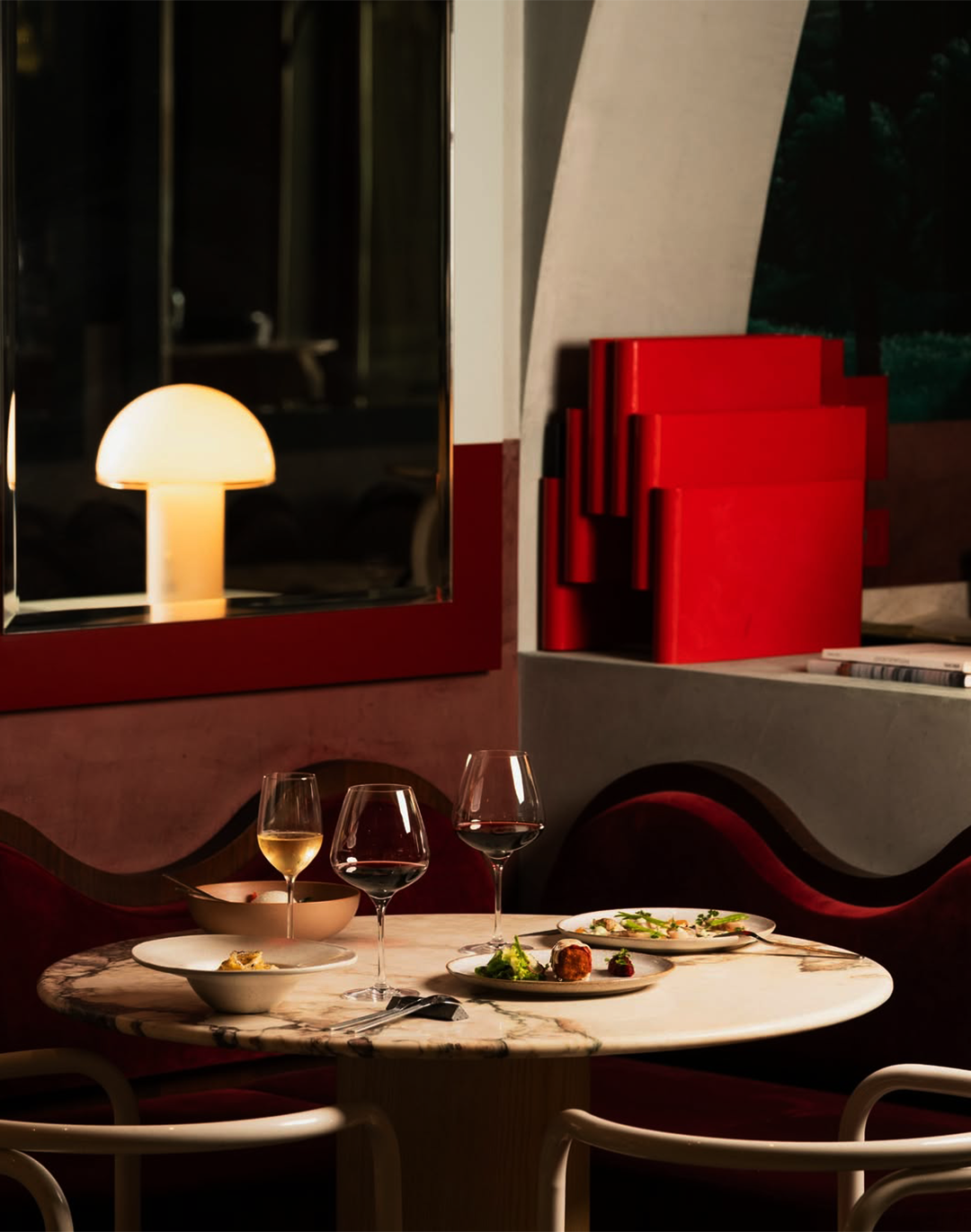
In the heart of Rialto, Naranzaria develops within the ancient Fabbriche Vecchie, reinterpreting the city’s mercantile memory and its historical connection with Mediterranean exchanges. The space restores the original identity of the site through a cuisine that intertwines Venetian tradition, local production and contemporary gastronomic research. Seasonal ingredients and local wines build a coherent narrative of contemporary Venice. Naranzaria stands as a place of encounter and historical continuity, where cuisine becomes a cultural language and the Grand Canal the perfect backdrop for a convivial theatre.