
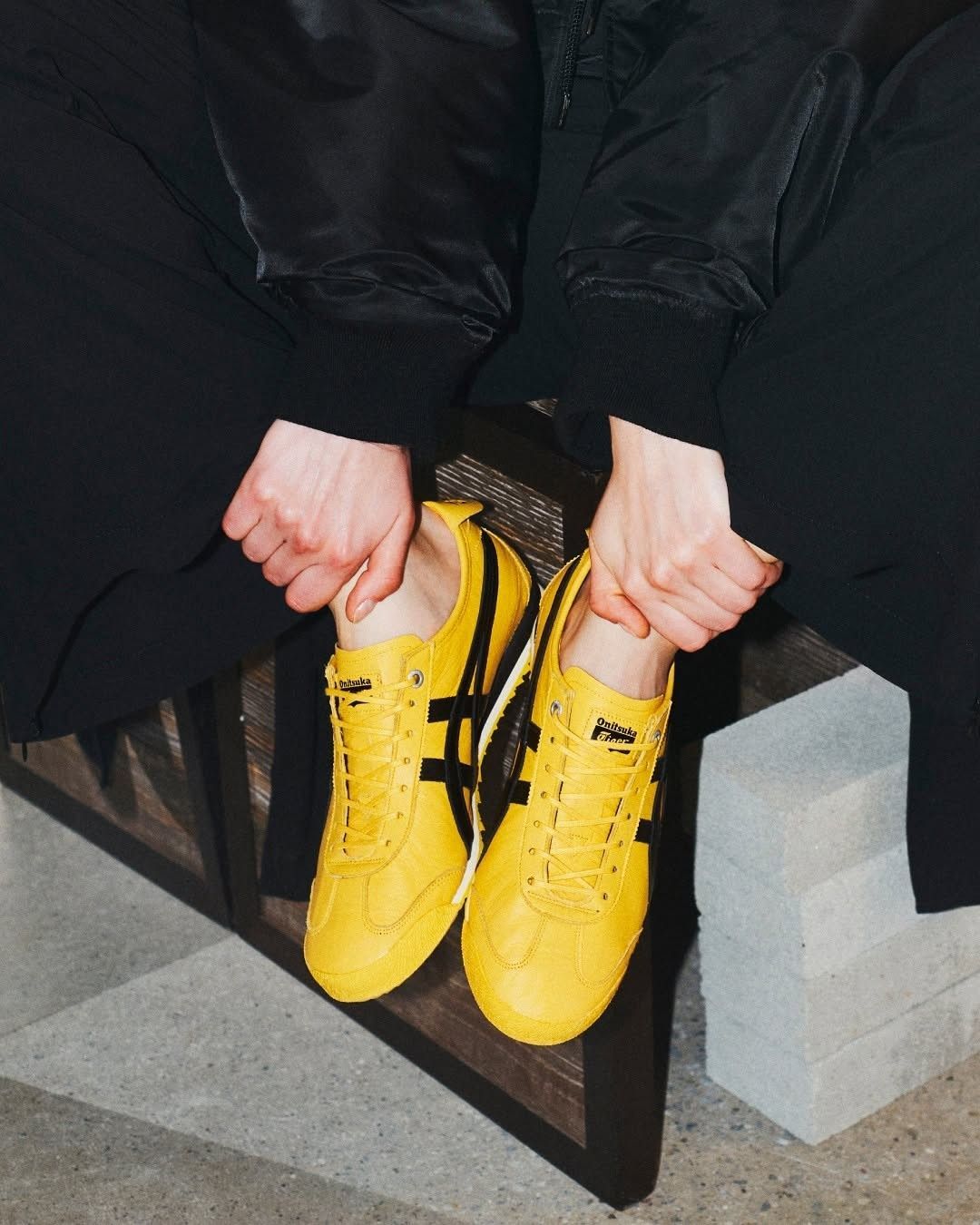
A new era has begun for Onitsuka Tiger The brand, which has been part of Asics until now, will once again become an independent company after 49 years
We are perhaps in the culturally hottest moment for the world of low-top sneakers which, for a few years now, have supplanted the bulkier shoes of the streetwear era. And perhaps this is why the Asics group has decided to change its structure for the first time in its history: starting today, the brand on which the group was built at the end of the 1940s, namely Onitsuka Tiger, will become a standalone entity and thus separate from Asics, which was born in 1977 after the original company merged with GTO and Jalenk to create what we now know as Asics. But what does this decision mean and why is it important?
Room to grow
The idea behind the corporate split marks the maturation journey of Onitsuka Tiger that began around 2017 with the arrival of Andrea Pompilio at the brand, whose task was precisely to elevate the brand’s offering in the fashion field, developing its identity over time. Today (and we will see this shortly) the brand has grown significantly and therefore must embark on a new managerial path that expands its potential.
Last Wednesday, Asics’ board of directors approved the establishment of OT Group Corp., a new company controlled by the parent group that will exist definitively starting from January 1, 2027. In this way, the entire business related to Onitsuka Tiger, including the regional operating entities in various countries, will be transferred to the new company.
The split will however involve an independent headquarters and president. Asics will remain at its historic headquarters in Kobe and will keep its president and CEO Mitsuyuki Tominaga, while OT Group will be based in Tokyo and will be led by Ryoji Shoda, who currently holds the role of brand manager. As mentioned, the reorganization comes at a time of strong growth for the brand, which in recent years has expanded its geographic presence and market recognition.
Where has Onitsuka Tiger arrived today?
In every city whilst shopping one walks straight into this scene
— Gita Rachel Mathew (@gita_mathew) June 4, 2026
While Europe has lines snaking out of Gucci and Prada, here the longest queue is for Onitsuka Tiger.
No hypebeast frenzy or influencer overload — just foreigners patiently waiting for hours because these… pic.twitter.com/9veJVfMgjf
As WWD explains, thanks to its internal management system, the brand has invested in the opening of directly operated stores and has positioned itself as a luxury lifestyle brand, collaborating for example with Versace and Patou. With the transition to an independent operating structure, the aim is to accelerate decision-making processes and develop initiatives more aligned with Onitsuka Tiger’s specific characteristics, while also improving the governance system and the transparency of results across the various divisions and managerial responsibilities.
The numbers confirm the positive moment. In the first quarter of 2026, Onitsuka Tiger’s net sales increased by 33.8%, reaching 37.8 billion yen, equivalent to about 240 million dollars. This result follows the excellent year that was 2025, which closed with a 43% leap compared to the previous year and total sales of 136.5 billion yen, about 850 million dollars. All results achieved thanks to strong performances in Europe, inbound tourism to Japan and the favorable yen exchange rate.
Now the parent company, Asics, intends to balance the growth of its core sports business with the autonomous development of a brand whose ramifications have extended beyond the original scope of the founding company. The transition toward greater operational independence should allow Onitsuka Tiger to adapt with greater agility to market evolutions, while remaining part of the parent company. But in what sense, as we said at the beginning, is this the beginning of a new era for the brand? To understand this, we need to look at its history.
In the beginning there was Onitsuka Co., Ltd.
At the beginning, in 1949, Onitsuka Tiger was born from the meeting between a basketball coach and the former soldier Kihachiro Onitsuka. In Japan at that time, basketball had arrived but not the sneakers to play it – Onitsuka’s mission was precisely to create a Japanese basketball sneaker for Japanese youth.
The first attempts were unsatisfactory but in 1951, while eating a cold octopus and cucumber salad, Onitsuka had an epiphany: if he could reproduce on the rubber the concave shape of the octopus suckers, he would obtain the perfect sneaker for playing on the court. From that ingenious and unexpected intuition, the entire mythology of Onitsuka Tiger would begin.
Bruce Lee Rare Original “Game Death” Hong Kong Movie Poster! The Yellow Jumpsuit, Yellow Nunchaku , and Lastly the Yellow Onitsuka Tiger Shoes..iconic! #BruceLee #GameOfDeath1972 pic.twitter.com/KY0P5mXTLx
— Bruce Lee The Dragon (@bruceleedragon1) April 14, 2026
This is how the original Onitsuka Tiger model was born, which was already adopted starting from 1956 by the Japanese Olympic delegation. In 1964, at the Tokyo Games, sixteen Olympic golds stood on the podium wearing Tigers; the following year the national basketball team won the FIBA World Championship. The partnership with the Olympic delegation would last for twenty-four years, until 1980. During this period the brand name became increasingly linked to the world of Japanese Olympic excellence and competitive sports. The birth of the brand’s most iconic silhouette is also linked to Olympic history: the Mexico 66 presented in 1966 under the name Onitsuka Tiger Limber, during simulations for the upcoming Mexico City Olympics.
Just under ten years later, Onitsuka Tiger would merge with GTO and Jalenk to create Asics. In the meantime, definitive fame had come to the silhouette from the sports world: Tigers had already made their entry into America and their fame grew enormously when they became the sneakers of four-time Olympic gold medalist Lasse Virén and countless other athletes.
1/1 onitsuka tiger’s worn by uma thurman’s character ‘the bride’ in kill bill (2003) pic.twitter.com/K9AY8eS6vT
— Rogue Fashion (@rogue) August 25, 2025
The ultimate consecration, however, would come from cinema: 1978 was the year of Bruce Lee’s last film, Game of Death, in which the legendary actor wore a famous yellow and black outfit with a matching pair of Mexico 66. A combination that would become even more iconic in 2003 with the outfit worn by Uma Thurman in Kill Bill, a direct homage to Bruce Lee.
Another period of prosperity for the brand arrived in the 1990s. When the so-called Urahara aesthetic spread, emphasizing sportswear, colors, hip-hop and punk. It was the era in which the myths of Nigo and Jun Takahashi were born, but also the era in which wearing sportswear was a statement, a lifestyle. It was the period in which the Onitsuka Tiger myth began to grow again in preparation for the powerful 2002 relaunch. And since then the rise of Onitsuka has not stopped.
What to read next

ISSEY MIYAKE and ASICS have created the sneaker of the year
HYPER TAPING™ is a new sneaker inspired by sports taping
The eternal sensuality of slim sneakers
In a very short time, they have become the ultimate cult accessory