





















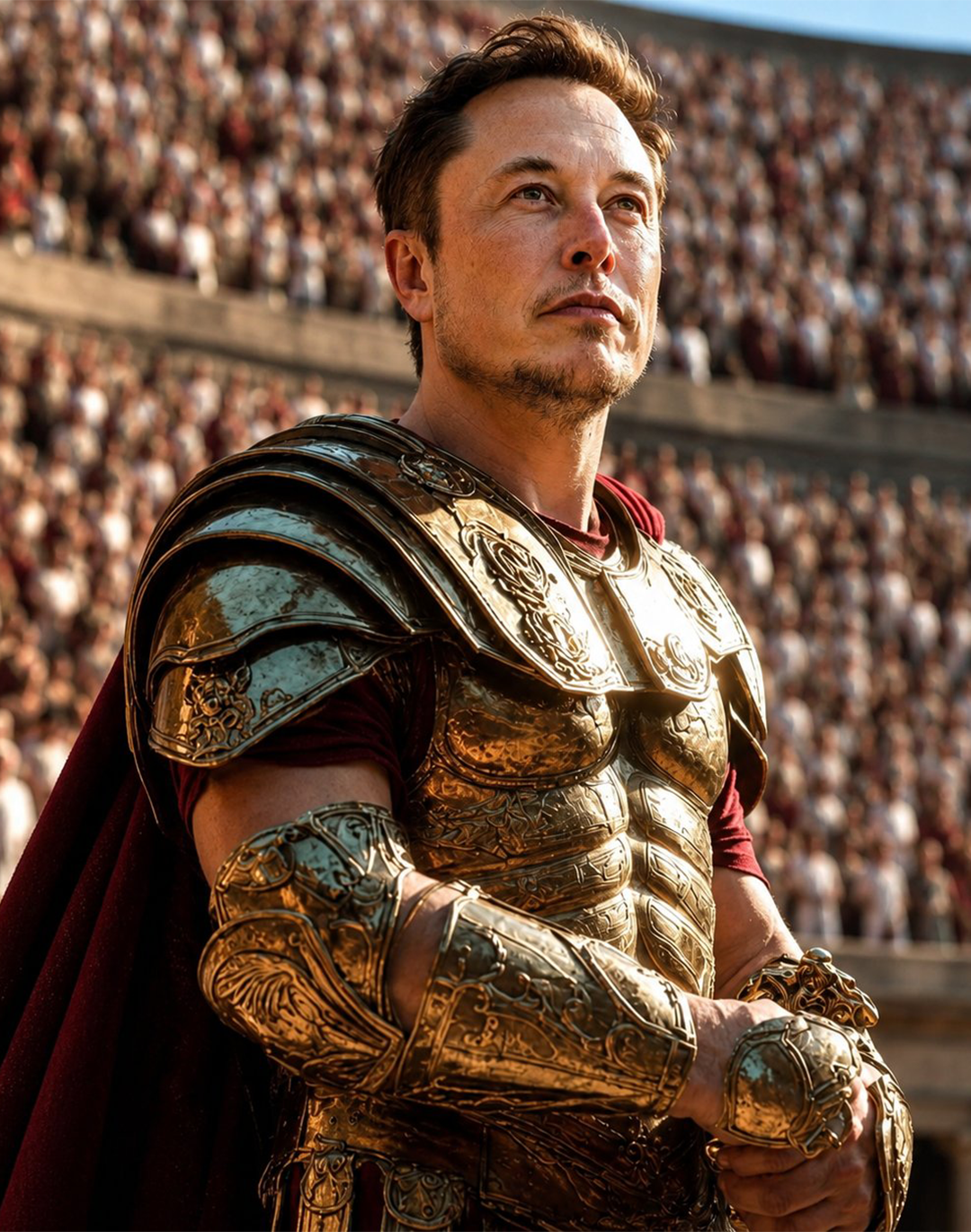
Elon Musk really wants to produce his own version of "The Odyssey" with Grok After the criticism towards Nolan's new film, the trillionaire ignites a war in Hollywood
It is the year of The Odyssey by Christopher Nolan, which, after months of anticipation, is establishing itself as one of the most acclaimed films among critics and audiences alike. Shot entirely in IMAX and boasting a stellar cast led by Matt Damon as Odysseus and Anne Hathaway as Penelope, the film continues to post impressive box office numbers at cinemas around the world. Controversy has naturally followed, and among those who criticized the film even before its release is Elon Musk, who in recent weeks has turned The Odyssey into yet another battleground in his personal culture war against Hollywood.
Not only has the owner of X challenged certain casting choices with arguments that many have openly described as racist and transphobic, but he has gone so far as to announce that his artificial intelligence Grok would soon be capable of producing its own version of Homer's work. In a post published on X he wrote: "Before the end of the year, Grok Imagine will produce a full-length feature film of the Odyssey that will be historically accurate and faithful to Homer's art," followed by a roughly three-minute teaser generated with Grok Imagine, depicting a scene between Odysseus and the nymph Calypso.
So, if even Elon Musk is weighing in on the historical accuracy of Christopher Nolan's work, perhaps it is worth pausing for a moment to ask what it really means to talk about "faithfulness" when adapting one of the most significant texts in Western literature.
The casting controversy
Before this year ends, Grok Imagine will make a full-length movie of The Odyssey that is historically accurate and true to the art of Homer https://t.co/bVHzUmY9WN
— Elon Musk (@elonmusk) July 22, 2026
Even before the film reached cinemas, Musk had reshared on X several offensive posts targeting Christopher Nolan's decision to cast non-white actors and a transgender actor in certain roles. In the crosshairs were Lupita Nyong'o, chosen to play Helen of Sparta and Clytemnestra, and Elliot Page in the role of Sinon. Commenting on those posts, Musk added: "Nolan wants to win awards" and "He has lost his integrity."
These accusations are part of a now-recurring debate about representation in historical films or those inspired by the great classics. A discussion that invariably ends up conflating the concept of historical reconstruction with that of cinematic adaptation, forgetting that cinema is not a documentary but an expressive language with its own rules.
Furthermore, debating the historical accuracy of the Odyssey is already a paradox in itself. The Homeric poem does not recount historically verifiable events, but rather a collection of myths, oral traditions, and stories that accumulated over centuries. Even the figure of Homer is shrouded in uncertainty: according to many scholars, he was not the sole author of the poem, but rather the name through which tradition identified a narrative heritage born from multiple bards and committed to written form only at a later stage.
It is precisely this fluid nature of the work that has allowed for numerous reinterpretations over the centuries. Nolan is no exception; his is a cinematic adaptation that speaks to the present. After all, so-called "poetic license" has always been one of the fundamental tools of every author. Demanding absolute fidelity to a text that, by its very nature, is the product of centuries of transformation means ignoring the way in which culture has evolved.
Can artificial intelligence replace an author?
Musk's announcement also comes at a time when the relationship between cinema and artificial intelligence continues to divide the industry. Even today, making a film of over three hours is a countercultural act, especially in an era when audiences' average attention span is increasingly short. The notion that a work generated through a series of prompts could automatically prove "more faithful" or even "better" than one made by one of the most important filmmakers in contemporary cinema looks more like an ideological show of faith in technology than a genuine artistic project.
For his part, Nolan himself has repeatedly expressed deep skepticism about the role of artificial intelligence in film production: "The idea that it can completely replace human beings and human creativity, to me, is simply an absurdity," adding, "I have never seen a technology adopted with such enthusiasm by Wall Street, by investors and tech companies, as artificial intelligence, while audiences have rejected it so decisively."
A storm in a teacup
Musk's statements have not gone unnoticed. Back in May, Lupita Nyong'o had already responded to the criticism she received over the casting: "Our cast represents the world we live in. I will not spend my time trying to defend myself. The criticism will exist regardless of whether I choose to respond or not." Christopher Nolan also played down the controversy, noting how this kind of discussion now systematically precedes the release of each of his films: "These conversations that arise before people have seen the film are always irrelevant, because none of those taking part in them actually knows what the film is."
If Elon Musk genuinely intends to produce his own version of the Odyssey with Grok, the issue is not so much the technical feasibility of doing so, but rather the idea that a work can be judged solely on the basis of its supposed "accuracy." Because cinema is not a contest of philological fidelity, but also interpretation. And perhaps the real question is not which of the two Odysseys will be more correct, but how many people will actually be willing to sit in a theatre for hours simply to decide which one is better.
What to read next

adidas Originals opens a new store in Rome on Via del Babuino
Here's what went down at the opening event
Miu Miu's commercial boom is coming to a halt
The rest of the Prada Group, however, is holding up well
5 Style Lessons We Can Learn from Jeff Goldblum
How to put together a look inspired by the iconic actor