
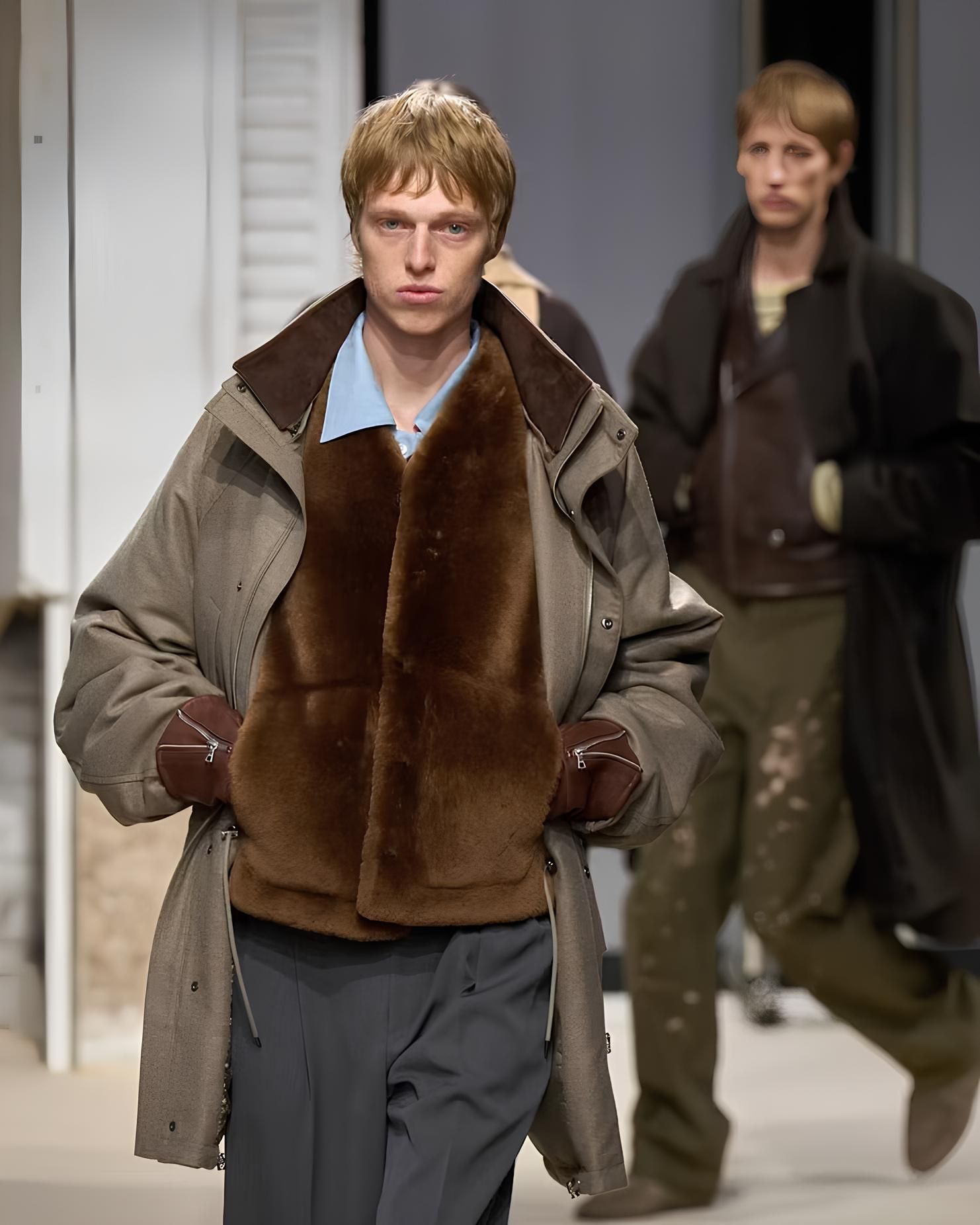
Is menswear going through a creative crisis? Between canceled shows and aesthetic monotony, innovation in men's fashion seems impossible
"Menswear is I think fundamentally designed by men themselves. It's the hardest part of any house to design, because it's such a resistant audience. Men don't like being dictated to like women," Lee McQueen once said. A sentence that perfectly explains the strange period that men's fashion is entering, between cancelled shows and the rise of independent cult brands, and that perhaps signals a real creative crisis in menswear.
The Disappearance of Men's Fashion Shows
The doubt about the changing status of menswear was rightly raised on Instagram by Antonio Padilla, who pointed out a sharp decline in the category that is manifesting itself through cancelled shows, the merging of men's collections into co-ed formats and ever-emptier men's fashion weeks. We could trace it all back to last summer when the men's edition of London Fashion Week was completely cancelled. But even in Milan the men's calendar, as we have noted several times, is emptying out more and more every season. Now things have accelerated.
Just today, Emporio Armani announced it is adopting the co-ed format. At Kering, under Luca De Meo's stabilisation plan, menswear has been completely excluded from McQueen's runway shows, remaining only a commercial appendix. Gucci has also announced a co-ed regime for the foreseeable future, which in truth has been the norm throughout 2025 and the entire Alessandro Michele era. Nothing is known yet about the fate of menswear under the new creative directions at Loewe, Balenciaga and Givenchy. Regarding the latter, Paul Simonon's appearance in the SS26 campaign suggested that a menswear line might actually be launched, though for now it seems limited to a plain black suit.
Overall, even at LVMH menswear appears to be quietly retreating. Dior Men has not held a dedicated Resort show since 2022 and Jonathan Anderson's latest Pre-Fall 2026 collection, released today, confirms it will be presented via lookbook. The last Louis Vuitton show dedicated to a men's pre-collection dates back to 2023; since then there have been only two annual menswear shows, while womenswear has three. Since 2024 Fendi and Kenzo have merged their collections into a co-ed format while Berluti, which only does menswear, has not shown on the runway for five years.
Comparing the numbers of shows between the SS25 and SS26 seasons, we go from around eighty shows in June 2024 to about 55 in June 2025, a drop of roughly 30%. Of course, factoring in the brands that have moved to co-ed format, the net reduction falls to 9%, but the decline still highlights how the category itself is losing importance.
Why Are Menswear Shows Being Abandoned?
For people asking what's the menswear equivalent of this aesthetic, you can check out (in order of appearance): Lemaire, Auralee, Stoffa, and 7115 by Szeki. More affordably, Uniqlo U. Designer lines are $$$, but you can also experiment with stuff like workwear and vintage pic.twitter.com/eQSIRLNqFU
— derek guy (@dieworkwear) October 31, 2024
We do not have precise data on menswear's commercial performance, but it is safe to assume that right now men's ready-to-wear simply does not sell as much as women's. Staging a show costs millions of euros and if menswear makes no real difference in terms of revenue or brand image, in a phase of rationalisation and restructuring it is logical that it is the first to be sacrificed.
In general, men who love fashion are perhaps turning their attention away from the big traditional luxury names. In enthusiasts' conversations today there is more hype around brands like Auralee, Mfpen, Our Legacy, Rier, Stoffa, Studio Nicholson, Comoli or A.Presse, all small labels with very strong communities and heavily focused on minimalist products that emphasise utility construction and exceptional materials.
On the big numbers level, however, the menswear segment is commercially stuck: according to Statista, for example, the total market, while worth hundreds of billions annually, is expected to grow only 1.7% in 2026. According to Euromonitor, menswear should grow about 0.2% more than womenswear over the next four years, though the two segments are very different in size and the latter will remain the dominant category. It is natural to wonder why men's fashion is struggling to take off, and the only answer seems to be its own structural limitations: men largely dress in basic clothing. Which leads us to ask: is menswear falling behind because it is not innovative enough?
All Menswear Is The Same Menswear
For at least a couple of years now BoF has been talking about an epidemic of "sameness" in menswear. The term refers to the monotony of men's looks which, beyond the minimally varied offerings of tailoring and colour palettes, continue to repeat a basic look that oscillates between formal and workwear (all the minimalist Scandinavian or Japanese brands essentially do workwear, grunge and preppy) that ultimately offers no real innovative product to focus on.
Taking two of today's cult menswear stores, Ven Space in New York and The Archivist in Paris, a multi-brand and an archive fashion retailer respectively, we can see that their curation and brand selection is practically immaculate, perfect. Yet it is impossible not to notice that the products that work so well in menswear are generally aesthetically "basic" and instantly recognisable. Looking only at Ven Space, we can see that only four of the dozens of brands in the store (namely Auralee, Dries Van Noten, Comme des Garçons and The Row) are part of any official runway calendar.
@tanner_dean Ven. Space #nyc #fashion Rinsed - Dean Blunt
Moving to the luxury world and examining, for example, Dior's Pre-Fall 2026, which as mentioned was released today, it is easy to see that, removing the mega-shorts inspired by Dior's historic Delft dress and the Napoleonic coats already seen in the first men's show, the real look they continue to bet on includes jeans, monochrome sweaters, blazers and cardigans, loafers: basically a look whose true specialist would be Ralph Lauren and that in general features no design that cannot already be found everywhere, details and workmanship aside.
In truth, in recent years making innovative menswear has often become synonymous with outright feminisation. Which is not a problem in itself, but it causes menswear to lose its mass appeal because it is an aesthetic choice that speaks only to the LGBTQ+ quadrant of fashion customers. After Valentino's latest show, for example, Jacob Gallagher of the NY Times wrote: «I’m not sure that many retailers will be quick to apportion their men’s budgets to sleeveless Big Bird yellow halter tops, see-through shirts and ruched teal blouses. Gender may be a porous concept in high fashion, but commercial realities remain».
More and more, innovating the male wardrobe feels like trying to reinvent the wheel. For the cis-gender segment of that clientele, the offering remains stuck either on Uniqlo-style basics translated across different price points, or on vintage-style clothes already in grandpa's wardrobe, or on a version of casual, slightly tacky and heavily logoed garments worn by wealthy Chinese, Russian or Arab tourists in Europe's luxury capitals or resort locations like Saint Tropez, Gstaad or Capri. But if this is the kind of menswear that is dying, we can certainly say that almost no one will mourn it.
Takeaways
- Menswear is experiencing a creative and commercial crisis: dedicated runway shows are disappearing or being merged into co-ed formats, calendars are emptying (with a net drop of 9-30% in shows between 2024 and 2025) and major luxury groups are sacrificing men’s presentations to cut costs.
- Men’s ready-to-wear sells less than women’s and contributes little to brand image, pushing houses like McQueen, Gucci, Dior, Fendi and Kenzo to reduce its visibility.
- Meanwhile, enthusiasts are shifting their attention to small, community-driven independent labels (such as Auralee, Mfpen, Rier, Stoffa and Our Legacy) that offer essential minimalism built on exceptional materials and “basic but perfect” silhouettes.
- This aesthetic uniformity makes almost all contemporary menswear interchangeable and lacking true product innovation. When innovation is attempted, it often results in overt feminisation that mainly appeals to an LGBTQ+ niche and fails to resonate with the mass market.
- The result is a sector that seems unable to break out of the loop of jeans, blazers, monochrome sweaters and revisited workwear, while the average male consumer continues to prefer safe, timeless and low-risk pieces.