



















How Asian designers are revolutionizing Haute Couture In recent days, four designers have focused not on the past but on cultural celebration
For decades, Western Haute Couture has functioned as a perfectly oiled symbolic machine: a system built on the celebration of craftsmanship and the myth of the Parisian Maison. However, at the latest 2026 Paris Couture Week, four Asian designers proposed a new language for Haute Couture, one that goes beyond the system to become a tool for self-narration, cultural dialogue, and creative responsibility.
Here they are.
1. Robert Wun and the biographical cue
@wisdm8 Robert Wun Couture. Spring 2026.
original sound - Wisdom Kaye
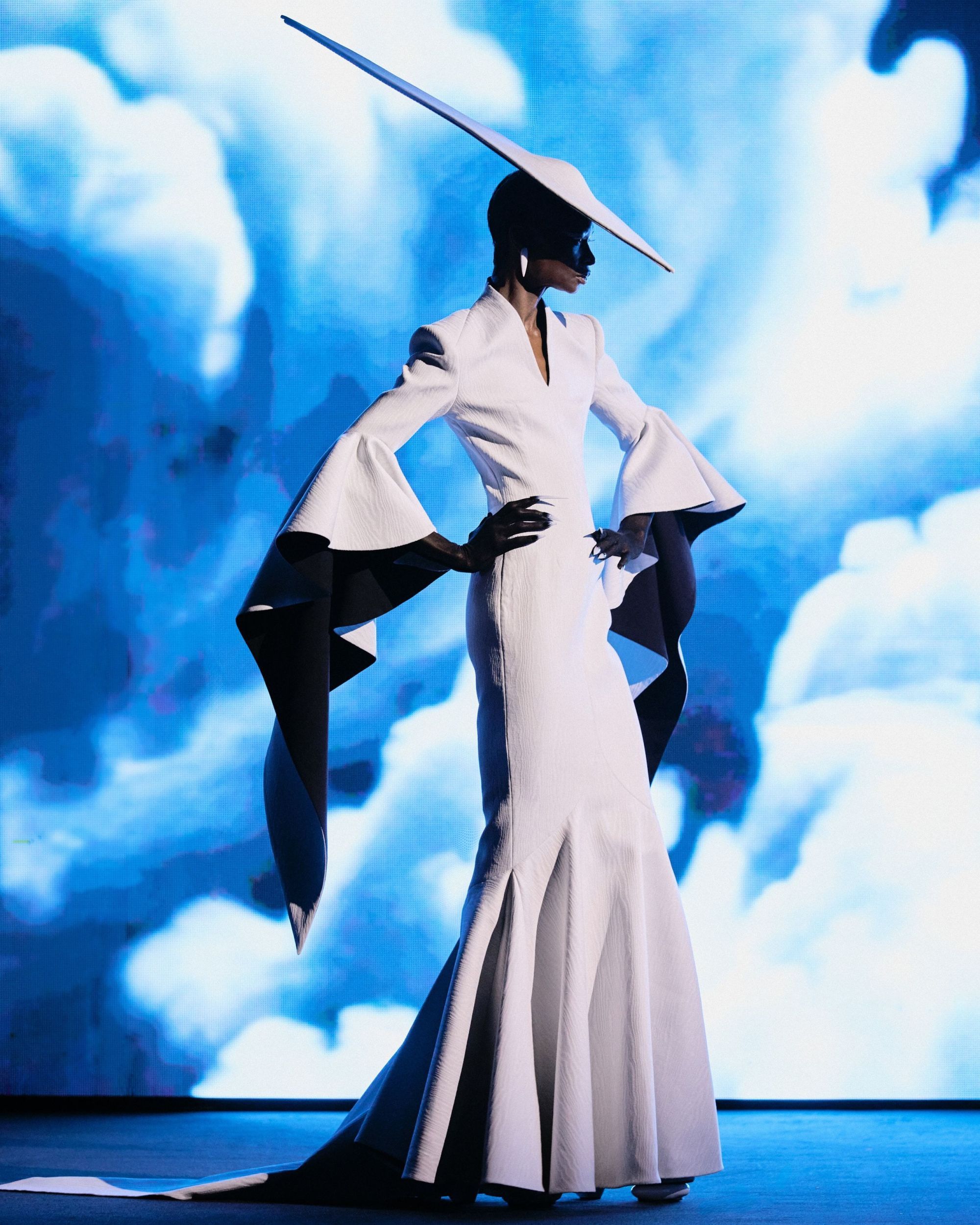
Graduated from the London College of Fashion in 2012, Robert Wun was the first Hong Kong designer to walk the Parisian Haute Couture runway. The 2026 Couture collection, Valor: The Desire to Create, and the Courage to Carry On, is an existential parable divided into three acts. The first, Library, is set in an ideal library made of white pages stained with black ink, the same colors used in the initial silhouettes. It is the memory of days spent studying, drawing, the beginning of his own career. These rigid structures are accompanied by delicate notes such as applied butterflies and transparent veils on headdresses that culminate in a dress with a circular structure, covered in glass pearls.
The second act, Luxury: Confrontation of Reality, stages the clash between creative aspiration and economic reality. The initial dream collides with bills, expenses, with the demands of an industry that assigns value to the final product according to its own logic. The models become display stands for velvet jewelry: pointed breasts, hands in coquettish poses, strands of stones and pearls wrapping the body, reminding that beneath the object there is living flesh. The final act, Valor, takes on the contours of an epic. In the background, lightning and thunderbolts announce the arrival of the hero: the designer who chooses to challenge the system, economic difficulties, and his own inner battles in order to defend his art.
2. Miss Sohee and the narration of the female body
Sohee Park continues to do what she does best: exalting femininity by creating a bridge between West and East. In the sumptuous interiors of the Shangri-La Hotel, the 2026 Couture collection presents itself as a journey to her summer home in the far south of Korea, overlooking the sea. Wisteria leaves and mother-of-pearl inlays bloom on slender and tapered figures; the peacock appears in various looks as a headdress or accessory; the blue motifs on a white background, typical of Qinghua porcelain, are transposed onto a dress with a coordinated clutch.
Although the silhouettes are rather classic and feminine, a bit in the style of Bridgerton but more sophisticated, they are amplified by scenographic elements: bamboo and cherry branches climb around the models, trompe l’œil that slim the figures, strass and crystals, opulent embroidery and draping. Each look is rich in details: fan-clutches, long chains of beads attached to jade bracelets.
3. Yuima Nakazato and the connection with nature
@nssfrance L’asmr du défilé Yuima Nakazato à Paris #fashion #hautecouture #asmr #fashiontiktok #parisfashionweek original sound - nssfrance
The only Japanese designer to present a Haute Couture collection in Paris, Yuima Nakazato staged an immersive experience, with no background music, no sensational graphics but only the constant white noise of two ceramic objects produced by the designer himself, seated on the floor of the presbytery of the American Cathedral.
According to WWD, the designer reportedly spent 1,500 hours over six months to create all the ceramic elements to apply to the garments: some resemble leaves, others irregular stones, still others look like mushrooms. The pieces, glazed in white with gold and silver outlines, are applied to fabric bases that become completely marginal since it is the ceramic that plays the primary role in covering the body, enhancing it, inhabiting it.
Fabric and knitwear are relegated to supporting roles. The genesis of this collection is a journey through the ancient forests of Yakushima, an island south of Kyūshū, Japan, of which the collection seeks to reproduce the cedars and river stones. The color palette is therefore reduced to shades of white, black, and brown; in some cases, the fabric has been treated with metallic coatings and crumpled as if to replicate the appearance of bark.
4. Phan Huy and Vietnamese art
The youngest of the group, Phan Huy founded his maison in 2023. Born in Vietnam and trained between Asia and Europe, he uses Couture as a tool for cultural preservation, transforming it into a living archive of memories and innovation. The title of the 2026 Couture collection, Cành Vàng Lá Ngọc (The Golden Branch and Jade Leaf), recalls the decorations symbolizing Vietnamese royal opulence, a metaphor for a nobility more cultural than social.
References to Vietnamese tradition are not didactic or particularly explicit, but filtered through an almost nostalgic sensibility. The show opens with a silk dress with applied flowers, inspired by the silk painting Bridal Adornment by painter Mai Trung Thu. Among the inspirations is also La Grande Odalisque by Ingres, juxtaposed with Nude by Mai Trung Thu. The backs of the dresses are almost more surprising than the fronts: they reveal trailing trains hung from the shoulders with beaded straps, swaying with every step; exaggerated puffed volumes; embroidered fans. The craftsmanship is evident in the voile petals, with edges embroidered with golden beads, that float gracefully with every step.
What is the difference with "classic" Haute Couture?
@nssfrance Voici quelques-uns des looks que nous avons pu voir cette dernière semaine de la Haute Couture dans les rues de Paris. Qu’en penses-tu ? #paris #streetstyle #outfitinspo #fashioninspo #streetfashion ANGELWITHNOWINGS - BLONDE SUPPERMACY
If the great Western names of Couture, from Dior to Schiaparelli, use Haute Couture as a mythological machine (exaltation of craftsmanship, historical quotation, and symbolic power), these Asian designers seem to use it as a tool for self-narration. Robert Wun stages the existential conflict of the contemporary creative, torn between vocation and survival; Miss Sohee uses women's bodies as a surface for dialogue between East and West; Yuima Nakazato translates artisanal knowledge onto a terrain beyond fashion, turning the dress into an artistic installation; Phan Huy restores to Haute Couture an intimate and spiritual dimension, in which the garment is not a trophy but a means of cultural transmission.
The difference does not lie so much in the aesthetics, as in the intention. What emerges is a substantial difference: while Western Haute Couture tends to celebrate the system represented by the Maison, heritage, and the dream of luxury; that of these Asian designers seems to question the very process of creation. The creative act is never neutral, but laden with cultural, emotional, and material responsibility. The body is not just an aesthetic support, but a territory of dialogue; the material is not just decoration, but a carrier of meaning.
The risk of remaining trapped in one's comfort zone exists, especially for the more established Miss Sohee and Robert Wun, but it is precisely the tension between identity, tradition, and contemporaneity that makes their contribution to Couture not only relevant, but necessary: because it reminds us that Haute Couture is not merely an exercise in style, but a living language, capable of telling stories that the Western system often