





























Is smoking glamorous again? Just like in the 90s
Over the past month, the “cigarette comeback” has once again appeared where it really matters, within the pop imaginary. Kylie Jenner was seen smoking a cigarette in the new music video by A. G. Cook for Residue, a track tied to the soundtrack of Charli xcx’s film The Moment. Meanwhile, Connor Storrie and Hudson Williams, the stars of the show of the moment, Heated Rivalry, are often photographed with a cigarette in their mouths, both within the context of the series and outside of it. On that note, Williams found himself at the center of a small controversy when, outside the Giorgio Armani show, he was reprimanded for lighting up a cigarette. Closing the circle was Sean Penn, who was spotted smoking indoors at his table during the 2026 Golden Globes.
Hollywood stars have started smoking again
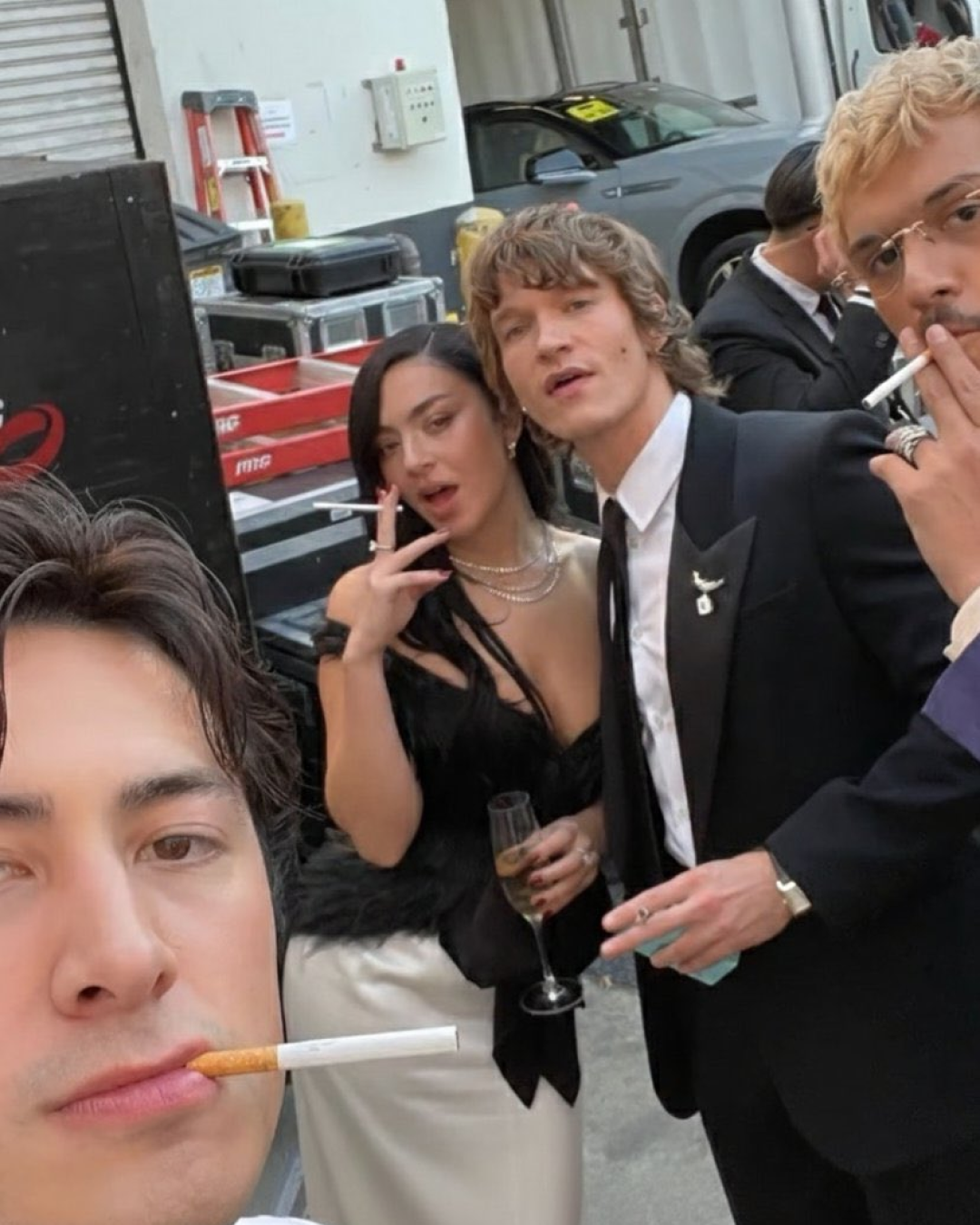
A growing number of people, especially young people and celebrities, are reclaiming smoking as a glamorous and emancipatory act, almost as if it were a way of asserting their identity. Cigarettes, in short, are regaining a certain appeal, particularly within show business and the creative industries. Brands Christian Cowan and LaQuan Smith at last year’s New York Fashion Week sent some models down the runway with a cigarette in hand.
Charli XCX had previously stated that embodying the “brat” style required, among other things, a pack of cigarettes and a Bic lighter; Rosalía herself showed up at the British singer’s birthday party with a bouquet of flowers and cigarettes. Lady Gaga, too, is portrayed smoking a cigarette on the cover of her recent single Die With A Smile. The same goes for Addison Rae in the music video for Aquamarine: speaking to Interview Magazine, the American singer encouraged people to smoke “real” cigarettes rather than electronic ones.
What is surprising is that this trend is also affecting the film and television industry, an area in which smoking had seemingly become taboo. Especially in the United States, anti-smoking campaigns over the past twenty years had almost entirely erased cigarettes from Hollywood. In fact, smokers often tended not to admit it publicly, given the growing stigmatization. Paul Mescal has not hidden the fact that he refused to quit smoking during training for the filming of Gladiator II. Jeremy Allen White is also a habitual smoker, both in his private life and in The Bear, as is Lily-Rose Depp, particularly in The Idol. In the TV series Griselda, the protagonist smokes a cigarette in practically every scene.
More and more cigarettes are appearing in films
@justsammorris Only Carrie Bradshaw made smoking look as cool as they did in Saltburn, good grief!
Murder On The Dancefloor - Sophie Ellis-Bextor
What has changed compared to the past is the visibility of cigarettes in American films and TV series. Of the ten titles nominated for the 2024 Academy Award for Best Picture, nine contained scenes in which characters smoke, three more than the previous edition. In Oppenheimer, for example, cigarettes appear in more than 130 scenes, and during filming Cillian Murphy revealed that he smoked around 3,000 cigarettes in total, joking that in his next film he would like to play a non-smoker.
Asteroid City by Wes Anderson is the film with the most smoking scenes, with over 150 such shots. Back to Black, the biopic about the life of Amy Winehouse, includes around ninety smoking scenes, while Challengers has a total of 62. Bradley Cooper, in the biopic about conductor Leonard Bernstein, Maestro, smokes in almost every scene. In Saltburn, director Emerald Fennell chose to set the film in a period before the introduction of the ban on smoking in enclosed public spaces in the United Kingdom, in order to evoke the atmosphere of freedom and hedonism that characterized those years.
For Gen Z, cigarettes are “cool”
The return of cigarettes as a style accessory and symbol of allure is a phenomenon that in Italy, and more broadly in Europe, is harder to grasp, considering that smoking is less stigmatized than in the United States. Experts and associations fear that the renewed prominence of cigarettes in mainstream media could help spread the idea that smoking is cool, risking the undoing of years of anti-smoking awareness campaigns. In this context, the fascination of Gen Z with the 1990s, a period in which smoking was widespread and broadly accepted, also plays a significant role. This has helped revive the sensual, melancholic, and vaguely nihilistic atmosphere typical of that decade.
A clear example of this rediscovery is the success of Instagram accounts such as Cigfluencers, which celebrate “sexy people keeping the art of smoking and being cool alive”. The posts portray famous figures smoking, mixing stars from the past, especially from the 1990s, with today’s celebrities. Judging by the comments under the photos, smoking increasingly appears to be perceived as trendy, despite the fact that the entire world is well aware of the damage it can cause to health.