





























What is the Doomsday Clock? Some scientists argue that we're 85 seconds away from catastrophe
In 1945, Albert Einstein, J. Robert Oppenheimer, and the scientists from the University of Chicago who contributed to the development of the first atomic weapons as part of the Manhattan Project founded the Bulletin of the Atomic Scientists, an independent, non-profit organization created to monitor and analyze human-made threats to humanity’s survival. “The Bulletin,” as stated in its manifesto, “was born as an emergency action, created by scientists who recognized the urgent need for public awareness in the aftermath of the atomic bombings of Hiroshima and Nagasaki.” Even then, scientists understood that the atomic bomb would be only the first of many “dangerous gifts from the Pandora’s box of modern science.”
In the years that followed, rapid technological and scientific progress did indeed give rise to new and complex challenges, with repercussions on the environment, public health, cybersecurity, and the misuse of genetic engineering and artificial intelligence. It was within this context that, in 1947, the Bulletin of the Atomic Scientists introduced the Doomsday Clock, a symbol representing the estimated probability of a human-caused global catastrophe. “Its hands indicate how close we are to extinction,” reads the official website of the academic journal.
How does the Doomsday Clock work?
The point of no return is set at midnight: the closer the hands move toward that symbolic hour, the more imminent the catastrophe becomes, and the harder it is to reverse course. Responsibility for updating the clock lies with the Bulletin’s Board of Directors, made up of scientists specializing in nuclear technology, climate science, and global security, alongside nine Nobel Prize laureates, who meet twice a year to assess the state of the world.
When it was first created in 1947, the Doomsday Clock stood at seven minutes to midnight. It was the dawn of the Cold War, just months after Hiroshima and Nagasaki. Over nearly eighty years, the clock has been updated 27 times: in 1953 it reached two minutes to midnight following hydrogen bomb tests by the United States and the Soviet Union; in 1991, with the end of the Cold War, it moved back to 17 minutes.
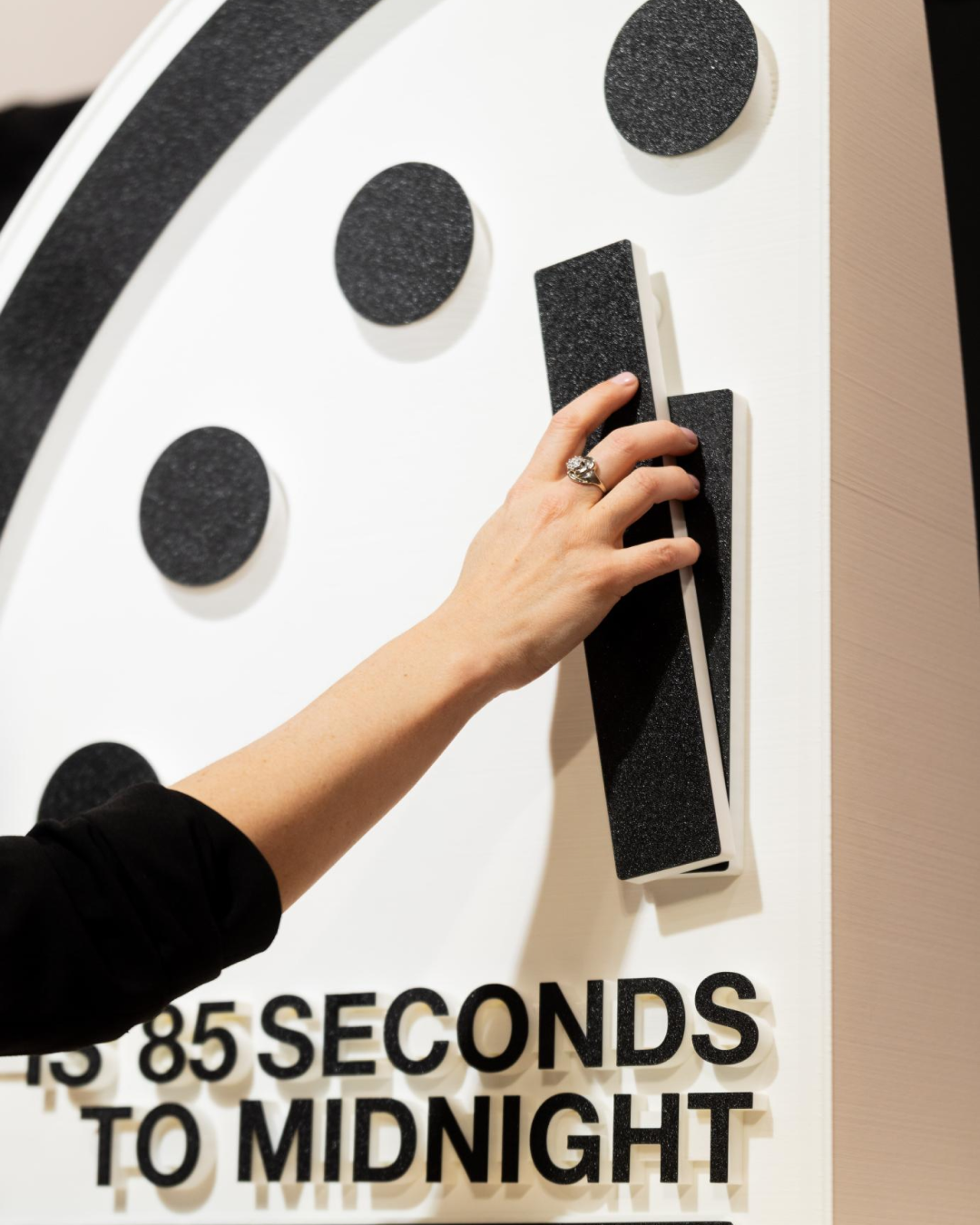
Since then, however, the time remaining has steadily decreased. On January 28, 2026, the Bulletin announced that the clock now stands at 85 seconds to midnight, the closest it has ever been to catastrophe. In just one year, four seconds were lost, confirming a sharp deterioration in the global outlook.
Why the apocalypse is getting closer
According to the Bulletin’s Science and Security Board, this worsening scenario is the result of a convergence of factors. On the geopolitical front, the conflict between Russia and Ukraine continues to include references to the possible use of nuclear weapons; tensions in the Middle East between Israel, Gaza, Iran, and the United States have also led to direct attacks on nuclear infrastructure; while in Asia, unresolved tensions persist among China, Taiwan, and North Korea, alongside the more recent armed confrontation between India and Pakistan, both nuclear-armed countries. At the same time, the United States, Russia, and China have intensified a new arms race, modernizing delivery systems and increasing the number of warheads.
Added to this is the climate crisis. The year 2024 was the hottest ever recorded, with 2025 showing similar figures, and atmospheric carbon dioxide levels reaching 150% of pre-industrial levels. Heatwaves, droughts, floods, and rising sea levels have affected vast areas of the planet, from the Amazon to Africa and across Europe. Political responses, however, remain inadequate: recent decisions by the Trump administration to dismantle climate policies, undermine renewable energy, and withdraw from international agreements have further exacerbated the situation.
Finally, risks linked to biotechnology and artificial intelligence are growing. The Bulletin has raised the alarm over the potential laboratory creation of so-called mirror life, mirror-image life forms that could evade all biological controls. At the same time, the use of AI in military and healthcare contexts raises concrete concerns, from the design of new pathogens to the destabilization of global information systems, in a climate marked by widespread disinformation and the return of nationalistic and authoritarian logics.