
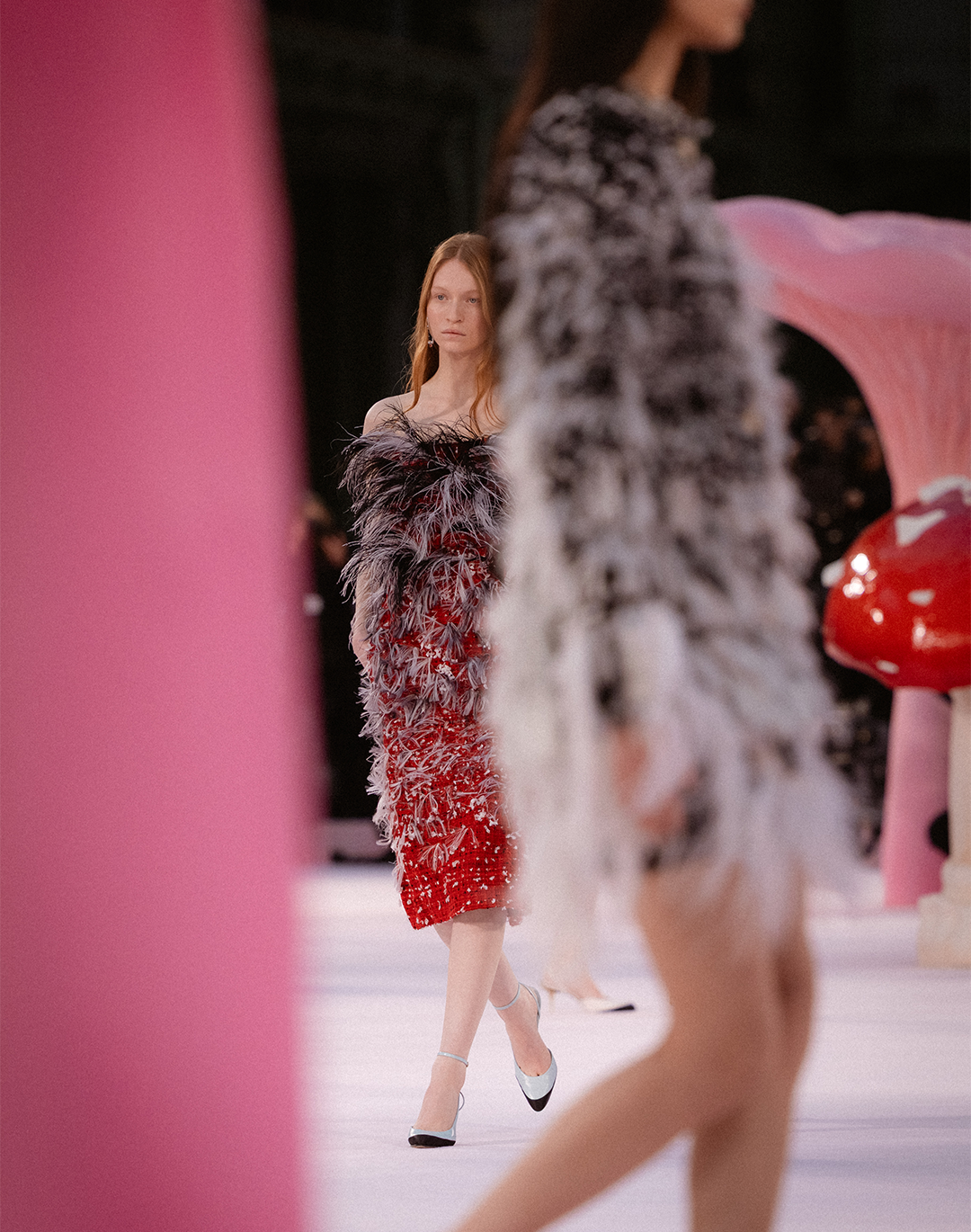
Who decides the boundary between ready-to-wear and Haute Couture? The latest Couture Week showed us how the fashion system is changing
The Haute Couture Week in Paris has just come to an end, yet amid new debuts, long-standing confirmations and unexpected surprises, something does not seem to convince the fashion system. From this season, a series of questions emerges, moving across three levels: aesthetics, the reconsideration of the hierarchical boundary between Haute Couture and ready-to-wear, which this year appears to have thinned, and the role of Couture as a branding tool within a context marked by a growing crisis in luxury sales.
The reflection also concerns the very function of Couture today. Should these garments remain unrepeatable spectacles for social media, or return to a normality that mirrors the lives of clients? The central question concerns precisely the meaning and destination of a form of luxury that historically has never known mass production. Haute Couture seems to be entering a new era, one of the last remnants of the old world’s hierarchy, with the arrival of a new generation of designers who are charging it with something new, unexpected and not without risk.
How does Haute Couture work?
Haute Couture is perhaps the crown jewel of the entire fashion system, not necessarily in terms of revenue but for the savoir-faire of the maisons. Not every brand can aspire to take a place in the Olympus of haute couture: the title is protected by French law and regulated by the Chambre Syndicale de la Haute Couture (part of the Fédération de la Haute Couture et de la Mode). To be officially recognised as a maison, a brand must comply with specific criteria: having ateliers in Paris with at least fifteen permanent employees; presenting collections twice a year with at least fifty looks per season (day and evening); and creating each garment made-to-measure using traditional tailoring techniques.
Part of the controversy raised by the more general online audience concerns the very concept at the core of Couture: garments as manifestos of heritage and savoir-faire, shaped by a spectacular component that makes them almost works of art. This, however, belongs to a contemporary imaginary of Haute Couture, as in the first half of the 20th century bespoke garments, although made to measure for clients, followed a tradition of impeccable craftsmanship and rigorous tailoring, without market segmentation. Today, on the other hand, the distinction between segments is more evident for reasons of branding. In this sense, the unusual presence of bags in the show by Dior becomes a significant signal: a rare element within a Couture context, yet precisely for this reason revealing of a shift within the industry.
The new era of Haute Couture
@jo.rdyyy There were tears @schiaparelli Berghain - ROSALÍA & Björk & Yves Tumor
To claim that Haute Couture garments may resemble ready-to-wear is, without doubt, a blasphemy. And yet, after the Chanel Couture SS26 show by Matthieu Blazy and the Dior Couture SS26 by Jonathan Anderson, critics noted that the two collections almost seemed like simple extensions of their respective ready-to-wear lines.
Rather than asking what couture is and what it is not, the real question concerns why it appeared so different to us. Haute Couture, for reasons of hierarchy but also of craftsmanship, should enjoy its own autonomy, remaining distant from the dynamics that animate prêt-à-porter, such as trends or, more simply, the risk of a standardisation of the imaginary, instead offering itself as a laboratory of experimentation for designers. Confirmation of this came from Daniel Roseberry at Schiaparelli, who stated that the collection, born from a visit to the Sistine Chapel, was not conceived for reviews or recognition, but for pure creative pleasure. Indeed, pragmatism gave way to wonder: the collection comes to life through an interplay of references and savoir-faire, as in look 30, where the “Elsa” jacket takes centre stage, with accentuated shoulders, hand-painted feathers and 3D bird beaks, suspended between lightness and gravity.
A question of media appeal
Que tus jeans, tu tank top y chaquetita de tweed de Chanel transparentes. Chanel Alta Costura SS26 por Matthieu Blazy. pic.twitter.com/su79kaJfQ6
— Rebeca Maccise (@rebecamaccise) January 27, 2026
There are two issues to consider: the first concerns the shift in presentations, which in recent years have progressively become imbued with meanings, references and cultural stratifications, within which some manage to activate these codes authentically, while others attempt at all costs to appear culturally relevant. In this scenario, the conceptual dimension sometimes seems to replace substance, while the other side of the coin is that the very same spectacularisation of the garment can function as a screen behind which to hide in the absence of real content.
If it is true that the truth lies in the middle, then one may affirm that a seemingly simple garment, or visually understated, is not necessarily devoid of content. On the contrary, it might represent precisely the new point of view we needed, both for Couture and for fashion itself. Spectacularisation distracts: it is fast and dopaminic. Synthesis, on the other hand, when it takes into account cultural and social contexts, rediscovers its ritual and critical dimension.
This was demonstrated by Alessandro Michele in his second Alta Moda outing for Valentino, catalysing the gaze and imagination on the nature of fashion in its duality, suspended between virality and contemplation, through the Kaiserpanorama, which highlighted the absence of a univocal narrative thread: the succession of looks appeared more like a series of epiphanies or illuminations than a coherent narrative.
A new language for haute couture
@juliabutenko Of course, even a couture bag will be super expensive and unaffordable for most of the people, but i’m mostly covering the pov of dior’s loyal clients, who either buy rtw, or couture occassionally. inspired by shoesanddrinks #diorcouture #diorbags #jonathananderson #hautecoutureweek #dior original sound - juliabutenko
In this sense, Haute Couture — or rather, the designers who operate within this context today — does not imitate Ready-to-Wear, but appropriates one of its specific capacities: that of questioning reality, shedding a solemnity that over time had become an end in itself. Jonathan Anderson, with his debut, challenged its codes not only through the introduction of oversized tote bags almost out of place, but also by bringing his ideas to the foreground — which, in turn, can influence the market and generate profit.
The realist poetics of Matthieu Blazy at Chanel, whose core lay in garments conceived for real life, left behind the self-serving opulence that creates distance and renders pieces self-referential. «This collection stems from a reflection on what couture represents: for me, its essence is a poetic exchange between creator and wearer, a dialogue that enhances the unique personality of each client», Blazy stated.
Thus, it is not a matter of replacing the language of Haute Couture, but of constructing a new one. Perhaps because the previous one — hierarchical and solemn — was no longer able to narrate anything, nor to convey messages and narratives that today stand as pillars of contemporary culture, shifting the perspective from which a Couture collection takes shape: no longer conceived primarily for the industry, but as an expression of the designer’s creative vision, with the market as its natural consequence.