
"Scherzetto" by Mario Martone Is a Dive into the Ghosts of the Past Presented out of competition at Venice 83, the Neapolitan director's new film relies on a magnificent Toni Servillo
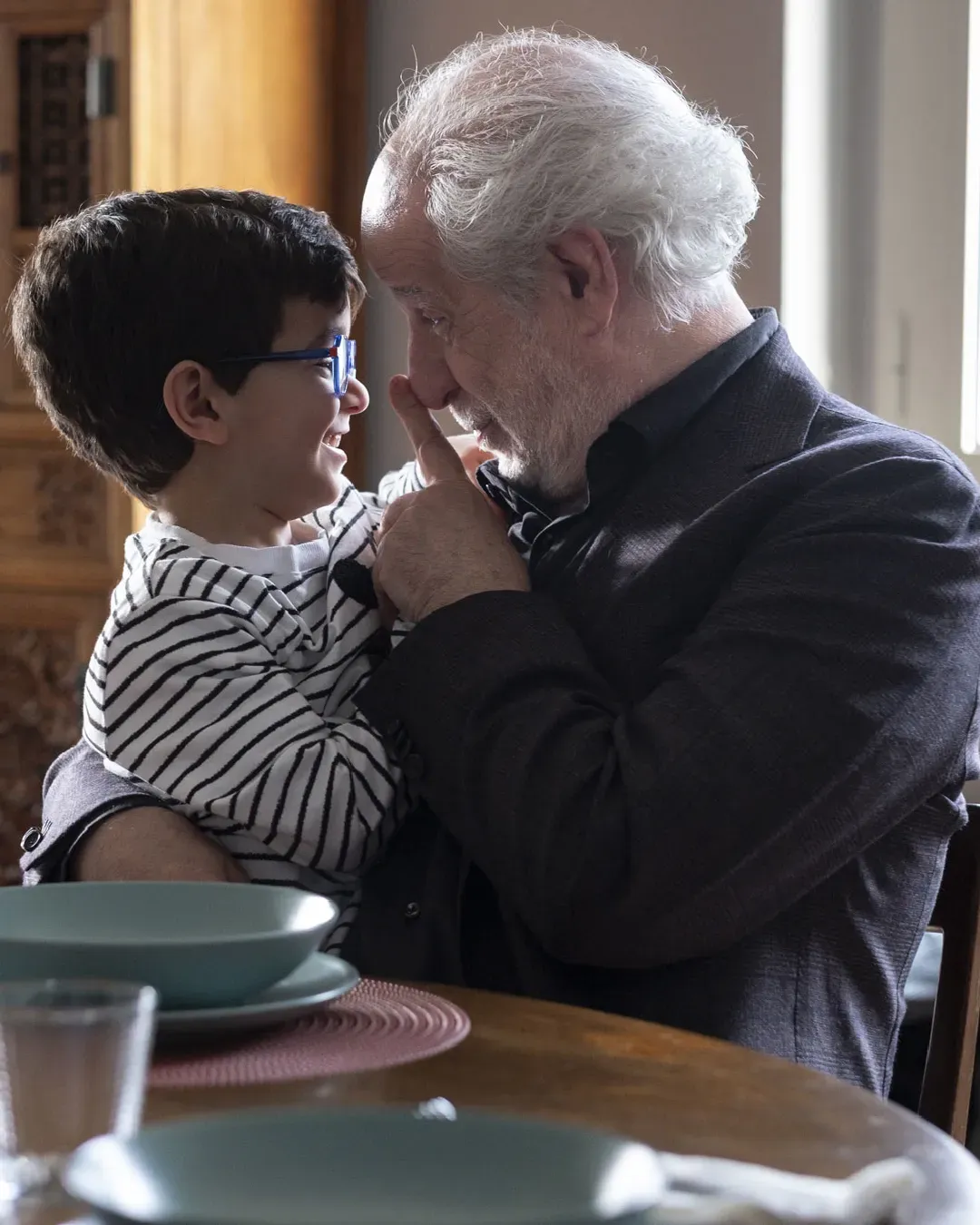
Scherzetto, the new film by Mario Martone presented out of competition at the last Venice International Film Festival and coming soon to cinemas with 01 Distribution, is yet another story set within an apartment. Here, though, people do go outside: Toni Servillo and Lorenzo Perrotta, grandfather and grandson respectively, wander through the neighbourhood, rediscovering a Naples that is fierce and dark, yet where tradition and a certain sense of wonder still endure.
Servillo's character is an illustrator: a man of some renown who has moved to Milan and now returns to Naples to look after his grandson while his daughter (Serena Rossi) and her husband (Leonardo Lidi, previously seen in Serpenti) are away at a conference. The film is adapted from the novel of the same name by Domenico Starnone, published in Italy by Einaudi. The screenplay was co-written by Ippolita di Majo and Martone himself.
Working within a confined space like an apartment allows the direction to breathe, to quickly find a form and a rhythm. This is because, in some sense, it draws close to theatre and that specific dimension, with its own rules and characteristics. While in Naples, Servillo's character must work on the illustrations for a book, but finds himself unable to do so; everything he draws comes from his past, from the childhood he spent in the very house to which he has returned. Much like in a comedy by Eduardo De Filippo, he is haunted by ghosts. But these ghosts are not his enemies: they are the sum of his memories, of the life he has already lived and the experiences that have shaped him into the man he has become.
At seventy, the thought of death is a constant, not an exception. And yet one also learns to keep a certain distance from it, handling it almost coldly. The relationship between Servillo and young Perrotta is one of the driving forces of the entire film. Martone, however, also manages to weave in other moments naturally: the exchanges between parent and daughter, reflections on creativity and art, the very nature of talent, with its fragile and unpredictable character.
There is also a particularly intense moment in which the film addresses the differences between social classes: those who hold a certain kind of job and can afford certain expenses, and those who, in some way, end up bearing the weight of others' wealth — both in purely quantitative terms, a matter of numbers, and in terms of perception. In this, Martone's critique, and that of the film as a whole, of the superficiality of the bourgeoisie is evident — of those who see only their own problems and fail to recognise the complexity of other people's lives.
Servillo's character, who works with his hands and his imagination, represents a kind of point of contact between reality and different dimensions. At times gruff and cantankerous, he knows how to engage with his grandson, who is sharp and quick to respond. Towards the end, Scherzetto takes on an almost dreamlike drift, with more fragmented images and the constant evocation of the ghosts that torment the protagonist. Even so, it manages to preserve an underlying lightness that holds the various moments together. Servillo has absolute command of every scene and handles each interaction with young Perrotta with ease. They have their own language and their own understanding, and this comes through clearly over the course of the film.
The voice-over that accompanies Scherzetto is never excessive or stifling; it lets the story breathe, accompanies it, and serves both as a support and as a guiding thread. Martone places his trust in Servillo while at the same time attempting to build a dimension that exists beyond him, beyond his performance and his character. A dimension made of memories — dark, terrible. Bordering, at certain moments, on the horrific. One thing this film does particularly well is harnessing tension, creating it simply through a gesture or a particular glance, a slight tilt of the frame or a silence that lingers a little longer, heavy with suspense.
In Scherzetto, the protagonist's past and present coexist, but so too do the past and present of a city — condemned by its own creativity and brilliance and only superficially free. Martone works by subtraction: he shows Naples without showing it, uses its absence, the specificity of the Ferrovia district, the everyday gestures of the characters. He addresses social class not by retreating into theory, but by recreating the spontaneity of daily routine. He uses play as a grand metaphor for life and for old age — and, if you will, for cinema itself. Once again, at this Festival, the theme of memory returns as a synthesis of who we are.
What to read next

"Un tranquillo funerale di famiglia" is everything comedy should not be today
Massimiliano Bruno's film had its premiere at the Rome Film Festival
«Club Kid is a once-in-a-lifetime opportunity», interview with Jordan Firstman
Everything about the directorial debut of the American actor and screenwriter
"Cambogia" teaches actors that you have to care about your own characters
Valerio Lundini's directorial debut premiered at the Rome Film Festival