
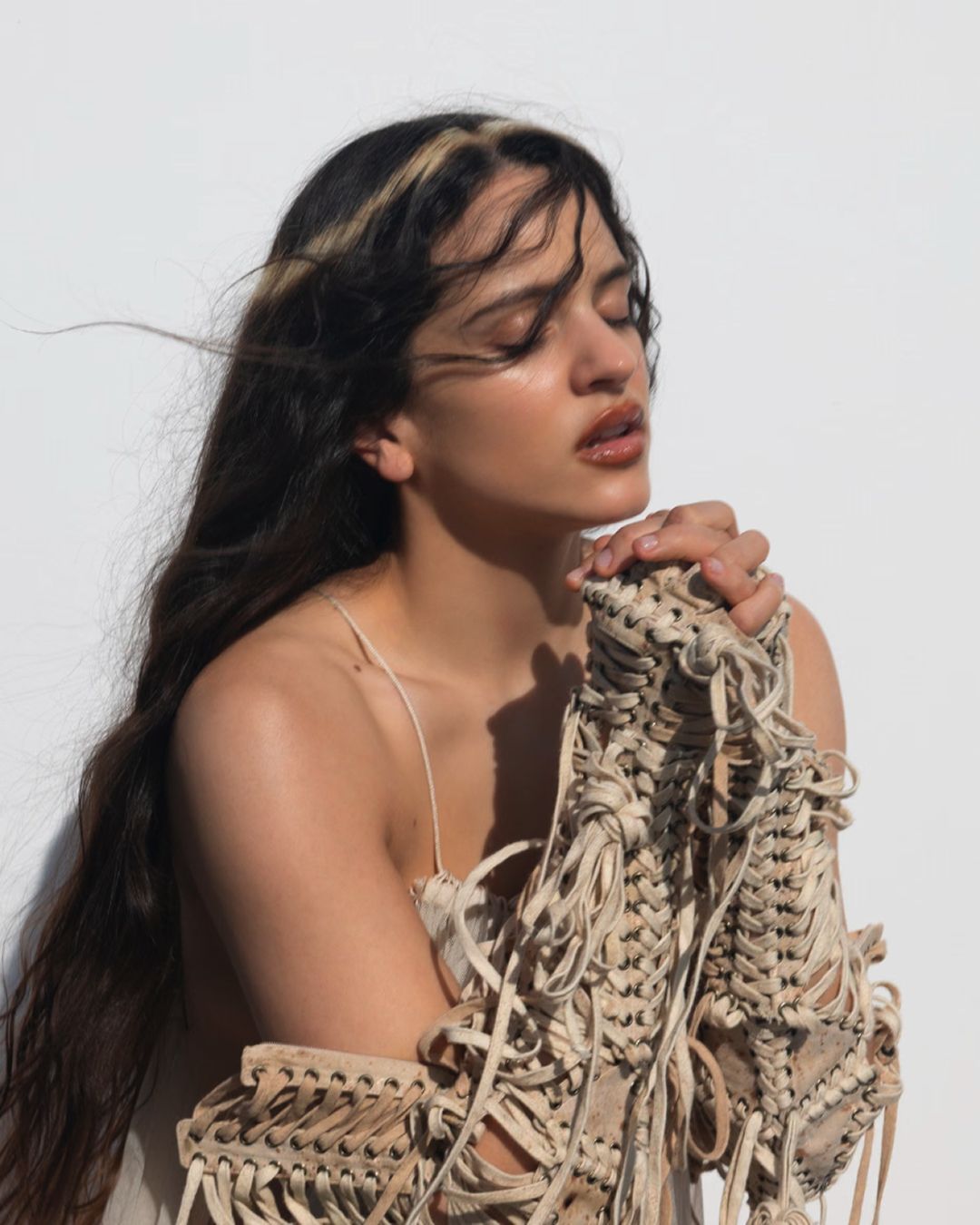
Understanding the greatness of “Lux” by Rosalía The album marking a before and an after in contemporary pop music
The fourth studio album by Rosalía, Lux, was met with great enthusiasm by critics, despite being an album seemingly very distant from the production that had so far characterized the Catalan singer. Rosalía became known thanks to songs in which she reinterpreted traditional Spanish music, mixing it with contemporary sounds close to hip-hop and reggaeton – among the many other genres explored in Motomami, the 2022 album that established her as the most successful non-Anglophone singer in the world. Lux, on the other hand, is a very sophisticated album without particular hits, at least by the standards of today’s music industry, also due to the fact that many of the songs draw from Baroque music, opera, and more generally from the operatic tradition. Not by chance, the album is divided into four movements, where piano, strings, and choirs – along with Rosalía’s voice – are the absolute protagonists. Although instruments tied to electronic music are almost entirely secondary in Lux, the album has great sonic power, but at the same time represents perhaps Rosalía’s most intimate production, for which she collaborated with the London Symphony Orchestra, conducted by the Icelander Daníel Bjarnason.
With all likelihood, Rosalía’s new album will divide the public: some will rank it among the best records of recent years, while others will dismiss it as a mere stylistic exercise by the Catalan singer. The fact remains that the most respected music critics already consider it a masterpiece. The Guardian gave Lux the highest rating, praising Rosalía’s willingness to challenge her audience with an album far removed from commercial and catchy sounds. «Lux sounds like nothing else in music right now. It is a record that no other pop star could have made», wrote the American edition of Rolling Stone. The Guardian expressed a similar stance, describing Lux as «bold and spiritual», and saying it has made Rosalía an «avant-garde auteur». The renowned music magazine Pitchfork also praised the album, as did the New York Times. The Italian magazine Rivista Studio commented instead that «with Lux, [Rosalía] abandons the cyber-pop aesthetic and seeks a more intimate, almost liturgical sound. No slogans or provocations, but an idea of pop that looks to contemporary art and spirituality». In some ways, the imagery of Lux recalls an ultra-modern aesthetic that until now only singers such as Solange or FKA Twigs had partly managed to explore in some of their previous works.
@applemusic “MOTOMAMI was minimalist. This is maximalism.” @La Rosalia on her new album, LUX. Full @Zane Lowe original sound - Apple Music
Lux also stands out for its rich linguistic diversity: among the 15 tracks on the album, there are verses in Arabic, Ukrainian, Latin, Mandarin, Japanese, Spanish, Sicilian dialect and German – as well as an entire song in Italian, Mio Cristo Piange Diamante, which well summarizes the classical music references present throughout the album. Rosalía has stated that she wanted to place more «humanity» at the center of her new production, in opposition to the growing spread of artificial intelligence technologies in contemporary music. The result is an album capable of being intense and at the same time deeply emotional, thanks also to the frequent dynamic shifts that support much of the composition. This, along with the extensive use of the orchestra, is perhaps one of the album’s most distinctive traits, which will very likely mark a before and an after in contemporary pop production.
Rosalía explained that the need to create such a breaking album compared to her previous works arose from a kind of rejection of the sounds that had always characterized her music. The Catalan singer also clarified that the writing of the lyrics was influenced by her study of various female figures, including Saint Lucy, a Christian martyr who lived between the 3rd and 4th centuries – the very cover of Lux itself evokes a spiritual and religious dimension. The album’s release was preceded by the single Berghain, made together with Yves Tumor – a leading figure in contemporary electronic music – and an artist Rosalía has never hidden as a source of inspiration: Björk, one of the most influential singers in experimental pop. In addition to these and other contributions, the album boasts several major collaborations, including those with Guy-Manuel de Homem-Christo (former member of Daft Punk), Pharrell Williams, and Charlotte Gainsbourg.
What to read next

Blondie and Cortado Coffee Shops Open Two New Locations in Paris
Rosalia and Jacob Elordi’s favorite coffee shops continue their takeover of the French capital
All the saints and nuns mentioned by Rosalía in “Lux”
In addition to Saint Rosalía, of course