
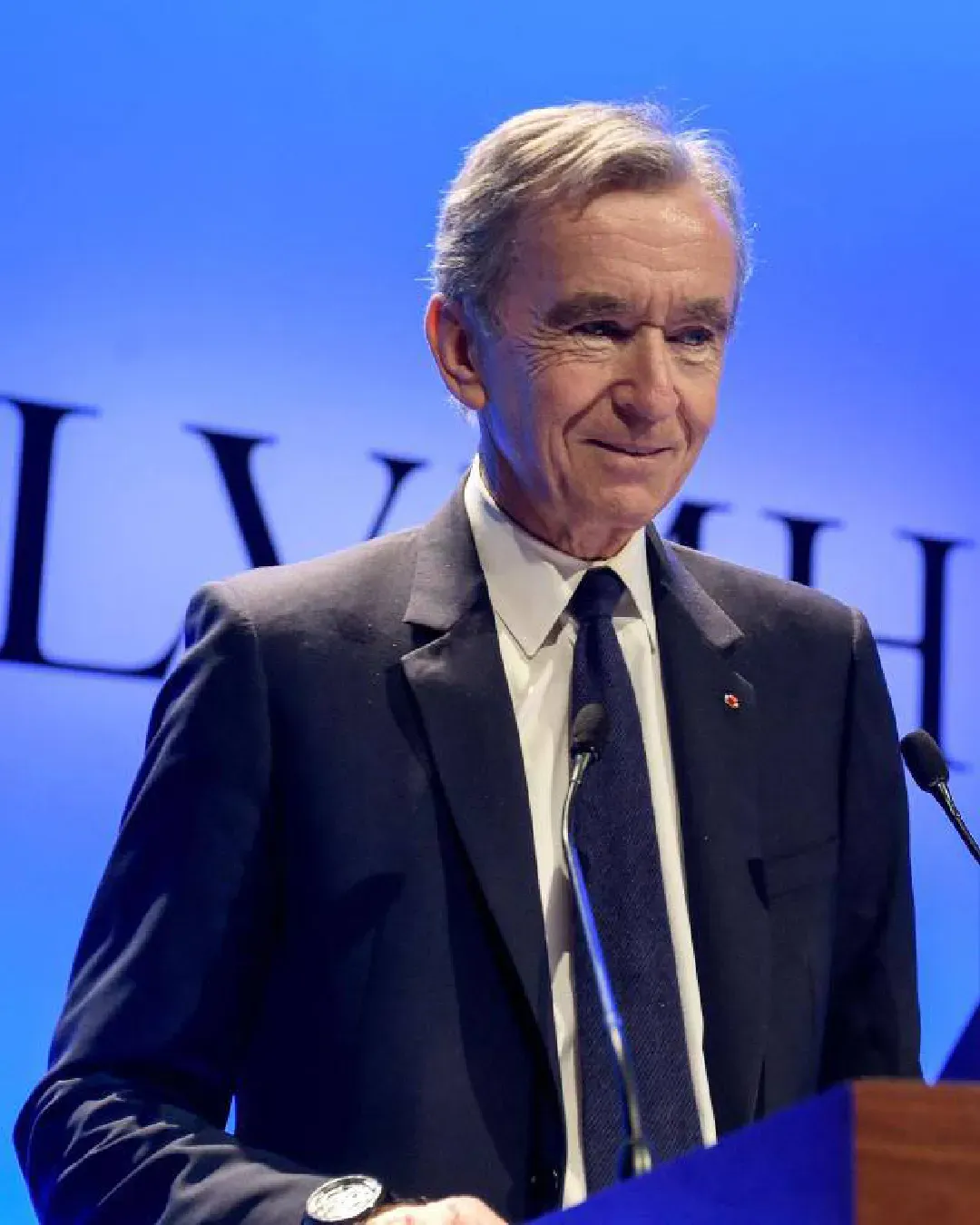
What is happening (again) at LVMH? The Arnault clan restructures and looks to the future
Money never sleeps, and the Arnault family knows this well. That is why, as the tectonic plates of the luxury industry shift with seismic jolts, fashion's imperial family is reorganizing its ranks. The moment is a weighty one: just over a week ago, L'Oréal's stock overtook LVMH's on the Paris Stock Exchange, and the family holding company, Agache, is no longer in the top 10 of Europe's highest market-cap companies for the first time in a decade.
LVMH, however, remains the greatest power in luxury. And while uncertainty over the empire's succession plans is causing unease, the future heirs are broadening the scope of their business dealings. We have seen young Alexandre Arnault step away from his managerial roles to join, somewhat mysteriously, Nike's board; we have seen the second-born, Antoine Arnault, become a shareholder in a hypercar company. We have also seen the family patriarch, Bernard Arnault, decide to sell off brands that are less useful to his arsenal, such as Marc Jacobs, Stella McCartney, and even Off-White. And the news is not over yet.
The Arnault family yesterday announced a sweeping reorganization plan aimed at simplifying the chain of companies through which it exercises control over LVMH: the group and Dior are separate entities, controlled by Financière Agache, which is in turn controlled by Agache SCA. In short, the family wants to consolidate its controlling stake into a single listed entity, while preserving its guarantees over the unified management of LVMH.
But what does this mean?
The Arnault Reorganization
@tarnaultfam_lmfans Arnault Family @Dior Fall/Winter 2026-2027 Couture collection by Jonathan.anderson #fredericarnault #bernardarnault #jeanarnault #dior #เทรนวันนี้ Illusionary Daytime x - Extended Edit Version - Shirfine
According to the plan disclosed by Christian Dior, the restructuring first involves the merger of the family holding company Agache with its operating subsidiary Financière Agache. The resulting entity will then be incorporated into Christian Dior, which will in turn be converted into a partnership limited by shares and renamed Agache. Once these operations are complete, the "new" Agache will directly hold 49.76% of LVMH's share capital and 65.55% of voting rights, effectively consolidating the entire stake of the family group, of which Bernard Arnault will remain the more or less absolute head.
However, converting Christian Dior into a partnership limited by shares will trigger, under French law, the obligation to launch an all-cash public tender offer for the shares not held by the Arnault family — namely the 2.44% of capital still in the hands of outside investors, which the family is legally required to purchase in order to give everyone the opportunity to exit on fair terms. Buying all those shares in cash at the current market price would mean spending €1.63 billion, though the price is subject to change and will be determined in the final days before the decisive shareholders' meeting.
One notable aspect for minority investors is the absence of a squeeze-out procedure. Those who do not tender their shares will be able to choose to remain shareholders of the new Agache, which will continue to be listed on Euronext Paris. In this way, the Arnault family will not force out any potential minority shareholders, leaving open the possibility of remaining invested in the company that will exercise direct control over LVMH.
The plan will need to receive shareholder approval and regulatory clearance, starting with the Autorité des marchés financiers. The extraordinary general meeting of Christian Dior, which will set everything in motion, is expected to take place by December 2026, while the public tender offer is expected to open in the first quarter of 2027, once the authorization process has been completed. Christian Dior's board of directors will also establish an ad hoc committee tasked with proposing the appointment of an independent expert to assess the fairness of the offer's financial terms.
This simplification comes at a time when the Arnault family has strengthened its stake in LVMH, crossing the 50% threshold of share capital in recent months. The strategy behind it has been to turn misfortune into a tailwind — taking advantage of LVMH's stock market decline, which has lost 38% since the start of the year, to carry out the entire operation with less expensive shares. This reorganization should therefore both make the corporate structure behind the group more efficient and stably and transparently consolidate the Arnault clan's ownership of their empire. Accountants and administrators will be working overtime, ça va sans dire.