.gif 2000w)






































Is the series "Minerva: La scuola" just war propaganda? And it makes us wonder why anyone felt the need to tell a story about a military school today
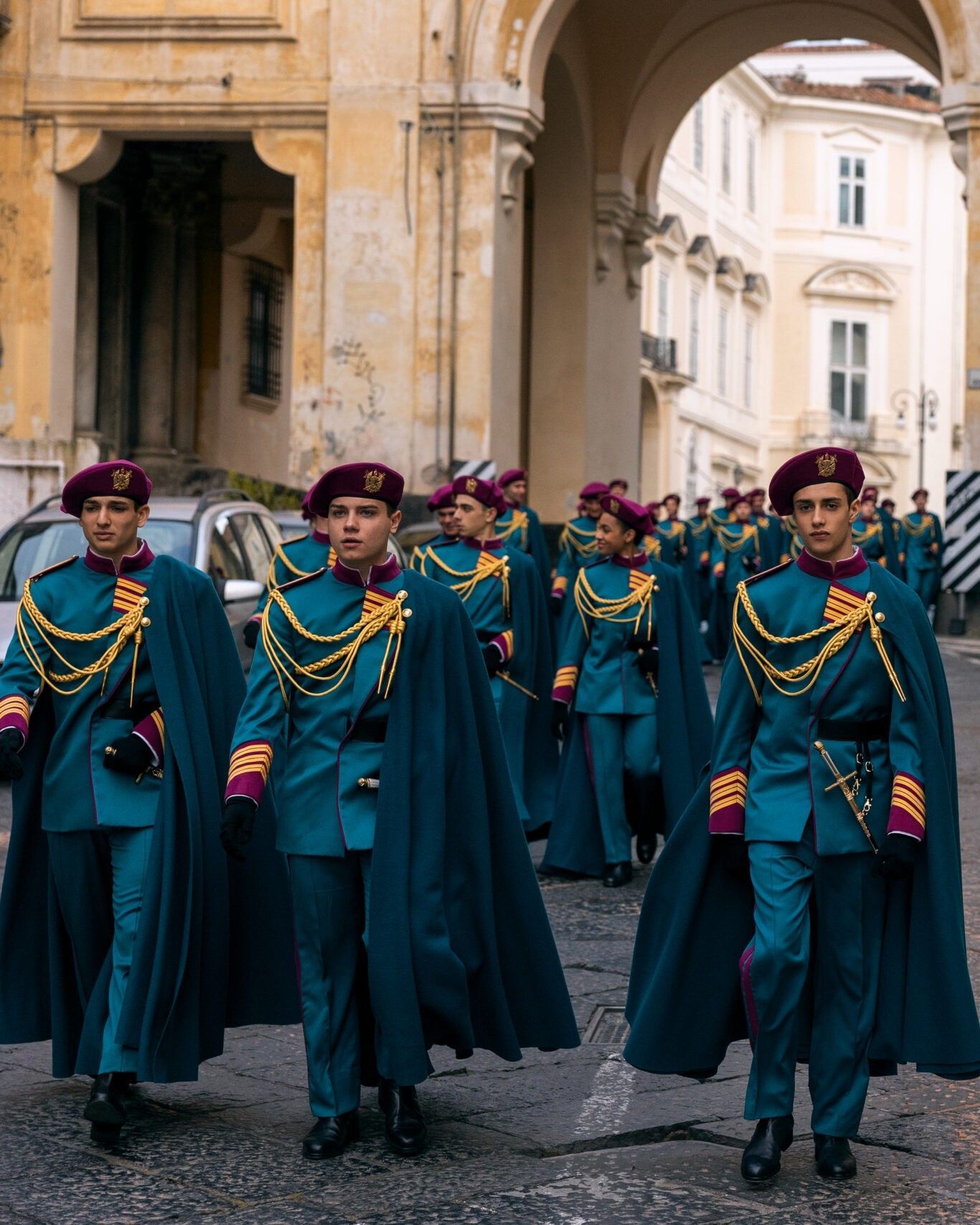
Watching Minerva - La scuola presents several difficulties. Let's not kid ourselves: it's not a rosy moment for Italy, or for the world, and having as Netflix's flagship national product the story of a group of young people in a military academy is hardly ideal. And yet the show's eight episodes, written by Ivano Fachin, Giovanni Galassi, Tommaso Matano and Michela Straniero and directed by Ivan Silvestrini, aren't entirely impossible to watch, and have the potential to captivate a young audience and beyond.
What can be observed, at least, is that the ideology is portrayed more as the domain of adults than of students. The writing is careful to ensure that the protagonists don't align themselves with any particular party — at least not the main characters, who even call those who are there through connections or don't deserve to attend the military high school given their character or outlook "little fascists." Furthermore, the constant glorification of the "strength, beauty and tradition" of the century-old institution in the heart of Naples (the location is the Reggia di Portici) is balanced against the restrictions, abuses and backwardness of the Italian military environment. Every morning the flag salute must be performed, yet the aim is to defeat the most boorish hazing culture, seeking a middle ground between the rigidity of the military and its obsolescence.
@netflixit Liceo militare, passioni e una verità che doveva restare nascosta. Preparatevi a entrare, Minerva - La scuola arriva il 22 settembre, solo su Netflix. #minervalascuola #serietv #netflixitalia suono originale - Netflix Italia
The protagonists are more forward-thinking than one might have hoped. They recognise that it's impossible to experience school as though cut off from the outside world — a condition in which one of the adult instructors finds himself instead, played by a stern Raiz, counterbalanced by the deputy commander played by Irene Maiorino. It's no coincidence that a hoped-for change comes from a woman. There is a constant questioning of the methods, punishments and actual training to which the students are subjected; there are those who want to distinguish themselves from the "fanatical nutcases" one might encounter at school, and there are characters who openly criticise Minerva high school, questioning whether the life they are leading is truly a healthy one.
And yet, both in terms of the show's tone and its positioning within the Italian serialised television landscape, it is clear that all the criticisms ultimately have their positive counterparts, so as to justify the title's very presence in the catalogue. The series will never indulge the ostracising and violent attitudes of conservatism, trying to have it both ways, while presenting itself as simultaneously faithful and respectful of the military ethos and progressive on the issues and attitudes with which certain situations are approached. Not before committing, for narrative purposes, a few missteps.
Approaching Minerva - La scuola is therefore a complex matter. One can acknowledge a certain modest achievement, and it also boasts a cast of young performers that is far from bad. But in times like these it is hard not to feel a disconnect between what Netflix is offering and a world out there that has no need to be told that "rules and discipline are very powerful weapons," but rather needs to relearn what welcome and empathy mean. These are values that the Netflix series does, in some way, seek to convey — almost as if its container were a Trojan horse — yet at the end of the day, it is always to the school and the uniform that one must return.
In any case, the show could easily become a hit, given that Picomedia and Roberto Sessa, producing Minerva, have adapted their Mare Fuori formula for it. The setting changes, the characters change, but the recipe remains the same, with an Italian vision that finds no middle ground, telling stories either of criminality and its absolution, or of authority figures and their duties. And if Minerva - La scuola does indeed become a flagship title, let us at least hope that, to restore some balance, both Lukas Dhont's Coward and Javier Calvo and Javier Ambrossi's La bola negra arrive in Italy soon.