
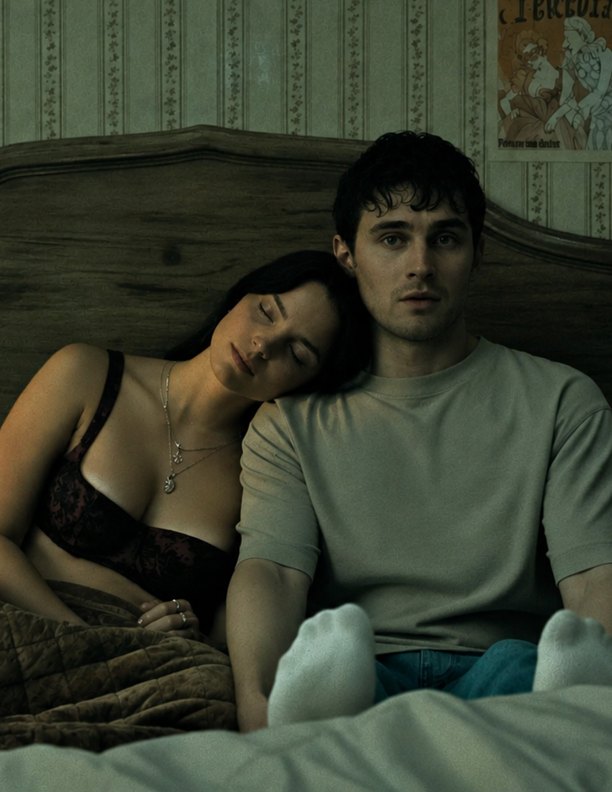
Why cinema will increasingly steal stories from the internet "Obsession" and "Backrooms" won't be the only web phenomena
When the seventh art was in its infancy and seeking to be taken seriously, it adopted the technique of adapting books and classics to enhance its cultural standing. No longer mere sensationalism, the cinema of attractions was moving toward institutionalization, and it did so — among its earliest efforts — with a classic like Dante Alighieri's Divine Comedy, which became a film in 1911 directed by Francesco Bertolini, Giuseppe De Liguoro, and Adolfo Padovan. History also played its part: 1927 saw the magnum opus of Abel Gance, Napoleon, complete with its innovative Polyvision for an ultra-immersive cinematic epic on the personal and military life of the politician and general Bonaparte. Over the years, things have changed.
With the introduction of new entertainment venues, the audiovisual industry began looking elsewhere for stories it could translate to the big (and now also small) screen. The potential for narratives could be found anywhere, especially in places where a ready-made audience already existed. Today, the widest pool to draw from is the internet, a container whose branches are varied and endless. If this has been the year of Backrooms and Obsession — feature films born from the minds of two YouTube personalities, Kane Parsons and Curry Barker — the web has in fact been a well from which the film industry has been drawing for some time, with 2026 marking the official date of the maximum fusion of these two worlds.
The success of "Iron Lung"
The formula "internet-plus-cinema = success" is by no means guaranteed, least of all when it involves prominent figures like YouTubers. Also from this year is the film Iron Lung, which blends sci-fi and horror, written, directed, edited, and performed by Markiplier. A story that, however, does not draw on an idea born purely in the online world, but is rather an adaptation of the eponymous video game by David Szymanski — the relationship between video games and cinema, of course, would require an entirely separate discussion. A work that, yes, was a box office success with its $50 million gross against a $3 million budget, but did not set the direction of global attention the way its counterparts Obsession and Backrooms did. Iron Lung's achievement nonetheless remains one not to be underestimated, stemming from the fact that cinema can now rely on established personalities or pre-existing lore to find its next narratives.
Internet lore is the new favorite genre of the major studios
One interesting aspect of this transition from the web to the big screen is the growing interest from major studios in stories born and spread online, often belonging to the horror genre. A strand that, more than most, retains a strong independent streak — long fertile ground for the birth of cult classics.
Among the most recent examples is Warner Bros, which is developing a film adaptation of Siren Head, a creature that entered the collective imagination through the creepypasta phenomenon. Its legend began circulating on TikTok in 2018, fueled by the monstrous figure conceived by Canadian artist Trevor Henderson. Not coincidentally, that same year saw another creature born from internet horror lore arrive in theaters: Slender Man. For the potential Siren Head film, the studio has brought in Zach Cregger, director of Weapons and Resident Evil. The acquisition of the rights also proved particularly hotly contested: Warner Bros managed to outbid four other production companies, securing the opportunity to bring the siren-headed monster to the big screen.
Increasingly young directors (and Steven Spielberg)
Even a veteran like Steven Spielberg is not being left behind when it comes to cinematic novelties, having decided to produce The Mandela Catalogue, another title over which no fewer than eleven studios battled for the rights. Much like Backrooms, here too we are dealing with a series of videos that went viral on YouTube, centered on a small town invaded by shapeshifting creatures called Alternates. And, just like Kane Parsons, its creator Alex Kister was only seventeen years old when he launched the project online in 2021, demonstrating how engagement with certain platforms is also dramatically lowering the age of their creators. This might suggest a young director for the adaptation itself, since Spielberg has currently stated that he does not feel the need to direct a horror film.
For the upcoming reboot of The Blair Witch Project, it is twenty-five-year-old Dylan Clark who is taking the helm — not the inventor of a franchise of his own launched on YouTube, but someone discovered by the industry thanks to a short film released on the platform in 2022, Portrait of God, which has to date amassed 11 million views.
From Reddit...
If horror is the genre that most readily finds its way to the big screen starting from videos and images circulated online, when it comes to stories born from digital writing, the protagonist is often romance. This is, of course, a far from rigid distinction. Two of the upcoming film adaptations tied to the world of Reddit prove the point, both sharing an atmosphere that is anything but romantic and the presence of Sydney Sweeney in the lead role.
The first is the horror film The Caretaker, based on a story by Marcus Kliewer: a tale not born directly on the platform, but connected to the journey of a writer who, before crossing over into traditional fiction, had built his experience through online writing. The second is the psychological thriller I Pretended to Be a Missing Girl, based on a fictional story published on Reddit by Joe Cote.
... to Wattpad, the favorite spaces of the romance genre
The romance genre, increasingly leaning into its young adult incarnation, remains one of the most popular trends making the journey from the literary boxes of the web to cinema or streaming platforms. The phenomenon from which most of these titles emerge is clearly Wattpad.
Founded in 2006 as a free writing space where users could publish their own stories, read others', and build communities that could both follow ongoing narratives and engage with comments and feedback, Wattpad has become fertile ground for moving stories from the web into the publishing world and onto screen. A shift that saw the online space first serve as a training ground for fanfiction, before original stories increasingly took hold. Among the most notable — and Italian — recent cases is Love Me Love Me by Stefania S., which went from web novel to literary saga with an adaptation for Prime Video, already at work on a sequel following the release of the first film in 2026.
Wattpad's track record is long. From the After book/film series to another Italian title like The Tearsmith, the platform has been sustaining its dual online/cinematic identity for years. The first installment of The Kissing Booth — a Netflix original followed by two sequels, and which launched now-star Jacob Elordi — dates back to 2018. Among more recent examples worth noting is the Spanish Prime Video production My Fault, written by Mercedes Ron, which followed the same Wattpad-bookstore-adaptation pipeline and has not only spawned sequels but even a British remake released two years after the original film.
Also set for 2026 is The Love Hypothesis by Ali Hazelwood, which began as a fanfiction titled Head Over Feet featuring Rey and Kylo Ren from Star Wars — not on Wattpad, but on Archive of Our Own — before being taken down from the platform, officially published as a novel in 2021, and reworked to be set in the world of STEM disciplines.
In 2027, Wattpad titles will continue their journey to the cinema. On the way are The Bad Boy's Girl by Blair Holden, which went from online story to a book series published by Sperling & Kupfer; Boulevard by Flor M. Salvador, which followed the same path; and Chasing Red by Isabelle Ronin, subsequently published by Mondadori, which will star two familiar faces: Madelaine Petsch from Riverdale and Gavin Casalegno from The Summer I Turned Pretty.
How to bring users to the cinema
The world of adaptation is undergoing a significant expansion that has added, alongside books, theatrical plays, comics, and video games, an entire digital realm that is proving to be particularly fertile ground even for more traditional audiovisual storytelling. It is a way of acquiring intellectual properties that relies not only — or even primarily — on the stories or characters being selected, but on the possibility of bringing online communities into movie theaters or onto the search pages of streaming platforms. Starting from the fans to expand one's horizons — horizons that, with the internet, have grown ever wider and remain entirely open to exploration.
What to read next

Films and series not to miss this November
From “Possible Love” to “Wild Horse Nine”, a month of masterpieces
There's a reason some films are set in a single location
The power of locking characters in a room, from "The Invite" to "12 Angry Men"
For Halloween, the director of "Obsession" gifted us a new short film
It's called "Mama Bear", it's on YouTube, and it was written, directed, and edited by Curry Barker