
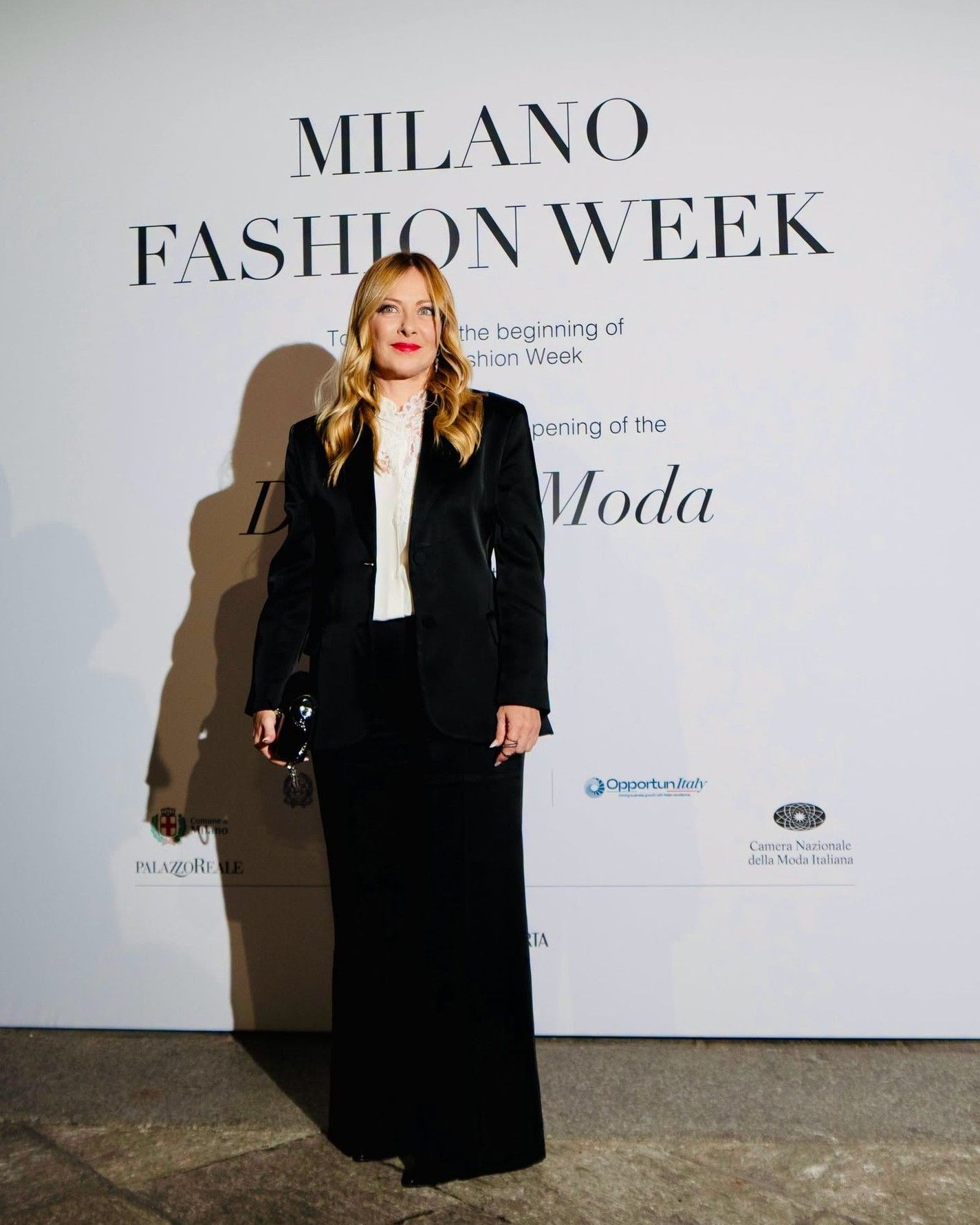
Why was Giorgia Meloni at the Milan Fashion Week gala? A gesture of closeness to the industry, as meaningful as it is symbolic
For those who work in fashion, an institutional dinner at the end of the day in the middle of Milan Fashion Week can feel about as welcome as a wedding on the August bank holiday. Yet our national fashion week has become an occasion significant enough to attract the most important names in the country, and to bring even the most prominent figure in Italian politics under the roof of Milan's Palazzo Reale: Prime Minister Giorgia Meloni. The premier was seated at the table of honour at the gala dinner organised by the Camera Nazionale della Moda Italiana at Palazzo Reale, to mark the opening of Fashion Week and the exhibition Dalí and Fashion.
"I felt it was particularly right this year, at a moment that is not the easiest for a sector that nonetheless continues to deliver great results, to give a tangible signal of presence and solidarity," said the Prime Minister, as reported by Il Corriere della Sera. "Not only through measures, not only through resources — you will have seen the 100 million to incentivise investment, the latest of many things we are doing — but also being here in person, I think, is a fine way of saying thank you to the sector for what it does for our economy, for our strength, for our image in the world, and also of showing that the government is here."
The last time a Prime Minister attended Milan Fashion Week was a decade ago, when Matteo Renzi took part in the opening event in 2016. Renzi himself, on Instagram, today criticised Premier Meloni by pointing out — perhaps with a degree of partisanship, but certainly with some justification — that yesterday in New York the 81st United Nations General Assembly was opening, drawing around 130 heads of state and government from across the world to the Glass Palace to discuss ongoing wars, climate change and artificial intelligence. A rather curious state of affairs. But how did it come about, and who went to the UN in her place?
Milan or New York?
Given that both events had been on the calendar for quite some time, one might wonder why the Prime Minister chose the CNMI gala dinner over the UN General Assembly. In reality, however, sources at Palazzo Chigi had already announced days earlier that the premier would delegate Italy's representation to Deputy Prime Minister and Foreign Minister Antonio Tajani, and the government itself was at pains to stress that this did not amount to a disengagement.
In itself, this is not particularly shocking: fashion accounts for 5% of GDP, as well as a very significant share of the country's soft power abroad, and it makes sense for the premier to show solidarity with the sector. Neither Putin nor Indian President Narendra Modi attended the UN either, while China sent only a delegate. But the point is that we are, quite literally, not living in peacetime, and so certain particularly pressing issues — such as the war in Iran, whatever is happening in Donald Trump's America, the climate crisis with a Super El Niño on the way hand in hand with a potential energy crisis — might perhaps have called for more than a delegated representative.
Perhaps that is why it felt somewhat jarring to see, in our social media feeds, the two scenes unfolding in parallel: on one side, Trump threatening to blow entire countries off the map while the Iranian delegate looks on impassively, and on the other, a dinner of fashion's great and good featuring paccheri al pomodoro, held in a plastic marquee in one of the courtyards of Palazzo Reale. If nothing else, the occasion provides a useful pretext for reflecting on the symbolic priorities of both the government and the fashion industry, as well as on the more substantive challenges facing the Made in Italy sector, which entered a period of crisis from 2024, continued into 2025, and has only partially eased this year. But what exactly are the 100 million euros Premier Meloni mentioned to journalists?
What are the 100 million euros for?
The implementing decree signed by Minister Urso allocates 100 million euros from the Sustainable Growth Fund to SMEs in the fashion supply chain, to activate investments of between 1 and 20 million euros to be carried out within the country, with the aim of enhancing production processes and strengthening aggregations along the supply chain using Italian or European materials and semi-finished goods. Depending on the scale of the project, these funds may also be used to finance innovation processes, employee training, and research and development. Seventy-five percent of the money is provided as a grant, while the remaining 25% is repaid by companies as a subsidised loan.
The measure has several positive aspects: it is oriented towards productive investment and rewards companies that choose to manufacture in Italy. In a highly fragmented sector such as fashion, where thousands of micro and small artisan businesses operate, the incentive for aggregation and the valorisation of the national supply chain can foster greater resilience and competitiveness. The possibility of also funding process innovation, staff training and, in larger projects, research activities makes the instrument relatively flexible.
At the same time, it is not all plain sailing. The 100 million euros, while not negligible, is a modest sum relative to a sector that generates tens of billions in turnover and employs hundreds of thousands of people. There is therefore a limited number of projects that can benefit from it, and it can certainly not single-handedly revive a sector that is only partially recovering and still under strain.
Furthermore, the measure does not address more structural challenges weighing on businesses, such as the pressure on margins exerted by major brands, liquidity difficulties, often unfair international competition, ever-rising energy costs, and a shortage of skilled labour. There is also a real risk that the bureaucratic complexity surrounding investment thresholds, required aggregations and eligibility criteria will exclude precisely the smallest and least organised firms. What is truly needed, rather than an implementing decree, is a series of long-term industrial policies, without which the intervention risks remaining little more than a modest, temporary injection of funds.
Meloni and Fashion
Last night's dinner is not, moreover, Meloni's first foray into Italian fashion over the past year. Back in December 2025, the premier had already attended, alongside former Prime Minister Mario Draghi, the world premiere of Brunello, il visionario garbato, the documentary film by Giuseppe Tornatore dedicated to the Umbrian entrepreneur. Taken together, the two episodes naturally prompt the question of whether this amounts to more than a simple coincidence of scheduling.
If the CNMI dinner comes just thirteen days after the publication of the decree on the 100 million euros for the supply chain, the question of whether the event was conceived in part as an institutional showcase — a kind of photo-op built around a measure already in the pipeline, rather than a spontaneous gesture of solidarity — is one worth entertaining. There is also a more political reading, equally speculative, that merits consideration: that the rapprochement with the cosmopolitan, international world of Milanese fashion, so distant from the identitarian and sovereigntist milieu of Fratelli d'Italia, may also respond to a need to reposition the premier's image and to distance herself, at least symbolically, from the controversial figure of Roberto Vannacci.
To sit at the tables of Kering, LVMH and Vogue, to be photographed alongside Anna Wintour, is to speak to a different electorate and a different public opinion from those reached by the more identitarian rhetoric of the Italian right. Whether this represents a substantive shift in the government's posture towards the economic and cultural establishment, or merely an exercise in image management, remains to be seen. But it is a question that, given only the information available today, cannot yet be definitively answered.