
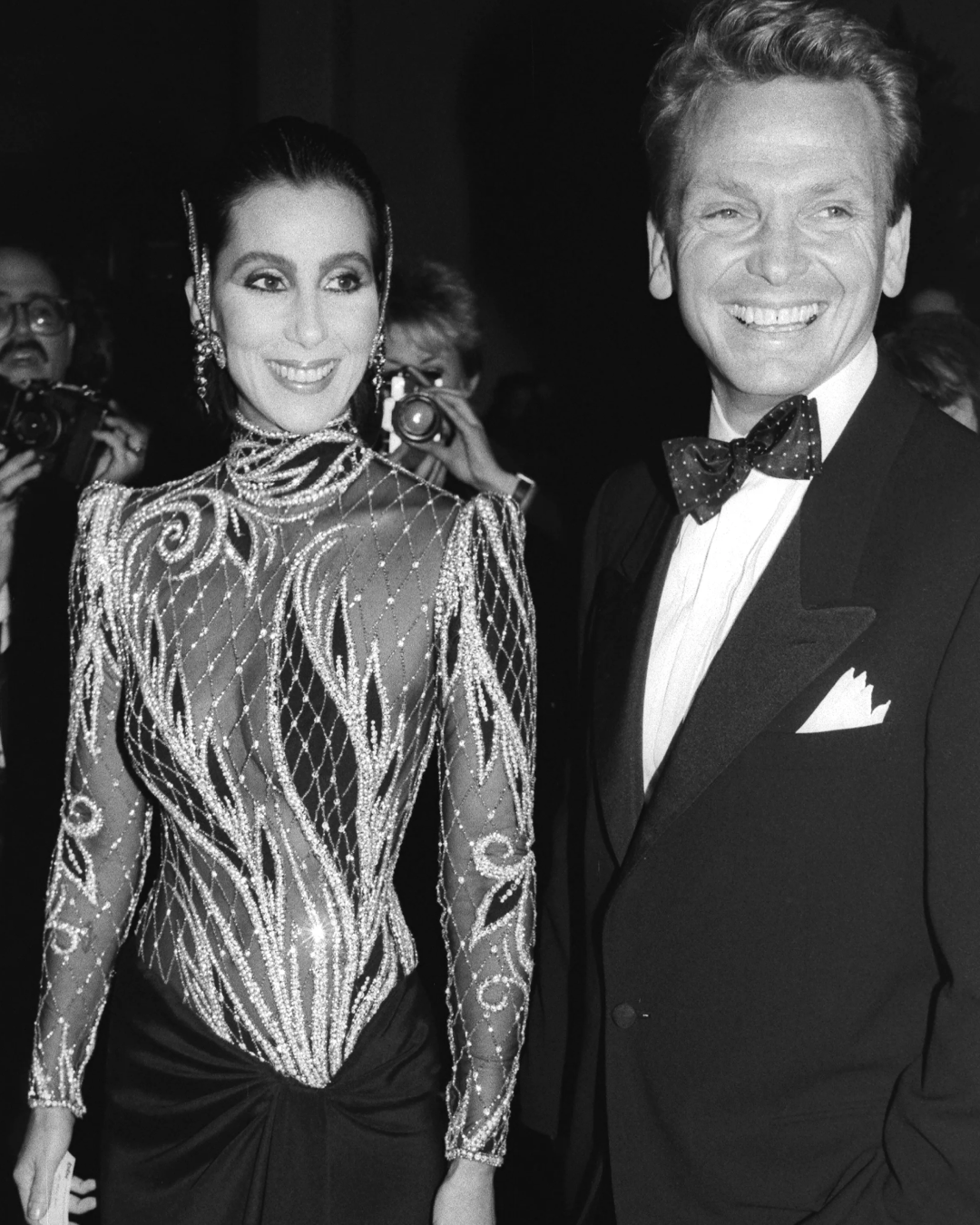
Bob Mackie didn't dress the stars, he created them From Marilyn Monroe's dress for Kennedy to Cher's transparent gown, all the most iconic creations by the American designer
Bob Mackie was not simply a costume designer. A winner of nine Emmy Awards and three-time Oscar nominee for Best Costume Design, he left behind one of the most recognizable visual vocabularies in the history of show business. Sequins, feathers, crystals, sheer fabrics, and embroidery were his language — tools through which he transformed the costume into something far beyond a mere garment. It was no coincidence that he would come to be nicknamed the "Sultan of Sequins," yet to reduce Mackie to his taste for glitter would be to fundamentally misunderstand his importance. The American designer had grasped something long before it became a rule of the entertainment industry: a celebrity does not simply wear a dress, but through that dress constructs her own public image. This is why his garments belong not only to the history of costume design but to pop culture itself.
From television stages to concerts, from red carpets to magazine covers, Mackie designed clothes meant to be seen, photographed, and above all remembered. And this is perhaps the most fascinating paradox of his career: Mackie, personally, was the opposite of his clothes. A discreet and reserved man, he dressed with elegance while never seeking to draw upon himself the attention he demanded from his costumes. His presence remained composed even as his imagination seemed to know no bounds.
From Anonymity to Marilyn Monroe
Imagine being so iconic that your first dress design ever is used for one of Marilyn Monroe’s most famous gowns. There will never another Bob Mackie. pic.twitter.com/FOH9cEv4E7
— Cora Harrington (@CoraCHarrington) September 14, 2026
After studying at the Chouinard Art Institute in Los Angeles, Mackie moved to Hollywood and began working as a costume designer's assistant to Jean Louis. It was a system in which the designer rarely occupied center stage: the costume was meant to belong to the character, not necessarily to whoever had designed it. In 1962, at just 23 years old, Mackie sketched the preparatory drawing for the gown that Marilyn Monroe would wear to sing Happy Birthday, Mr. President to John F. Kennedy at Madison Square Garden. The dress, executed by Jean Louis, was a flesh-colored second skin encrusted with crystals that clung to the actress's body to create the illusion that Marilyn was nearly naked beneath a luminous surface. Mackie did not receive the recognition he deserved for that drawing. And yet, within that anonymous sketch, one of the ideas destined to define his entire career was already fully formed.
1974: The Year Transparency Became a Manifesto
@nssmagazine Rest in peace to the legendary fashion designer Bob Mackie #bobmackie #TikTokFashion #cher #fashion Strong Enough - Cher
Twelve years later, that same intuition resurfaced in an even more radical form. In 1974, Cher arrived at the Met Gala in New York wearing one of the most daring gowns ever associated with Mackie's name. The dress was built around an extremely form-fitting silhouette and an almost provocative transparency. The fabric followed the body, allowing the skin to show through, while feathers, embroidery, and appliqués interrupted its surface like decorations applied directly to the body.
This is where Mackie's work becomes particularly modern. Nudity is not presented as the absence of clothing, but as the result of an extremely constructed garment. Cher, moreover, had already become a central figure in the gradual opening of American television toward a more explicit representation of the body. She was among the first celebrities permitted to show her navel on the small screen — a detail that today seems almost irrelevant but which, in the television landscape of the 1960s and 1970s, carried far from marginal significance.
With Mackie, that same tension entered the world of fashion: the body was no longer something to be concealed in order to make a garment elegant, but became the very heart of the visual composition. The dress did not end with the evening for which it was created; on the contrary, it had a much longer life. It even made it onto the cover of Time Magazine the following year.
Camp as a Language
If with Marilyn Monroe Mackie had constructed the illusion of nudity, and with Cher had transformed that illusion into an aesthetic statement, in the years that followed he would push the principle into the territory of camp — the deliberate use of excess, irony, and theatricality to transform the costume into spectacle.
In 1967, Carol Burnett entrusted him with the costumes for the Carol Burnett Show, a program that would make visual irony one of its primary tools. Mackie immediately understood that television could become a laboratory for his approach to costume design: not a mere complement to the scene, but an integral part of the comedy and the storytelling. When the show produced a parody of Gone with the Wind, retitled Went With the Wind!, Burnett played a caricatured version of Scarlett O'Hara, forced to fashion a dress out of her home's curtains. Mackie took the gag even further, asking the set department for a curtain rod as well, so he could construct a dress that truly seemed to belong to that absurd and theatrical world. It was the principle that would run through his entire career: a garment could be elegant, ridiculous, sensual, and theatrical all at once.
In 1975, he applied the same principle to the male body, transforming a Los Angeles Dodgers baseball uniform for Elton John into an explosion of sequins. One of the most recognizable symbols of American sporting masculinity was completely rewritten through glamour.
From Madonna to Today
In 1991, that language would return on another icon. For that year's Oscars, Mackie dressed Madonna in her celebrated homage to Marilyn Monroe: a crystal-encrusted gown built once again around the tension of the exposed body. It was a reference within a reference. Madonna was playing Marilyn, while Mackie, through Madonna, was revisiting the same visual vocabulary he had helped define decades earlier. The allusion was therefore not merely to a woman or a dress, but to fashion's capacity to continually construct and reconstruct the memory of pop culture. In recent years, his language has resurfaced on the red carpets and concert stages of a new generation of celebrities, from Zendaya to Miley Cyrus, who in 2024 wore a beaded fringe gown during her performance of Flowers at the Grammys.
To look at Bob Mackie's work today is to return to a moment when the costume was beginning to cease being merely something worn to step onto a stage, and was becoming part of the spectacle itself. This is why his creations have not remained confined to costume archives or red carpet photographs, but have become images in their own right. Mackie had understood that a star does not necessarily become memorable because she wears a great dress. She becomes memorable when the dress and the person can no longer be separated.