





















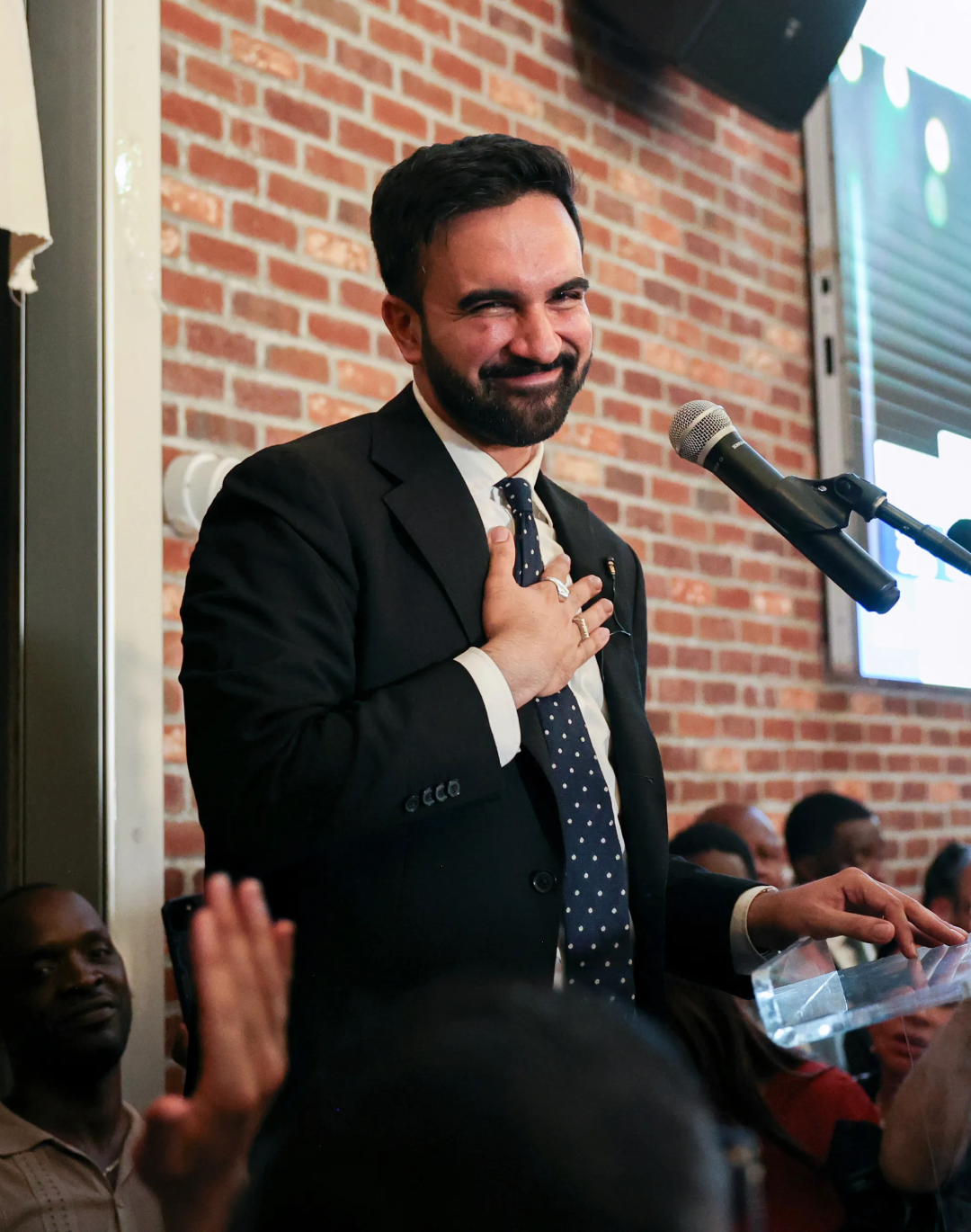
How does NYC's newest Mayor dress up? Zohran Mamdani is the first major Millennial (and socialist) mayor
There are three things people always repeat about Zohran Mamdani: he is 34 years old, a socialist, and Muslim. But reducing the new mayor of New York City to three labels is like trying to sum up an entire city through a single borough. The son of Indian filmmaker Mira Nair and Ugandan academic Mahmood Mamdani, Zohran grew up surrounded by different cultures, languages, and contradictions. Before becoming the most progressive face the city has ever elected, he was an activist, a precarious worker, and even a SoundCloud rapper under the name Mr. Cardamom. In 2019 he released a single titled Nani, a playful tribute to his grandmother that has recently resurfaced on TikTok thanks to his growing political fame.
Only a few years later, the same young man who once wrote lyrics about life in Kampala has become one of the most talked-about figures in contemporary American politics, a symbol of progressive revival in a city that had grown used to stagnation. What is most surprising today is not his ideology, but the way he expresses it through his personal style. Mamdani dresses simply, almost austerely, but never anonymously. His navy suit, white shirt, and patterned tie do not shout revolution, yet they say more than any campaign slogan. It is an everyman uniform, the kind you might see at Union Square early in the morning, but with a subtle political intention behind it, recognizable while still belonging to the people.
Zohran Mamdani’s Outfits
@thepeoplegallery Zohran Mamdani for NYC Mayor #zohranmamdani #ootd #election #thepeoplegallery original sound - The People Gallery
Unlike many of his peers who try to build an artificially youthful image (Sliwa’s red beret comes to mind), Mamdani does not pretend to be an outsider, he truly is one, and his aesthetics reflect that truth. His accessories tell more intimate stories than any interview: three rings designed by his wife, illustrator and designer Rama Duwaji, a digital Casio watch that looks straight out of the 1990s, and a red cotton bracelet on his wrist. When he is not in a suit and tie, Mamdani moves effortlessly between two worlds, the Western one he governs and the one where he grew up. He might wear a Uniqlo t-shirt or a traditional kurta with the ease of someone who knows that hybrid identities do not need to be explained but lived. “There are so many ways to convey formality,” he once told GQ, “and it has been exciting to explore every one of them.” A statement that sounds almost revolutionary in an era when American politics swings between rigid uniforms of power and the urge to destroy them.
Vanessa Friedman, writing for the New York Times, described his look as “a perfect balance between old-school and Gen Z”, a style that avoids political cosplay without ever falling into inauthenticity. Mamdani does not try to appear “relatable”, he simply is. With his direct way of speaking, shy smile, and disarming humor, he makes power feel human. In a feature for Interview, he joked that if he were ever brought down by a small scandal like former mayor Eric Adams, it would be for “a hair transplant in Turkey”, proving that humor can be the most elegant form of transparency.
How Did Zohran Win?
Zohran you have to stop. your drip too hard, your platform too different, your girl too iconic. they’ll kill you. pic.twitter.com/sSYEUsWIGY
— Sick Sad World (@YesYoureRacist) June 18, 2025
Behind the apparent simplicity lies a carefully built communication strategy. As The Guardian pointed out, Mamdani has understood that how a politician dresses today is an essential part of their public language. His accessible style, stripped of any ostentation, creates a connection with voters who see in him a different kind of New York politician, young but measured, idealistic but pragmatic, elegant but never distant.
Even The Cut dedicated a long article to his “anti-aesthetic of power”, observing how his image “escapes the cool-politician versus stiff-politician binary by embracing a new grammar of everyday life.” It is an aesthetic perfectly suited to contemporary New York, where appearances still matter but authenticity matters even more. While the boomer generation built authority on distance and power, Mamdani builds his on proximity, on the idea that you can govern a metropolis wearing the same shirt you campaigned in after a night of club-hopping to convince Bushwick ravers to vote. In his first speech as mayor, he reminded a crowd in Brooklyn that “New York will remain a city of immigrants, a city built by immigrants, powered by immigrants, and as of tonight, led by an immigrant.”
The New Mayor of New York City
His wardrobe is therefore a political statement more than a fashion one, a rejection of power-driven vanity in favor of a new form of visual empathy. In an era of politicians dressing like influencers or CEOs (where even that line has become blurry), Mamdani presents himself as a community servant, a regular guy who speaks, dresses, and lives like his voters. Perhaps that is the secret to his appeal: not the revolution of image, but consistency between what he says and what he wears. And as New York wonders what it means to have for the first time a socialist, Millennial, and Muslim mayor, Mamdani seems to answer without needing to say it. A white shirt, a Casio, and three rings are enough to show that in the world’s most eclectic city, normalcy can still be a political act.