
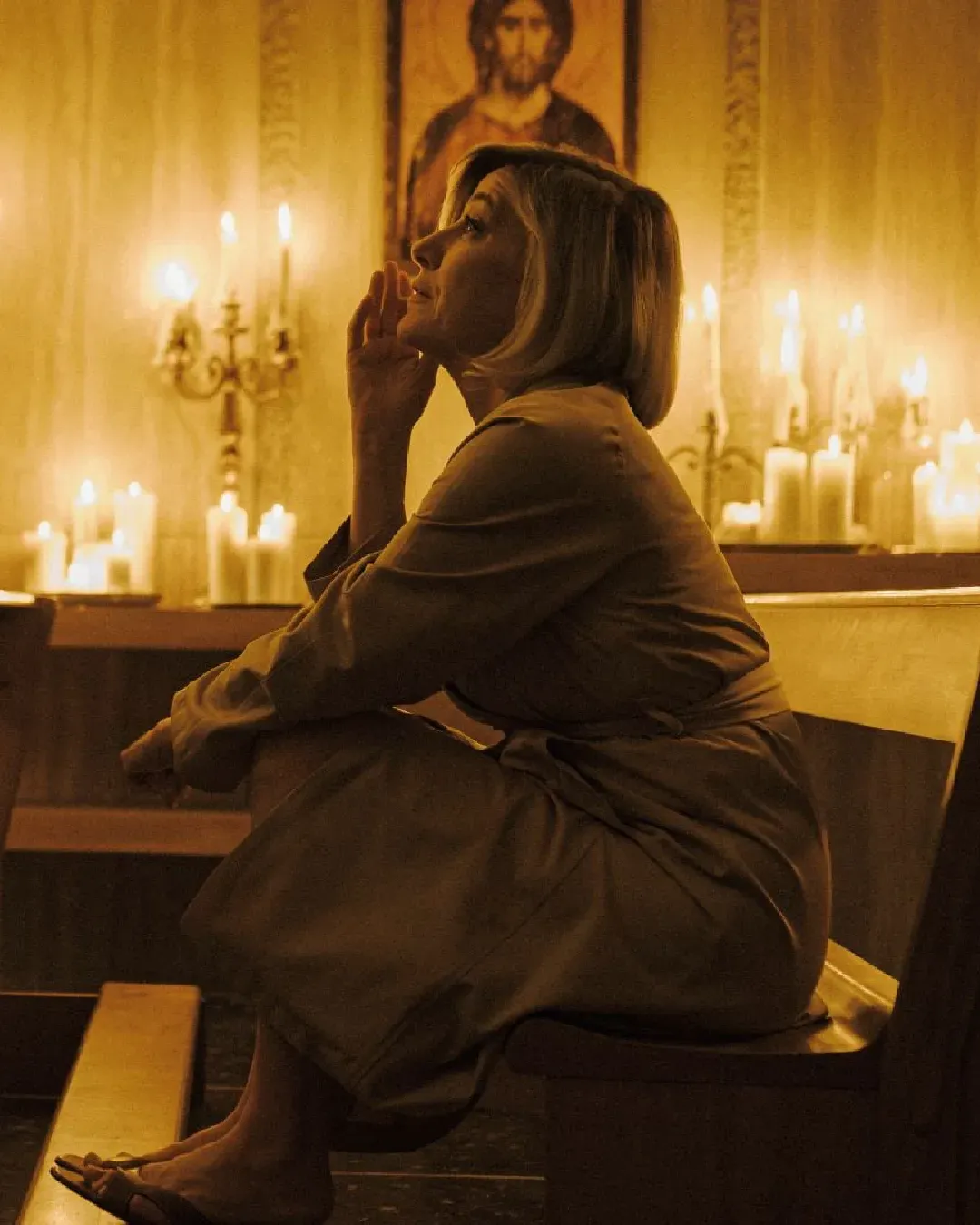
In "The Stranger" the family is fertile ground for horror and fear Paolo Strippoli's new film puts the mother-daughter relationship back at the center
L'estranea, the new film by Paolo Strippoli, can be read in two ways: the first as a psychological thriller, in which everything we see is real, the product of deliberate choices made by the characters; the second as a horror film, in which the supernatural and the non-existent hold sway. This is Strippoli's third film, not counting A Classic Horror Story, co-directed with Roberto De Feo, and in a sense it represents a change of direction from his previous work. While with La valle dei sorrisi Strippoli had deliberately constructed an impossible situation, handling genre material and evoking a vivid idea of the monstrous, with L'estranea he plays with implications, with things left unsaid, showing and not showing at the same time.
Like many other directors in competition at the Festival this year, Strippoli has also chosen to talk about family. The screenplay he wrote together with Salvatore De Chirico captures an exceptional situation of extreme success, in which everything seems to be going well: we have the mother, played by Jasmine Trinca, the father, played by Adriano Giannini, and the children, played respectively by Romana Maggiora Vergano and Andrea Genovese. At a certain point, however, the daughter has an accident and a strange woman (the estranea, or stranger, of the title) offers the mother a pact. From the very first moment we are led to think that this woman is the devil, or at least a figure resembling one. And Strippoli, throughout, takes pleasure in adding details, subtly altering them, shifting attention first to one character and then to another.
The stranger, played by Valeria Bruni Tedeschi, is without a doubt one of the best things in the film. Because she is brilliant, deliberately over the top, at times ferocious and at times sensual. She always leaves a question in her wake when she appears — and she appears multiple times throughout the film. She is shrouded in a mystery that, in Strippoli's hands, becomes an extremely useful tool, deployed both to reinforce certain narrative elements and to call every notion into question. When the mother goes to her daughter to tell her the truth, the film finds its narrative footing and transforms into a two-hander. The present and the past of the story are clearly distinguished: in the present, the protagonists are Romana Maggiora Vergano and Jasmine Trinca; in the past, there is a constant alternation of perspectives and faces. And it is no coincidence that L'estranea is divided into chapters.
Strippoli does not shy away from violence even in the most delicate and intense scenes — he is graphic and extremely explicit. It is at other moments, when he focuses on the characters' inner lives, that he seems to step back, and he does so not to diminish the complexity or density of the various situations and individual characters, but rather to reinforce this suspension in the interpretation of the story and its meaning.
Sound plays a fundamental role in L'estranea, marking the peaks of maximum tension and conveying, even more than the images themselves, the emotional state of the characters, particularly the one played by Jasmine Trinca. Strippoli wants to destroy, rather than merely dismantle, the family. Or rather, he wants to destroy our idea of the perfect family. And at the same time he uses it as the starting point for his story.
He seeks reversal, works with opposites, sometimes with extremes, and in this way manages to construct an adrenaline-fuelled story — intense, not shameless or artificial, but intelligent. And intelligence, when it comes to genre, is essential precisely because it is important to find a balance, using all available elements without repeating oneself, without chasing the audience's reaction at all costs. If it comes, it must come naturally.
#BiennaleCinema2026 #Venezia83 #Concorso #Competition pic.twitter.com/5tVud2ocf4
— La Biennale di Venezia (@la_Biennale) July 23, 2026
L'estranea, in competition at the Venice International Film Festival and in cinemas from 8 October with 01 Distribution, marks a departure from Strippoli's other films for one further reason. The film clearly aims to reach a broader audience, not just horror enthusiasts; and in the context of the Italian market, this is an almost forced choice, especially in order to secure the funding needed to develop a genre work. It is a compromise, yes, but a useful one from a storytelling standpoint, and therefore it serves the goal Strippoli has set himself.
The question at the end of the film remains: is what we have seen and the story we have been told real, or the product of the mind of the protagonist played by Jasmine Trinca? In this, L'estranea offers a reflection on cinema, on its purpose, and on the relationship that can form between the viewer and the film. To trust or to grow suspicious. To believe or to refuse. To surrender to the experience being offered to us, or to try to create another one — our own — in which we are the protagonists.
What to read next

«Club Kid is a once-in-a-lifetime opportunity», interview with Jordan Firstman
Everything about the directorial debut of the American actor and screenwriter
"Cambogia" teaches actors that you have to care about your own characters
Valerio Lundini's directorial debut premiered at the Rome Film Festival
In "The Debut" Julianne Moore gives a masterclass in acting
The film, premiering at the Rome Film Fest, hits theaters on January 1, 2027