





























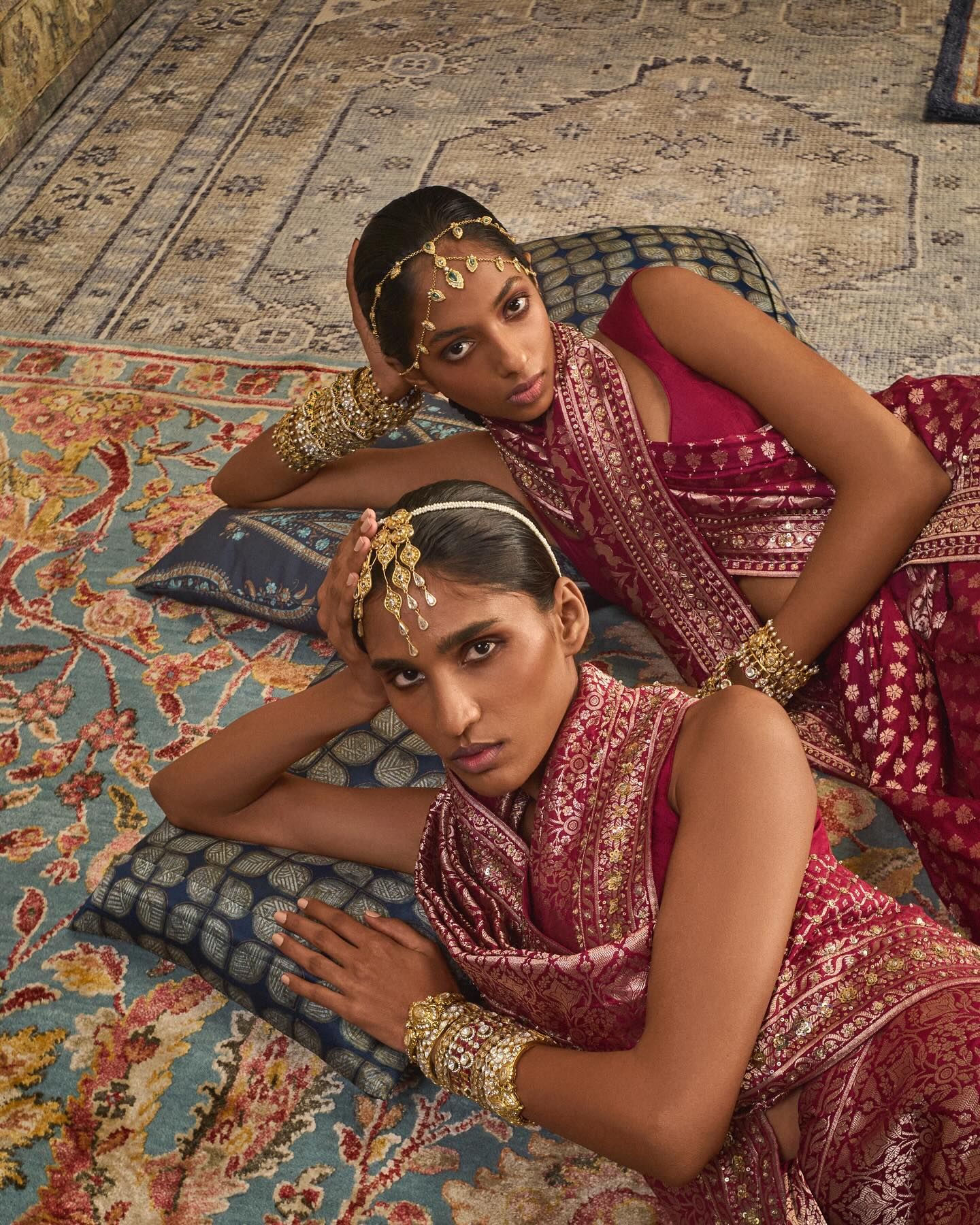
India is ready for luxury, but is luxury ready for India? As it expands across the country, fashion will have to face an audience it is not used to
Last November, in Mumbai, the first Indian branch of the legendary French department store Galeries Lafayette opened. A commercially historic event that marked a step forward in the complicated advance of Western luxury in the Indian subcontinent. Precisely this advance, which has been rather timid in recent years, has seen a certain acceleration in the last few weeks: on a purely symbolic level, for example, not only did Chanel appoint last April the first Indian ambassador, Ananya Panday, but it also had an Indian model, Bhavitha Mandava, open its recent show in New York.
On a less symbolic but far more concrete level, there is the free trade agreement signed last January 27 that could double European exports to India by 2032, eliminating or reducing tariffs on over 96.6% of goods exported by the EU, as explained by BBC. The agreement will be a goldmine for European fashion given that Indian tariffs have always been quite heavy, around 35% according to Fashionating World, and could now drop to 10-15%. There are also implications for the textile sector, but the important part here is that, according to the EU, European imports to India should soon double in volume.
Luxury seems ready (not to say eager) to enter India. But is the Indian market, especially the younger and more cosmopolitan segments, ready to welcome European luxury?
Many opportunities, many difficulties
According to an estimate by Euromonitor recently cited by Financial Times, India is the fifth most important luxury market in the world, with an annual volume of about 12 billion dollars. But it has a peculiarity: India has the world's largest Gen Z population, which according to data reported by BoF, numbers 377 million individuals. And according to a report, also cited by BoF, signed by Boston Consulting Group and Snap Inc., this segment of the population spends overall between 45 and 50 billion on average on luxury products and represents by itself just under half of the entire luxury market in the subcontinent. But there is a but.
Even though, according to Il Sole 24Ore, 86% of Indian consumers plan to increase their spending in the luxury category, signaling that the market is in any case in a growth phase, the data published by BoF regarding Gen Z suggest that their maximum spending ceiling (which hovers, for a round figure, around 1350 dollars) is quite below the mark-up desired by luxury brands today. The country's Gen Z is indeed numerous and is entering the job market, that is certain, but it is not yet so wealthy as to be able to become, if you will pardon the term, a “second China” for European fashion.
Beyond the highly profitable market worth 130 billion annually that revolves around wedding ceremonies and national festivals like Diwali, the data cited by BoF indicate that even though Gen Z spending is increasing, their expenditure consists of entry-level products and certainly not bags or garments whose price exceeds 2000 euros. And since the whole world is the same, Indian Gen Z has also begun to satisfy their hunger for branded products on secondhand platforms.
One of these, Luxury Pop, has 30% of its clientele precisely in that age group and in general other interviewees from BoF have said that now the country's Gen Z appreciates luxury goods and fashion culture, also getting used to marketing done by influencers or product placement in TV series, but that it will take five to ten years to see if they will become actual luxury consumers in the proper sense of the term.
But what are the brands doing?
The Indian market perhaps remains an unsolved enigma for Western luxury brands. On one hand we have a population dominated by enormous social disparities, unaccustomed to certain “crazy” expenses, but far more expert than the European one in terms of product quality, given the enormous Indian artisanal and textile tradition as well as a clientele fragmented across several very distant urban areas. On the other hand, there is the feeling that European brands are trying to seduce the market with the usual engagement strategies: famous ambassadors, public activations in shopping malls, immersive exhibitions, and partnerships like the one Dior has had with the Chanakya School of Craft for many years.
Yet a brand like Kartik Research, whose founder Kartik Kumra is only 25 years old, which is perhaps the most relevant Indian fashion brand internationally along with Rahul Mishra and Dhruv Kapoor, told BoF that when designing community events it tends to emphasize more the lifestyle, cultural, and community aspect over mega-activations to post on social media. In fact, the “experiential” category related to travel, restaurants, and leisure actually represents today the highest spending item for the country's Gen Z, again according to the same Boston Consulting Group study cited earlier.
We could also note in passing that a country as large as India already has its own fashion industry, with local designers much closer to their clientele than any European brand – as well as far less expensive compared to Italian and French luxury. Think of the case of Prada's Indian sandals which, in their artisanal and handmade version, cost the Indian equivalent of 12 American dollars and which, in the signed version, far exceed 800 dollars.
So what?
India is a price sensitive economy yet;
— Sejal Sud (@SejalSud) August 12, 2023
it’s luxury market grow by 180% in 2021
Here’s why pic.twitter.com/YU4Z6DKYj8
Even though the Indian luxury apparel market grows at an annual rate of 3-5%, according to IMARC Group, and the number of millionaires and billionaires has increased significantly in the last three years with over 30,000 new millionaires added just in 2024 and billionaires up 12% in one year to 191, the penetration of ultra-luxury European brands remains limited by cultural preferences and average spending still oriented toward entry-level and premium accessible.
In the coming years we will certainly witness an intensification of the dialogue between European fashion and the Indian market. One might perhaps expect a continuation and amplification of social media marketing, but the important fact is that luxury brands in general have a scarce direct retail footprint in the country. This signals a fairly high level of caution (Louis Vuitton has only three stores across the country, for example, while Prada opened just one last July) and a strong dependence on local partners such as Reliance, which practically acts as a diplomatic contact between the European and Indian commercial spheres.
Considering that luxury still appears to be in a moment of crisis, with LVMH's Fashion & Leather Goods division down 3% in the last quarter and a 2026 that does not appear particularly favorable, it remains to be seen how much the executives of these conglomerates, constantly seeking quarterly growth, will be willing to invest in a market that seems to reward premium fashion more than ultra-luxury but remains highly promising. India therefore appears to be a major bet, but who will play the highest stakes?
Takeaways
- Western luxury is accelerating its entry into India, with symbolic events such as the opening of Galeries Lafayette in Mumbai (November 2025), the appointment of Ananya Panday as Chanel’s first Indian ambassador, and the EU-India free trade agreement signed on January 27, 2026, which is expected to significantly reduce tariffs and double European exports by 2032.
- India is already the world’s fifth-largest luxury market (approximately $12 billion annually), with an enormous Gen Z population (377 million) driving nearly half of luxury spending ($45–50 billion), yet their spending capacity remains limited to entry-level products around $1,350, well below the prices of European ultra-luxury.
- Despite 86% of Indian consumers planning to increase luxury spending and the market showing growth, Indian Gen Z prefers accessible goods, second-hand items, and especially experiences (travel, restaurants, leisure), while Western luxury brands struggle to penetrate ultra-luxury due to cultural preferences and economic disparities.
- European brands adopt classic strategies (ambassadors, immersive exhibitions, partnerships like Dior-Chanakya School of Craft), but face a mature market with a strong local fashion industry (e.g., Kartik Research, Rahul Mishra) and designers closer to their clientele and less expensive; moreover, direct retail presence remains very limited (e.g., Louis Vuitton with only 3 stores, Prada with just one recent opening).
- India represents a major opportunity but also a risky bet for European luxury: the premium segment is growing faster than ultra-luxury, the market still appears to be in a maturation phase (it will take 5–10 years for Gen Z to become full-fledged luxury consumers), and in a context of global sector crisis (e.g., LVMH declining), conglomerates will have to decide how much to invest in a promising yet culturally and economically complex country.