



























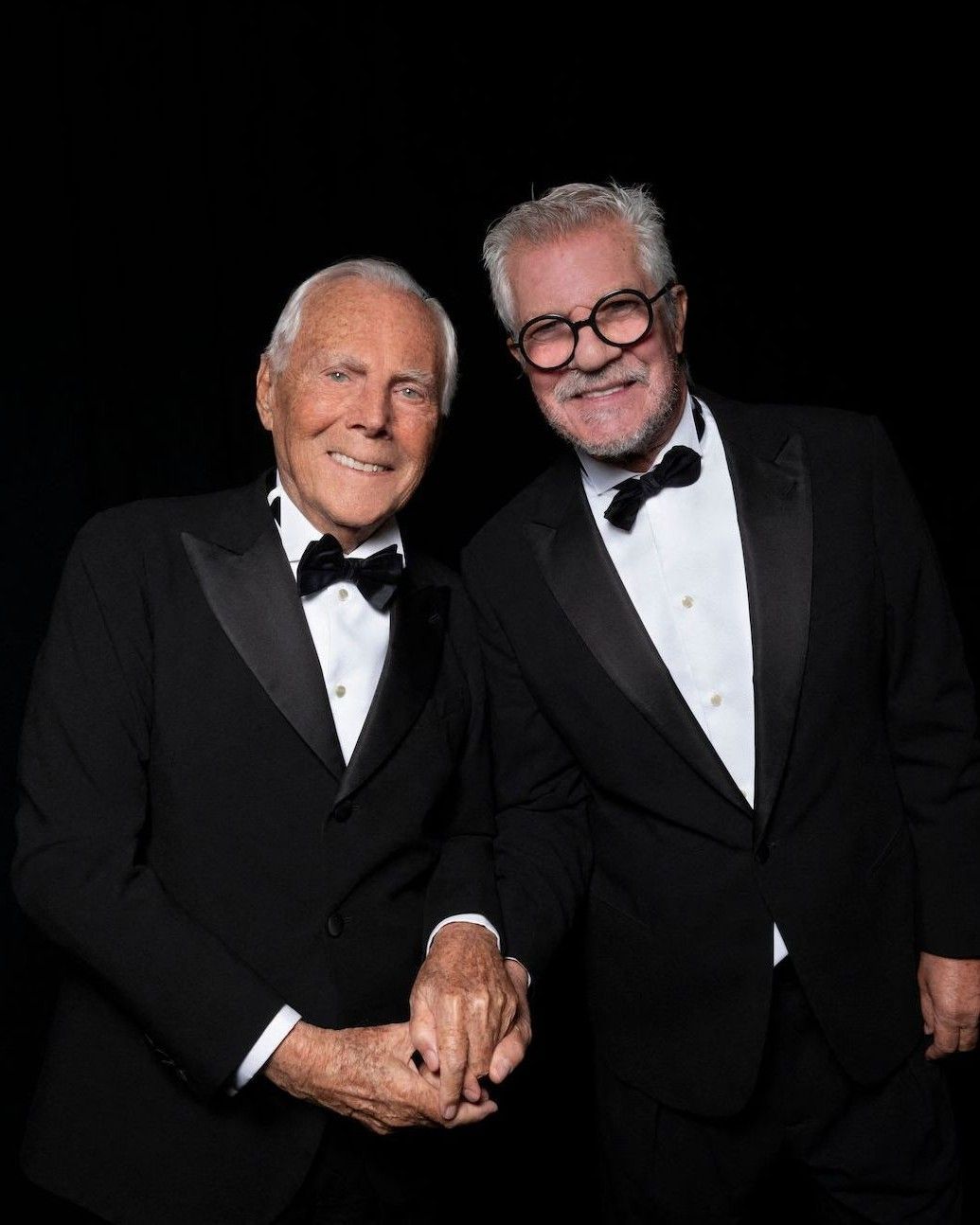
Here is what Giorgio Armani's will says Among the designer's last wishes was to sell shares to a luxury group or list the brand on the stock exchange.
The will of Giorgio Armani, made public this morning through the pages of MF Fashion and Il Sole 24Ore, has taken many observers in the fashion and luxury world by surprise, as it reveals the ambitious plan for the future of the maison that Armani had conceived before his passing, which includes an acquisition by a major industry player or, alternatively, a stock market listing, with the Armani Foundation set to retain a significant role in the capital. Specifically, the designer mandated the priority sale of 15% of Giorgio Armani S.p.A.’s shares within the first 18 months from the opening of the succession, preferably to groups such as LVMH, EssilorLuxottica, or L'Oréal, opening the door to a strategic entry of high-profile investors who could redefine the history of the legendary brand founded in 1975.
To guide the Foundation, Armani has codified in detail the ethical and stylistic principles that must permeate every managerial decision, reflecting his entrepreneurial philosophy developed over more than half a century of career. Among these are the obligation to manage activities with moral integrity, fairness, and an ethical approach that prioritizes transparency and respect for collaborators and consumers; the pursuit of an essential, modern, and elegant aesthetic, far from ostentatious excesses, which has defined the minimalist and timeless identity of the brand; and a constant focus on innovation, qualitative excellence, and product refinement, in order to adapt to market evolutions without betraying artisanal roots. These directives are not mere recommendations, but binding commitments that the Foundation must honor.
Who are Giorgio Armani’s heirs?
The inheritance structure of Giorgio Armani S.p.A. emerges as the cornerstone of the first will, drafted on March 14, 2025, in which the designer entrusts full control of the group to the Giorgio Armani Foundation, an entity he established to preserve his cultural and entrepreneurial legacy. The Foundation, which already held a symbolic 0.1% stake, receives full ownership of 9.9% of the capital, equivalent to 30% of the voting rights, and the right of bare ownership over the remaining 90%, ensuring significant influence over future strategic decisions. This move is not coincidental: Armani meticulously balanced usufruct and voting rights to ensure a smooth transition, with his lifelong partner, Pantaleo Dell’Orco, known as Leo, obtaining usufruct over 30% of the shares and 40% of the total voting rights, while the nephews Silvana Armani and Andrea Camerana, along with his sister Rosanna, share the remaining 30% of the votes, as many predictions had anticipated.
Regarding liquid assets and financial investments, excluding specific beneficiaries such as insurance policies, Armani opted for a clear division: 40% to Pantaleo Dell’Orco and 60% to the family, with 15% each to Rosanna, Silvana, Andrea, and Roberta Armani, the daughter of his late brother Sergio. Additionally, he assigns 1.5 million euros each to Andrea Camerana’s daughters to contribute to the Mamar Trust established by his sister, and a total of 33.985 million in Italian government bonds (Btp) to other unspecified beneficiaries, providing an immediate financial cushion to cover expenses and personal investments, in line with his vision of self-sufficiency and protection for his loved ones within a context of immense but prudently managed wealth.
Finally, the will includes precise instructions for the renewal of the Giorgio Armani Foundation’s governing bodies, now the 100% owner of the maison, to ensure continuity and expertise. For the board of directors, Armani appoints his nephew Andrea Camerana and notary Elena Terrenghi; for the evaluation committee, his nieces Silvana and Roberta; and for the supervisory committee, lawyer Sabrina Moretti and notary Carlo Munafò, creating a family and professional board that embodies values of integrity and legal expertise. This structure makes the Foundation not only the custodian of the economic heritage but also the guarantor of a legacy that will project Armani’s name into the future of global luxury, with Leo Dell’Orco, Rosanna, and the nephews as billionaire heirs of an empire built on elegance and vision.
What does the will say about a potential acquisition?
@accasfilm Come NON vestirsi per essere eleganti Giorgio Armani svela l’errore da evitare assolutamente se vuoi essere davvero elegante. Consiglio semplice, ma fondamentale per il tuo stile! #storiadellamoda #giorgioarmani #modaitaliana #accadeoggi #eleganza #consiglidimoda #accasfilm #memoria suono originale - archivio accasfilm
A central element of the succession is the first phase of share disposal, outlined with precision to preserve the brand’s independence while opening to external partnerships. Armani explicitly tasked the Foundation, among its posthumous obligations, with negotiating within 12 months from the opening of the will, and no later than 18 months, the sale of a 15% stake in the company’s capital, with absolute priority given to luxury conglomerates such as LVMH, EssilorLuxottica, or L'Oréal, or other equivalent groups operating in the fashion and luxury sector. This choice does not exclude other entities, provided they are of comparable standing and preferably already partners of Armani, such as those with whom Armani has historically collaborated for licenses and production. The decision requires the approval of Leo Dell’Orco, or, in his absence, Andrea and Silvana Armani, to avoid fragmentation and ensure an acquirer aligned with the brand’s values.
Moving forward, the will outlines a second tranche of divestment that could lead to a change in majority control, with the aim of injecting fresh capital and external expertise without excessively diluting family control. Starting from the third year and within the fifth year from the succession, upon the Foundation’s initiative and with Leo Dell’Orco’s consent, the sale of an additional stake ranging from 30% to 54.9% of the capital to the same buyer as the first phase is planned, potentially elevating them to majority shareholder and accelerating global growth for the maison. This mechanism, defined as the “first and second tranches,” is designed to attract a strategic partner capable of expanding markets and innovating product lines, explicitly excluding investment funds or purely financial entities in favor of luxury operators that share Armani’s vision. The proceeds from these transactions will be distributed with 32% to Dell’Orco and 17% to each family member, proportional to their voting rights.
Will the brand go public?
In the event of the failure of this second phase, Armani provided instructions to proceed with the stock market listing of Giorgio Armani S.p.A., subject to the approval of Dell’Orco and at least one of the nephews within three years, but in any case within five or at most eight years from the opening of the succession, on a regulated Italian market or an equivalent international one. The listing aims to enhance the group’s value and increase its capital and investment capacity, while keeping the Foundation with at least 30.1% of the capital to exert stable influence and safeguard the brand’s integrity. Post-listing, the will mandates a gradual disposal plan for part of the Foundation’s remaining stake, aimed at optimizing value without falling below the minimum threshold, ensuring that Armani’s legacy remains anchored to principles of financial and cultural sustainability in a sector dominated by consolidation dynamics.
Another significant chapter of the will concerns Armani’s shareholding in EssilorLuxottica, the eyewear giant with which the maison has a historic partnership for eyewear licenses, valued at approximately 2.5 billion euros for about 2% of the capital. This stake is distributed with 40% to Pantaleo Dell’Orco, worth around 1 billion euros, and 60% to the family, totaling 1.5 billion distributed among the sister and nephews. Prior to this division, Armani allocated 100,000 shares to Michele Morselli, the CEO of the real estate company and a trusted friend, for a value of 26.5 million, and 7,500 shares each to four key collaborators (Daniele Balestrazzi, Giuseppe Marsocci, Laura Tadini, and Luca Pastorelli) for approximately 2 million each, recognizing their essential contribution to his professional and personal life, in a gesture that underscores gratitude toward a close and loyal entourage.
And who will inherit Armani’s many houses?
Giorgio Armani's apartment in Milan, Italy pic.twitter.com/MB48unpNSQ
— Hyperion (@Ortgeist) September 4, 2025
As everyone knows, Armani was a lover of beautiful homes and owned stunning properties around the world, especially in Europe, including the legendary villa in Pantelleria and the palazzo on Via Borgonuovo in Milan, whose doorway bears his name. The company L'Immobiliare S.r.l., which controls properties in Saint-Tropez, Antigua, Broni, and Pantelleria, is transferred in full ownership at 75% to his sister Rosanna and his nephews Andrea Camerana and Silvana Armani, with the remaining 25% in bare ownership to the same heirs, while lifetime usufruct is granted to Leo Dell’Orco, allowing him to fully enjoy these assets without altering family ownership. In Pantelleria, the villa beloved by the designer for its privacy and natural beauty follows the same scheme, with Dell’Orco benefiting from it immediately. For the residence in St. Moritz, bare ownership goes to Andrea Camerana, with usufruct to Dell’Orco, while in New York one apartment is assigned to his partner, who will grant its use to Morselli, and the other to his sister and nephews; in Paris, instead, the property is designated exclusively for Silvana Armani.
Particularly moving is the clause concerning the palazzo at Via Borgonuovo 21 in Milan, the heart of Armani’s private life, where the designer provided lifetime usufruct for Leo Dell’Orco over the entire building, stipulating that furnishings, ornaments, and objects, including knick-knacks, rugs, and furniture, must remain exactly in place, except for a Matisse painting and a Man Ray photograph donated elsewhere, in order to preserve the intimate and unchanged atmosphere of the place as long as his partner wishes. The will goes into minute detail about the distribution of these decorative elements from various residences, from a desk in one home to a table in another, even down to minor artworks, assigning them precisely to avoid disputes and to honor the sentimental value of each piece.
Also, the designer’s private yacht, formally registered under his sister and nephews, is subject to balanced provisions that prioritize shared use: Rosanna, Silvana, and Andrea Armani are required to allow Dell’Orco to charter it for four weeks each year, not necessarily consecutive, with the right to choose the period to be communicated by April; for two of those weeks, the yacht may host Morselli together with his family and sister. This regulation not only guarantees his partner privileged access to a luxury asset, but also extends hospitality to close figures, embodying Armani’s inclusive spirit toward a small circle of loved ones and ensuring that the nautical heritage remains a source of shared joy rather than division.