


















Melania Trump and the politics of silence What the documentary about the First Lady of the United States does not tell us
The miniskirt revolution of 1968, the studs of anti-establishment punk subcultures in the 1980s, rappers’ durags at the turn of the millennium, the slogan tees worn by queer youth: fashion is intrinsically a political tool, and it always has been. What we choose to wear every morning is an indication of our political alignment, whether conscious or unconscious.
The process, however, is not one-directional. On the contrary, politicians have long used fashion to communicate with the public. The Kennedys were aesthetically impeccable but never “forced”: they always appeared in tailored looks, carefully coordinated with one another, yet never afraid to show the American public moments of their everyday lives. The same applies to the Obamas, who were consistently refined while also having to balance the weight of prejudices tied to being the first African American first couple. In an interview with Revolt TV, Michelle Obama admitted that despite her desire to wear protective hairstyles such as locs and braids, she felt the public would respond with resistance: “We were the first. And I thought, first of all, they need to get used to us.”
Clothes, shoes, and accessories are powerful tools of mass communication. Why did Rama Duwaji choose to wear a Lebanese-Palestinian brand for the inauguration of her husband, Zohran Mamdani? Why did Mamdani himself wear a Carhartt jacket to address the people of New York during a snowstorm that has been disrupting the daily lives of millions of citizens for weeks? Writing for The Cut, Robin Givhan has pointed out how fashion allows politicians to draw closer to their electorate, but also to create distance from it, as demonstrated by Melania Trump.
What does the Melania Trump documentary tell us?
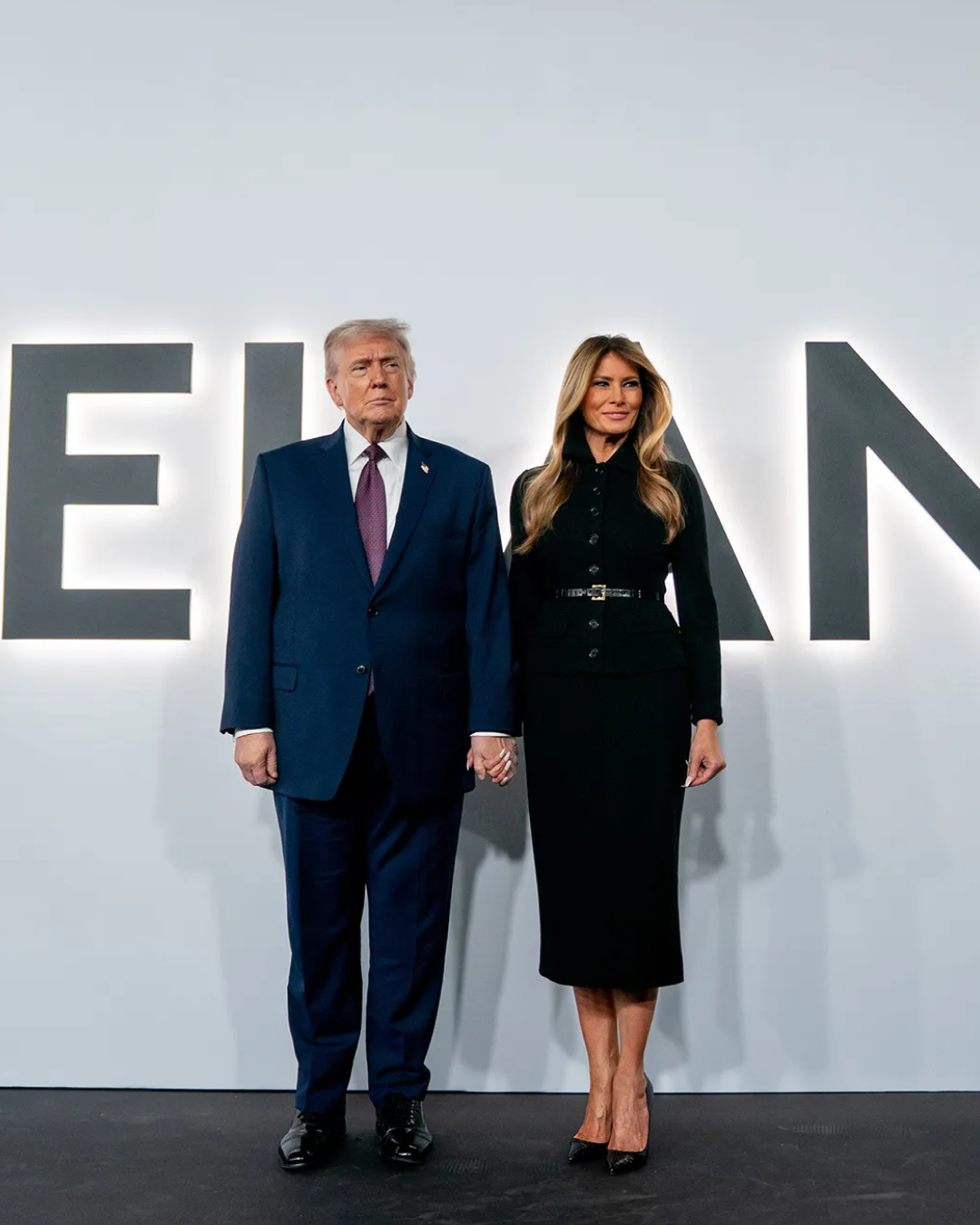
The recent documentary about the First Lady of the United States, Melania, produced by herself, starring herself, and entirely centered around herself, is a mere exercise of vanity. Not because it is a one-woman show, but because it ultimately tells us nothing about the life of the Slovenian model. The feature-length film, which runs well over two hours, focuses exclusively on the twenty days leading up to Donald Trump’s inauguration as the 47th President of the United States.
And despite Melania being, formally, the protagonist, every hyper-orchestrated action ends up confirming a broader truth: her figure remains an accessory within the ultra-conservative MAGA narrative. Entire fitting sequences linger on almost insignificant outfit details, yet the film never explains why Hervé Pierre was chosen to design the Inauguration Day dress, offers no analysis of the absence of color, and provides no insight into the decision-making process. Nothing. Just close-ups of sky-high stilettos or the oversized sunglasses that often obscure Trump’s face during official appearances, perhaps deliberately used as a shield.
Melania’s style as a mirror of MAGA politics
Melania Trump’s wardrobe, however, has not always been so dark and monochromatic. During her husband’s first term, the First Lady seemed eager to communicate to the public that, despite the gap between popular will and electoral outcome, she would perform her role proactively: not merely as the President’s wife, but as the First Lady of the country.
For the 2017 inauguration, Melania chose Ralph Lauren, the quintessential American designer, opting for a look composed of a structured jacket and a baby-blue longuette dress. Some historians have suggested that the color choice may have been inspired by the official portrait of Louisa Catherine Adams, wife of the sixth President of the United States and the first (and only, at the time) First Lady born overseas, and therefore an immigrant, just like Melania. A parallel never officially confirmed, yet difficult to dismiss as mere coincidence.
Likewise, it is no coincidence that while between 2017 and 2020 Melania’s wardrobe featured vibrant colors and varied silhouettes, today it consists almost exclusively of tight-fitting sheath dresses in neutral, often dark tones, paired with accessories that systematically conceal her gaze, whether hats or sunglasses. An austere, rigid aesthetic that faithfully mirrors her husband’s current political stance. After all, it is no secret that between his first and second term Donald Trump has gradually abandoned the image of the ultra-Republican in favor of an increasingly autocratic one.
Silence, consent
all maga ladies look the exact same what the fuck
— cipsy (@flabbergeasted) February 4, 2026
One might argue that, at this point, what matters less is what the documentary tells us than what it deliberately chooses not to say. Melania Trump’s role as First Lady reflects her relationship with fashion exactly: a body on display that does not participate, a mannequin placed in a shop window, impeccable and distant, wearing clothes without ever allowing them to speak.
Within this silence, which appears purely aesthetic, a precise political posture emerges. A dynamic that does not concern Melania alone, but seems to permeate the entire Trumpian imaginary, populated by hyper-visible female figures who are systematically mute. Women who are observed, celebrated, displayed, but rarely heard, like Lauren Sánchez-Bezos, constantly under the spotlight yet almost never allowed to occupy an autonomous space of speech. The documentary, then, does not merely tell Melania’s story, but actively contributes to constructing an ideal: a MAGA model of womanhood that exists primarily as image, as reassuring surface, as a decorative presence functional to power.