
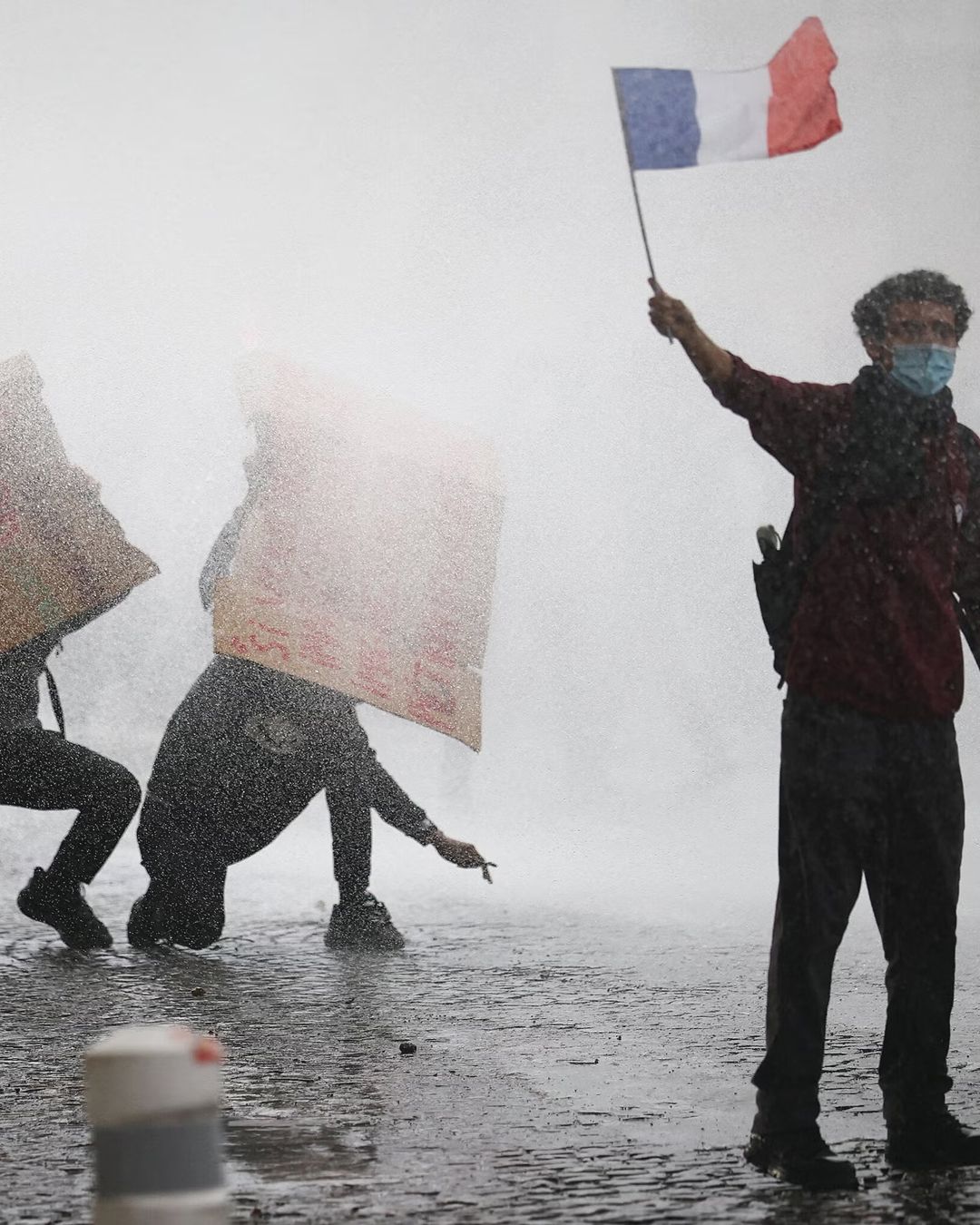
The protests in France have very specific slogans and cultural references Often ironic, tied to the world of superheroes and antiheroes
The recent protests in France drew more than 800,000 people, according to the main trade unions that organised them, including 110,000 in Paris alone. Part of these demonstrations was followed by clashes with police, attacks on public buildings and looting of various businesses across many of the country's urban centres, to the point that French Interior Minister Laurent Nuñez acknowledged having «lost control of the situation» in several cities. The government announced that nearly 2,400 people were arrested in total during the weekend protests, while around a thousand police officers were injured.
The protests in France are linked to the rise in fuel prices, and more broadly to the increase in the cost of living and the decline in purchasing power. Over the weeks, the protests spread: initially, it was mainly secondary school students who took to the streets, criticising overcrowded and dirty classrooms, a lack of adequate resources and sufficient school staff, as well as university admissions procedures. The demonstrations also drew the so-called "Yellow Vests," a movement that emerged nearly ten years ago to protest against the erosion of purchasing power.
The slogan «Bismillah, c'est les ténèbres»
What does this slogan used by French student protesters actually mean? https://t.co/Gg4q38gzuA
— AJ+ (@ajplus) October 20, 2026
As the protests in France expanded, so too did the ways of demonstrating, especially among younger people, who adopted codes and symbols that those unfamiliar with social media platforms like TikTok or Snapchat struggle to decipher. One of the most widespread expressions is «Bismillah, c'est les ténèbres», roughly translatable as «In the name of God, it's total darkness». It has no precise meaning, and as often happens with certain trends that develop online, that is precisely what made it effective — so much so that the phrase now appears on placards and banners in Italy too, where highly attended protests have recently taken place in cities such as Milan, Turin and Bologna.
According to reconstructions by French media, the expression «Bismillah, c'est les ténèbres» most likely originated on Snapchat, one of the platforms most widely used by students. During the days of the protests, some users reportedly received messages from unknown profiles persistently asking for information about the dates and locations of individual marches. One such message, attributed to an alleged undercover police officer, opened with «Bismillah, c'est les ténèbres» — interpreted as a clumsy attempt to imitate the slang of young people from the French banlieues. The expression quickly became a meme, used to mock infiltrators at the demonstrations and to highlight both the ethnic prejudices and the gulf between institutions and young people that the episode had laid bare. Subsequently, «Bismillah, c'est les ténèbres» also became a slogan against systemic racism and surveillance, taken up by Greta Thunberg in a video expressing support for the student movements.
The cultural references of the revolts in France
I love how the onepiece Straw Hat Jolly Roger has become a symbol of freedom around the world and now it’s being used by the people of France https://t.co/juqQnEf5RE
— Zuffy (@strawhatzuffy) October 17, 2026
At the marches in France and beyond, a number of people — presumably young — were seen dressed as fictional characters, including Goku, Obelix, Batman, Spider-Man, the Joker, the Teenage Mutant Ninja Turtles, Captain America and Superman, among others. One of the most common costumes, however, was that of Monkey D. Luffy, the protagonist of One Piece, who throughout the popular Japanese saga faces — alongside his crew — a series of enemies, among them the so-called World Government, portrayed as authoritarian and corrupt. For many young people, the story of One Piece effectively embodies the struggle against injustice and inequality: it is precisely for this reason that so many in France chose to display the manga's flag. It is one of the most recognisable symbols of the series, depicting a skull with crossed tibias in the classic pirate style, but in this case the skull wears a straw hat, just like the character of Monkey D. Luffy.
More broadly, the One Piece flag has long been a symbol of protest around the world, partly owing to the saga's widespread fame: beyond France, it has appeared at student protests against the government in Albania and its capital Tirana. Last year, to express dissent towards the increasingly authoritarian government of Indonesia, many citizens displayed the same flag outside their homes or on their cars.
As several French media outlets have noted, some protesters reportedly positioned themselves in front of police cordons mimicking the poses typical of the so-called aura battles, in which younger people face off in ironic challenges to demonstrate charisma and self-confidence. For many young people, these cultural references represent a way of identifying with shared ideals while opposing a system perceived as old, rigid and out of touch. This outlook is also partly reflected in the organisation of the protests themselves, which — compared to the Yellow Vest mobilisations and traditional union marches — stand out for their lack of leaders and genuine spokespeople, their decentralised structure and their more ironic tone, far removed from the solemn register of traditional demonstrations.
What to read next

This Summer, the Stade de France keeps breaking attendance records
Aya Nakamura and The Weeknd on top of the world
Anti-ultra fast fashion law officially comes into force this September 1st
You will now pay more for items ordered on Temu or Shein