


























But where do the lucky bracelets sold on the beach actually come from? The story of a cult object of the Italian summer
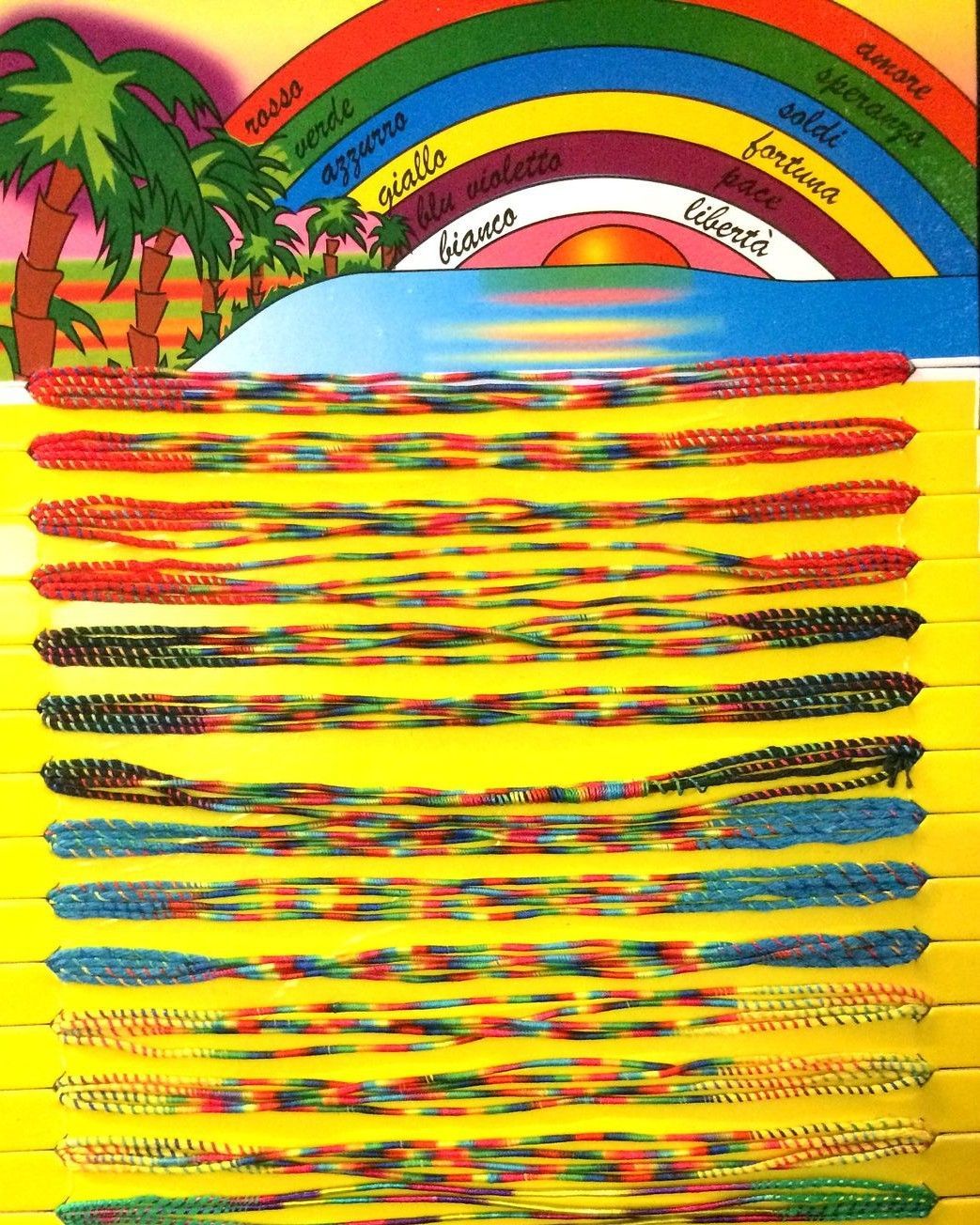
Lucky charm bracelets, also known as friendship bracelets, are something of a classic of the Italian summer. Sold for decades in the same cardboard display stand, still bearing the words Portafortuna Brasiliani and featuring an image — likewise unchanged through the years — of a rainbow in which red is associated with love, green with hope, blue with money, and so on. Images of palm trees and dream beaches are often part of the picture too.
Over the years, these bracelets — worn almost exclusively by children and pre-teens — have become such a fixed and unchanging presence that, in fact, no one wonders anymore where they come from or why they are popular. So what is their story?
Back in time, in Brazil…
@theartofbrazilianliving Do you know the Senhor do Bonfim ribbon ritual? It’s a traditional ritual from Bahia, Brazil: you tie the ribbon around your wrist, make three knots, and three wishes. When it falls off naturally, many believe those wishes may come true. In Brazil, faith is deeply present and guides the way we live. Você conhece o ritual da fitinha do Senhor do Bonfim? É uma tradição da Bahia: você amarra a fitinha no pulso, faz três nós e três pedidos. Quando ela cai naturalmente, muitos acreditam que esses desejos podem se realizar. No Brasil, a fé está presente e guia a forma como vivemos. #Faith #TheArtOfBrazilianLiving #AlineMuniz #Bahia #brazilidade #BrazilianCulture #VisitBrazil #CulturalJourney #traveltiktok #BrazilTravel #salvadorbahia som original - The Art of Brazilian Living
The name these bracelets go by today gives us an important clue as to where to begin our investigation: Brazil. That is precisely where a type of simple paper-strip bracelet is famous, known as "Senhor do Bonfim ribbons," "Bahia Bands," or, more literally, "Pulseras de la Suerte." Their story begins in the eighteenth century: around 1740, a Portuguese traveller had a sacred image of Jesus brought to Brazil, still venerated today as the "Senhor do Bonfim." About seventy years later, among the faithful of Salvador de Bahia, the custom spread of carrying as an ex-voto a coloured ribbon measuring exactly the length of the statue's right arm — 47 centimetres — hence the name "medida do Bonfim," meaning "measure of the Bonfim," to be hung on the church gates.
From this religious rite, a kind of syncretism between Catholicism and Afro-Brazilian cults, arose the custom — later secularised and spread throughout the world — of tying the ribbon around another person's wrist with three knots, one for each wish, in the belief that the wish comes true only when the ribbon, worn away by time, falls off on its own. In the original tradition, each colour of the ribbon is associated with a deity from Afro-American religions, the Orixá, each carrying its own meaning: white for health, orange for happiness, blue for prosperity, red for love, green for work, yellow for balance.
The slender multicoloured cotton or nylon bracelets sold on the beach today, packaged in little cards printed with a colour legend, a rainbow, and palm trees, are a direct evolution of this tradition, commercialised and turned into a mass-market product. Here it is not the ribbon as a whole that carries a colour, but rather the colour of the thread at the base of the weave that defines the scope of the wish. It is a system of meanings that closely echoes that of the Bonfim ribbons, yet departs from it slightly — a sign of how much the symbolism has been reworked in its journey from the sanctuary of Bahia to the beach stall.
From Brazil to the World
Che ricordi! Cicche di sigarette, carte di cioccolatini, involucro di profilattico, braccialetti “brasiliani” spezzati... la mia Smemo del 1998 pesava 1,6 kg a fine anno.
— io, me e la frency (@frencina82) March 8, 2018
The decisive leap that transformed these bracelets into a mass phenomenon took place in the 1980s, and its origins are anything but carefree. During that period, in Guatemala, a different type of traditional woven bracelet began to be worn during protests against government repression and to denounce the disappearance of peasants and members of Maya communities, victims of Guatemala's brutal civil war.
Religious groups and solidarity activists brought the custom to the United States, where the bracelets began to circulate at political gatherings and demonstrations, taking on meanings different from the original ones, yet retaining the symbolic core of the bond and solidarity between those who exchanged them. From there, the phenomenon took two parallel paths. On one hand, the original macramé bracelet entered pop culture as a handcrafted accessory associated with summer camps, the hippie world, and later the "boho" fashion of the 1990s and 2000s.
On the other, the thread bracelet became one of the typical goods of itinerant small-scale crafts, exported around the world alongside other Central American handmade items such as woven bags, rattles, and jewellery made from natural fibres. It is worth noting here that the original "commercial" bracelets featured the rainbow but the thread always had a dominant colour corresponding to the wish — a feature still found on some but not all of them. In mass production and export, only the rainbow survived.
Italy in the 1980s
In Italy, the beach trade connected to the world of the colourful bracelet spread towards the end of the 1980s, following the rise of the street vendor tradition — vendors who had originally sold genuine jewellery on the beach. Shortly afterwards, the bracelets became mass-produced and distributed as small-scale retail goods through the same wholesale channels from which street vendors also sourced beach towels, hats, swimwear, and other costume jewellery: wholesalers, often run by communities of South Asian origin, frequently located on the outskirts of coastal towns.
Their success can be explained by a number of very concrete factors: low production and retail costs, ease of transport in large quantities, packaging designed specifically to be instantly recognisable and gift-ready, and a vivid aesthetic that pairs perfectly with the imagery of seaside holidays. Unlike handcrafted jewellery, the value of the product here lies not in individual craftsmanship but in the serial repetition of a symbol. But perhaps that is how a classic is born — through a mixture of chance and luck.
What to read next
Westwing and Victoria Beckham have collaborated on a tableware line
The English designer explores the world of the table
Andrew Scott gives the best performance of his career in "Elsinore"
Simon Stone's film tells the true story of actor Ian Charleson and his production of "Hamlet"